| Facetotecta | |
|---|---|
| |
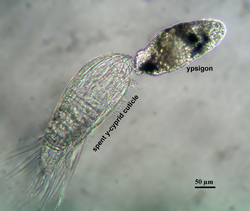
| A Y-psigon escaping from its y-cyprid | |
Scientific classification 
| |
| Kingdom: | Animalia |
| Phylum: | Arthropoda |
| Clade: | Pancrustacea |
| Class: | Thecostraca |
| Subclass: | Facetotecta Grygier, 1985 |
| Family: | Hansenocarididae Itô, 1985 |
| Genus: | Hansenocaris Itô, 1985 |
| Species | |
|
See text | |
Facetotecta is a poorly known subclass of thecostracan crustaceans.1 The adult forms have never been recognized, and the group is known only from its larvae, the "y-nauplius" and "y-cyprid" larvae.2 The only known genus is Hansenocaris in the family Hansenocarididae. They are mostly found in the north Atlantic Ocean, neritic waters around Japan,3 and the Mediterranean Basin, where they also survive in brackish water.4 The adults are probably endoparasites of unknown hosts.5
History
The German zoologist Christian Andreas Victor Hensen first collected facetotectans from the North Sea in 1887 but assigned them to the copepod family Corycaeidae; later Hans Jacob Hansen named them "y-nauplia", assuming them to be the larvae of unidentified barnacles.6 More recently, it has been suggested that, since there is a potential gap in the tantulocarid life cycle, y-larvae may be the larvae of tantulocarids. However, this would be "a very tight fit", and it is more likely that the adult forms have not yet been seen.2 Genetic analysis using 18S ribosomal DNA reveal Facetotecta to be the sister group to the remaining Thecostraca (Ascothoracida and Cirripedia).7
Life cycle
-
 Y-nauplius illustration
 -
 Y-cyprid illustration
The known larval stages of facetotectans closely resemble those of parasitic rhizocephalan barnacles, this is thought to be an example of convergent evolution rather than a common origin.8
Nauplius
Y-nauplii are 250–620 micrometres (0.010–0.024 in) long,2 with a faceted cephalic shield, from which the group derives its name.9 The abdomen is relatively long, and also ornamented.2 In common with other thecostracans, Facetotecta pass through five naupliar instars before undergoing a single cyprid phase.6
Cyprid
The presence of a distinctive cyprid larva indicates that the Facetotecta is a member of the Thecostraca. A number of species have been described on the basis of a y-cyprid alone.10 As in barnacles, the cyprid is adapted to seeking a place to settle as an adult. It has compound eyes, can walk using its antennae, and is capable of producing an adhesive glue.11
Juvenile
In 2008, a juvenile form was artificially produced by treating y-larvae with the hormone 20-hydroxyecdysone, which stimulated ecdysis and the transition to a new life phase. The resulting animal, named the y-psigon, was slug-like, apparently unsegmented, and limbless.1112
Adults
While they have never been seen, the adult facetotectans are hypothesised to be endoparasites of unknown host animals,5 some of which could be inhabitants of coral reefs.13
Species
Eleven species are currently recognised,3 while one species which is assigned to Hansenocaris – H. hanseni (Steuer, 1905) – is of uncertain affinities:6
- Hansenocaris acutifrons Itô, 1985
- Hansenocaris corvinae Belmonte, 2005
- Hansenocaris furcifera Itô, 1989
- Hansenocaris itoi Kolbasov & Høeg, 2003
- Hansenocaris leucadea Belmonte, 2005
- Hansenocaris mediterranea Belmonte, 2005
- Hansenocaris pacifica Itô, 1985
- Hansenocaris papillata Kolbasov & Grygier, 2007
- Hansenocaris rostrata Itô, 1985
- Hansenocaris salentina Belmonte, 2005
- Hansenocaris tentaculata Itô, 1986
References
References
- Chan, Benny K. K.; Dreyer, Niklas; Gale, Andy S.; Glenner, Henrik; et al. (2021). "The evolutionary diversity of barnacles, with an updated classification of fossil and living forms". Zoological Journal of the Linnean Society. 193 (3): 789–846. doi:10.1093/zoolinnean/zlaa160. hdl:11250/2990967.
- Joel W. Martin; George E. Davis (2001). An Updated Classification of the Recent Crustacea (PDF). Natural History Museum of Los Angeles County. p. 132. Archived from the original (PDF) on 2013-05-12. Retrieved 2009-12-14.
- Daphne Cuvelier (April 4, 2005). "Hansenocaris Itô, 1985". World Register of Marine Species.
- Genuario Belmonte (2005). "Y-nauplii (Crustacea, Thecostraca, Facetotecta) from coastal waters of the Salento Peninsula (south eastern Italy, Mediterranean Sea) with descriptions of four new species". Marine Biology Research. 1 (4): 254–266. Bibcode:2005MBioR...1..254B. doi:10.1080/17451000500202518. S2CID 208372852.
- Olesen, Jørgen; Gerken, Sarah; Kocot, Kevin; Wetzer, Regina (2025-04-21). "The first report of y-larvae (Crustacea: Facetotecta) from the Caribbean coast of Panama, with an overview of their occurrence in the Americas and surprising parallels to the Okinawan fauna". Journal of Crustacean Biology. 45 (2) ruaf026. doi:10.1093/jcbiol/ruaf026. ISSN 0278-0372.
- E. A. Ponomarenko (2006). "Facetotecta – Unsolved Riddle of Marine Biology". Russian Journal of Marine Biology. 32 (Suppl. 1): S1–S10. Bibcode:2006RuJMB..32S...1P. doi:10.1134/S1063074006070017. S2CID 2943845.
- Marcos Pérez-Losada; Jens T. Høeg; Gregory A. Kolbasov; Keith A. Crandall (2002). "Reanalysis of the relationships among the Cirripedia and the Ascothoracida and the phylogenetic position of the Facetotecta (Maxillopoda: Thecostraca) using 18S rDNA sequences". Journal of Crustacean Biology. 22 (3): 661–669. doi:10.1651/0278-0372(2002)022[0661:ROTRAT]2.0.CO;2. S2CID 84126659.
- Pérez-Losada, Marcos; Høeg, Jens T; Crandall, Keith A (December 2009). "Remarkable convergent evolution in specialized parasitic Thecostraca (Crustacea)". BMC Biology. 7 (1) 15. Bibcode:2009BMCB....7...15P. doi:10.1186/1741-7007-7-15. ISSN 1741-7007. PMC 2678073. PMID 19374762.
- Christopher Taylor (February 23, 2008). "The secret of y-larvae". Catalogue of Organisms.
- Gregory A. Kolbasov; Mark J. Grygier; Viatcheslav V. Ivanenko; Alejandro A. Vagelli (2007). "A new species of the y-larva genus Hansenocaris Itô, 1985 (Crustacea: Thecostraca: Facetotecta) from Indonesia, with a review of y-cyprids and a key to all their described species" (PDF). Raffles Bulletin of Zoology. 55 (2): 343–353.
- Gerhard Scholtz (2008). "Zoological detective stories: the case of the facetotectan crustacean life cycle". Journal of Biology. 7 (5): 16. doi:10.1186/jbiol77. PMC 2447532. PMID 18598383.
- Henrik Glenner; Jens T. Høeg; Mark J. Grygier; Yoshihisa Fujita (2008). "Induced metamorphosis in crustacean y-larvae: Towards a solution to a 100-year-old riddle". BMC Biology. 6 21. doi:10.1186/1741-7007-6-21. PMC 2412843. PMID 18492233.
- Mark Grygier; Jens T. Høeg; Yoshihisa Fujita (July 2004). Introduction to the tremendous diversity of y-larvae (Crustacea: Maxillopoda: Thecostraca: Facetotecta) in inshore coral reef plankton at Sesoko Island, Okinawa, Japan (PDF). 10th International Coral Reef Symposium. Biodiversity and Diversification in the Indo-West Pacific. Okinawa, Japan. Archived from the original (PDF) on 2011-06-11.