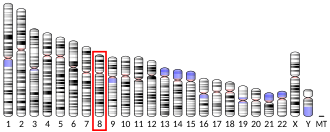






Exostosin-1 is a protein that in humans is encoded by the EXT1 gene.5
This gene encodes one of the two endoplasmic reticulum-resident type II transmembrane glycosyltransferase – the other being EXT2 – which are involved in the chain elongation step of heparan sulfate biosynthesis. Mutations in this gene cause the type I form of multiple exostoses.5
Interactions
EXT1 has been shown to interact with TRAP1.6
References
References
- GRCh38: Ensembl release 89: ENSG00000182197 – Ensembl, May 2017
- GRCm38: Ensembl release 89: ENSMUSG00000061731 – Ensembl, May 2017
- "Human PubMed Reference:". National Center for Biotechnology Information, U.S. National Library of Medicine.
- "Mouse PubMed Reference:". National Center for Biotechnology Information, U.S. National Library of Medicine.
- "Entrez Gene: EXT1 exostoses (multiple) 1".
- Simmons, A D; Musy M M; Lopes C S; Hwang L Y; Yang Y P; Lovett M (Nov 1999). "A direct interaction between EXT proteins and glycosyltransferases is defective in hereditary multiple exostoses". Hum. Mol. Genet. 8 (12). ENGLAND: 2155–64. doi:10.1093/hmg/8.12.2155. ISSN 0964-6906. PMID 10545594.
Further reading
Further reading
- Wuyts W, Van Hul W (2000). "Molecular basis of multiple exostoses: mutations in the EXT1 and EXT2 genes". Hum. Mutat. 15 (3): 220–7. doi:10.1002/(SICI)1098-1004(200003)15:3<220::AID-HUMU2>3.0.CO;2-K. PMID 10679937. S2CID 45999816.
- Duncan G, McCormick C, Tufaro F (2001). "The link between heparan sulfate and hereditary bone disease: finding a function for the EXT family of putative tumor suppressor proteins". J. Clin. Invest. 108 (4): 511–6. doi:10.1172/JCI13737. PMC 209410. PMID 11518722.
- Ogle RF, Dalzell P, Turner G, et al. (1992). "Multiple exostoses in a patient with t(8;11)(q24.11;p15.5)". J. Med. Genet. 28 (12): 881–3. doi:10.1136/jmg.28.12.881. PMC 1017169. PMID 1757967.
- Ahn J, Lüdecke HJ, Lindow S, et al. (1995). "Cloning of the putative tumour suppressor gene for hereditary multiple exostoses (EXT1)". Nat. Genet. 11 (2): 137–43. doi:10.1038/ng1095-137. PMID 7550340. S2CID 39272385.
- Cook A, Raskind W, Blanton SH, et al. (1993). "Genetic heterogeneity in families with hereditary multiple exostoses". Am. J. Hum. Genet. 53 (1): 71–9. PMC 1682231. PMID 8317501.
- Hou J, Parrish J, Lüdecke HJ, et al. (1996). "A 4-megabase YAC contig that spans the Langer-Giedion syndrome region on human chromosome 8q24.1: use in refining the location of the trichorhinophalangeal syndrome and multiple exostoses genes (TRPS1 and EXT1)". Genomics. 29 (1): 87–97. doi:10.1006/geno.1995.1218. PMID 8530105.
- Hecht JT, Hogue D, Wang Y, et al. (1997). "Hereditary multiple exostoses (EXT): mutational studies of familial EXT1 cases and EXT-associated malignancies". Am. J. Hum. Genet. 60 (1): 80–6. PMC 1712567. PMID 8981950.
- Lüdecke HJ, Ahn J, Lin X, et al. (1997). "Genomic organization and promoter structure of the human EXT1 gene". Genomics. 40 (2): 351–4. doi:10.1006/geno.1996.4577. PMID 9119404.
- Philippe C, Porter DE, Emerton ME, et al. (1997). "Mutation screening of the EXT1 and EXT2 genes in patients with hereditary multiple exostoses". Am. J. Hum. Genet. 61 (3): 520–8. doi:10.1086/515505. PMC 1715939. PMID 9326317.
- Wuyts W, Van Hul W, De Boulle K, et al. (1998). "Mutations in the EXT1 and EXT2 genes in hereditary multiple exostoses". Am. J. Hum. Genet. 62 (2): 346–54. doi:10.1086/301726. PMC 1376901. PMID 9463333.
- Raskind WH, Conrad EU, Matsushita M, et al. (1998). "Evaluation of locus heterogeneity and EXT1 mutations in 34 families with hereditary multiple exostoses". Hum. Mutat. 11 (3): 231–9. doi:10.1002/(SICI)1098-1004(1998)11:3<231::AID-HUMU8>3.0.CO;2-K. PMID 9521425. S2CID 20194422.
- McCormick C, Leduc Y, Martindale D, et al. (1998). "The putative tumour suppressor EXT1 alters the expression of cell-surface heparan sulfate". Nat. Genet. 19 (2): 158–61. doi:10.1038/514. PMID 9620772. S2CID 25832441.
- Lin X, Gan L, Klein WH, Wells D (1998). "Expression and functional analysis of mouse EXT1, a homolog of the human multiple exostoses type 1 gene". Biochem. Biophys. Res. Commun. 248 (3): 738–43. doi:10.1006/bbrc.1998.9050. PMID 9703997.
- Lind T, Tufaro F, McCormick C, et al. (1998). "The putative tumor suppressors EXT1 and EXT2 are glycosyltransferases required for the biosynthesis of heparan sulfate". J. Biol. Chem. 273 (41): 26265–8. doi:10.1074/jbc.273.41.26265. PMID 9756849.
- Bovée JV, Cleton-Jansen AM, Wuyts W, et al. (1999). "EXT-mutation analysis and loss of heterozygosity in sporadic and hereditary osteochondromas and secondary chondrosarcomas". Am. J. Hum. Genet. 65 (3): 689–98. doi:10.1086/302532. PMC 1377975. PMID 10441575.
- Xu L, Xia J, Jiang H, et al. (1999). "Mutation analysis of hereditary multiple exostoses in the Chinese". Hum. Genet. 105 (1–2): 45–50. doi:10.1007/s004390051062. PMID 10480354.
- Simmons AD, Musy MM, Lopes CS, et al. (1999). "A direct interaction between EXT proteins and glycosyltransferases is defective in hereditary multiple exostoses". Hum. Mol. Genet. 8 (12): 2155–64. doi:10.1093/hmg/8.12.2155. PMID 10545594.
- McCormick C, Duncan G, Goutsos KT, Tufaro F (2000). "The putative tumor suppressors EXT1 and EXT2 form a stable complex that accumulates in the Golgi apparatus and catalyzes the synthesis of heparan sulfate". Proc. Natl. Acad. Sci. U.S.A. 97 (2): 668–73. Bibcode:2000PNAS...97..668M. doi:10.1073/pnas.97.2.668. PMC 15388. PMID 10639137.
- Kobayashi S, Morimoto K, Shimizu T, et al. (2000). "Association of EXT1 and EXT2, hereditary multiple exostoses gene products, in Golgi apparatus". Biochem. Biophys. Res. Commun. 268 (3): 860–7. doi:10.1006/bbrc.2000.2219. PMID 10679296.