 | |
| Identifiers | |
|---|---|
3D model (JSmol)
|
|
| ChemSpider |
|
| ECHA InfoCard | 100.013.787 |
PubChem CID
|
|
| UNII | |
CompTox Dashboard (EPA)
|
|
| |
| |
| Properties | |
| Eu2O3 | |
| Molar mass | 351.926 g/mol |
| Appearance | white to light-pink solid powder |
| Odor | odorless |
| Density | 7.42 g/cm3 |
| Melting point | 2,350 °C (4,260 °F; 2,620 K)1 |
| Boiling point | 4,118 °C (7,444 °F; 4,391 K) |
| Negligible | |
| +10,100·10−6 cm3/mol | |
| Thermal conductivity | 2.45 W/(m K) |
| Structure | |
| cubic, cI80, Monoclinic | |
| Ia-3, No. 206, C2/m, No. 12 | |
| Hazards | |
| Lethal dose or concentration (LD, LC): | |
LD50 (median dose)
|
5000 mg/kg (rat, oral) |
| Safety data sheet (SDS) | External MSDS |
| Related compounds | |
Other anions
|
Europium(III) chloride |
Other cations
|
Samarium(III) oxide, Gadolinium(III) oxide |
Except where otherwise noted, data are given for materials in their standard state (at 25 °C [77 °F], 100 kPa).
| |


Europium(III) oxide (Eu2O3), is a chemical compound of europium and oxygen. It is widely used as a red or blue phosphor in television sets and fluorescent lamps, and as an activator for yttrium-based phosphors. It is also an agent for the manufacture of fluorescent glass. Europium fluorescence is used in the anti-counterfeiting phosphors in Euro banknotes.2
Europium oxide has two common structures: Monoclinic (mS30, space group C2/m, No. 12)3 and cubic (cI80, space group Ia3, No. 206).4 The cubic structure is similar to that of manganese(III) oxide.
It may be formed by ignition of europium metal.5
It can react with acids to form the corresponding europium(III) salts.
Gallery
-
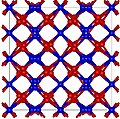 Cubic Eu2O3
 -
 Monoclinic Eu2O3
References
References
- Webelements Europium trioxide
- "Europium and the Euro". Archived from the original on 2009-08-04. Retrieved 2009-06-04.
- "ICSD Entry: 631453". Cambridge Structural Database: Access Structures. Cambridge Crystallographic Data Centre. Retrieved 2022-07-04.
- Heiba, Z. K.; Akin, Y.; Sigmund, W.; Hascicek, Y. S. (2003). "X-ray structure and microstructure determination of the mixed sesquioxides (Eu1−xYbx)2O3 prepared by a sol–gel process". J. Appl. Crystallogr. 36 (6): 1411–1416. doi:10.1107/S0021889803019319.
- Ugale, Akhilesh; Kalyani, Thejo N.; Dhoble, Sanjay J. (2018). "Potential of europium and samarium β -diketonates as red light emitters in organic light-emitting diodes". Lanthanide-Based Multifunctional Materials. pp. 59–97. doi:10.1016/B978-0-12-813840-3.00002-8. ISBN 978-0-12-813840-3.
Europium is the most reactive rare-earth element… It swiftly oxidizes in air, ignites in the range of 150–180°C to form Eu3+ oxide (Eu2O3).