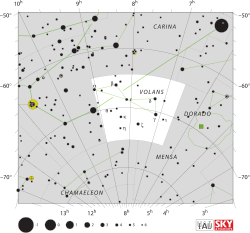
  | |
| Observation data Epoch J2000.0 Equinox ICRS | |
|---|---|
| Constellation | Volans |
| Right ascension | 08h 22m 04.45155s1 |
| Declination | −73° 23′ 59.9258″1 |
| Apparent magnitude (V) | 5.28±0.01 |
| Characteristics | |
| Evolutionary stage | main sequence2 |
| Spectral type | A0/1 IV/V3 |
| B−V color index | +0.014 |
| Astrometry | |
| Radial velocity (Rv) | +20.0±3.75 km/s |
| Proper motion (μ) | RA: −29.4321 mas/yr Dec.: +29.9261 mas/yr |
| Parallax (π) | 8.4310±0.0887 mas1 |
| Distance | 387 ± 4 ly (119 ± 1 pc) |
| Absolute magnitude (MV) | −0.066 |
| Details | |
| Mass | 2.73±0.087 M☉ |
| Radius | 3.78±0.128 R☉ |
| Luminosity | 849 L☉ |
| Surface gravity (log g) | 3.81±0.047 cgs |
| Temperature | 9,789±42710 K |
| Rotational velocity (v sin i) | 21411 km/s |
| Age | 3477 Myr |
| Other designations | |
| η Vol, CPD−72°694, FK5 2653, HD 71576, HIP 41003, HR 3334, SAO 25650512 | |
| Database references | |
| SIMBAD | data |
Eta Volantis, Latinized from η Volantis, is a single star13 in the southern constellation of Volans. It has an apparent visual magnitude of 5.28,14 which is bright enough to be seen with the naked eye as a dim, white-hued star. Based upon parallax measurements, it is approximately 387 light years from the Sun. The star is moving further away from the Sun with a radial velocity of 20 km/s.5
This is an A-type star with a stellar classification of A0/1 IV/V,3 displaying blended spectrum that shows aspects of a main sequence star and a subgiant. Stellar evolution models from Zorec and Royer (2012) place it on the main sequence turnoff, having completed 90.7% of its time on the main sequence.2 The star is estimated to be 347 million years old7 and is spinning rapidly with a projected rotational velocity of 214 km/s.11 It has 2.73 times the mass of the Sun7 and 3.43 times the Sun's radius.8 Eta Volantis is radiating 849 times the luminosity of the Sun from its photosphere at an effective temperature of 9,789 K.10
Eta Volantis has two 12th magnitude optical companions at angular separations of 26.8 and 48.1 arcseconds.15
References
References
- Vallenari, A.; et al. (Gaia collaboration) (2023). "Gaia Data Release 3. Summary of the content and survey properties". Astronomy and Astrophysics. 674: A1. arXiv:2208.00211. Bibcode:2023A&A...674A...1G. doi:10.1051/0004-6361/202243940. S2CID 244398875. Gaia DR3 record for this source at VizieR.
- Zorec, J.; Royer, F. (2012). "Rotational velocities of A-type stars. IV. Evolution of rotational velocities". Astronomy and Astrophysics. 537: A120. arXiv:1201.2052. Bibcode:2012A&A...537A.120Z. doi:10.1051/0004-6361/201117691.
- Houk, N.; Cowley, A. P. (1975). University of Michigan Catalogue of two-dimensional spectral types for the HD stars. Volume I. Declinations −90° to −53°. Bibcode:1975mcts.book.....H.
- Mermilliod, J.-C. (1986), "Compilation of Eggen's UBV data, transformed to UBV (unpublished)", Catalogue of Eggen's UBV Data. SIMBAD, Bibcode:1986EgUBV........0M.
- Kharchenko, N. V.; et al. (2007), "Astrophysical supplements to the ASCC-2.5: Ia. Radial velocities of ˜55000 stars and mean radial velocities of 516 Galactic open clusters and associations", Astronomische Nachrichten, 328 (9): 889, arXiv:0705.0878, Bibcode:2007AN....328..889K, doi:10.1002/asna.200710776, S2CID 119323941.
- Anderson, E.; Francis, Ch. (May 2012). "XHIP: An extended hipparcos compilation". Astronomy Letters. 38 (5): 331–346. arXiv:1108.4971. Bibcode:2012AstL...38..331A. doi:10.1134/S1063773712050015. eISSN 1562-6873. ISSN 1063-7737. S2CID 119257644.
- Gerbaldi, M.; Faraggiana, R.; Burnage, R.; Delmas, F.; Gómez, A. E.; Grenier, S. (June 1999). "Search for reference A0 dwarf stars: Masses and luminosities revisited withHipparcos parallaxes". Astronomy and Astrophysics Supplement Series. 137 (2): 273–292. Bibcode:1999A&AS..137..273G. doi:10.1051/aas:1999248. eISSN 1286-4846. ISSN 0365-0138.
- Stassun, Keivan G.; et al. (9 September 2019). "The Revised TESS Input Catalog and Candidate Target List". The Astronomical Journal. 158 (4): 138. arXiv:1905.10694. Bibcode:2019AJ....158..138S. doi:10.3847/1538-3881/ab3467. eISSN 1538-3881.
- McDonald, I.; Zijlstra, A. A.; Boyer, M. L. (2012). "Fundamental Parameters and Infrared Excesses of Hipparcos Stars". Monthly Notices of the Royal Astronomical Society. 427 (1): 343–57. arXiv:1208.2037. Bibcode:2012MNRAS.427..343M. doi:10.1111/j.1365-2966.2012.21873.x. S2CID 118665352.
- Paunzen, E.; Schnell, A.; Maitzen, H. M. (October 2006). "An empirical temperature calibration for the Δa photometric system II: The A-type and mid F-type stars". Astronomy & Astrophysics. 458 (1): 293–296. arXiv:astro-ph/0607567. Bibcode:2006A&A...458..293P. doi:10.1051/0004-6361:20064889. eISSN 1432-0746. ISSN 0004-6361.
- Royer, F.; et al. (February 2007), "Rotational velocities of A-type stars. III. Velocity distributions", Astronomy and Astrophysics, 463 (2): 671–682, arXiv:astro-ph/0610785, Bibcode:2007A&A...463..671R, doi:10.1051/0004-6361:20065224, S2CID 18475298.
- "* eps Vol". SIMBAD. Centre de données astronomiques de Strasbourg. Retrieved 2016-09-02.
{{cite web}}: CS1 maint: postscript (link) - Eggleton, P. P.; Tokovinin, A. A. (September 2008), "A catalogue of multiplicity among bright stellar systems", Monthly Notices of the Royal Astronomical Society, 389 (2): 869–879, arXiv:0806.2878, Bibcode:2008MNRAS.389..869E, doi:10.1111/j.1365-2966.2008.13596.x, S2CID 14878976.
- Høg, E.; Fabricius, C.; Makarov, V. V.; Urban, S.; Corbin, T.; Wycoff, G.; Bastian, U.; Schwekendiek, P.; Wicenec, A. (March 2000). "The Tycho-2 catalogue of the 2.5 million brightest stars". Astronomy and Astrophysics. 355: L27–L30. Bibcode:2000A&A...355L..27H. ISSN 0004-6361.
- Mason, B. D.; et al. (2014), "The Washington Visual Double Star Catalog", The Astronomical Journal, 122 (6): 3466, Bibcode:2001AJ....122.3466M, doi:10.1086/323920