  | |
| Observation data Epoch J2000.0 Equinox J2000.0 | |
|---|---|
| Constellation | Centaurus |
| Right ascension | 14h 35m 30.42416s1 |
| Declination | −42° 09′ 28.1708″1 |
| Apparent magnitude (V) | +2.352 (2.30 - 2.413) |
| Characteristics | |
| Spectral type | B1.5 Vne4 |
| U−B color index | −0.8622 |
| B−V color index | −0.2152 |
| Variable type | GCAS3 + LERI |
| Astrometry | |
| Radial velocity (Rv) | −0.25 km/s |
| Proper motion (μ) | RA: −34.731 mas/yr Dec.: −32.721 mas/yr |
| Parallax (π) | 10.67±0.21 mas1 |
| Distance | 306 ± 6 ly (94 ± 2 pc) |
| Absolute magnitude (MV) | −2.536 |
| Details | |
| Mass | 12.0±0.37 M☉ |
| Radius | 6.10±0.128 R☉ |
| Luminosity | 8,7004 L☉ |
| Surface gravity (log g) | 3.95±0.048 cgs |
| Temperature | 25,7004 K |
| Rotational velocity (v sin i) | 3304 km/s |
| Age | 5.6±1.07 Myr |
| Other designations | |
| η Cen, CD−41°8917, CPD−41°6839, FK5 537, HD 127972, HIP 71352, HR 5440, SAO 2250449 | |
| Database references | |
| SIMBAD | data |
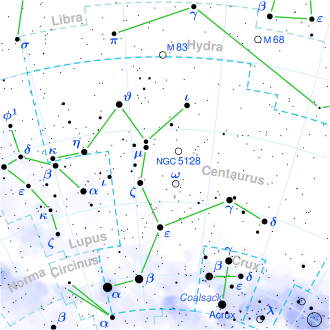
Eta Centauri is a star in the southern constellation of Centaurus. Its name is a Bayer designation that is Latinized from η Centauri, and abbreviated Eta Cen or η Cen. This star has an apparent visual magnitude of +2.35,2 which indicates it is readily visible to the naked eye. Based on parallax measurements, it is located at a distance of around 306 light-years (94 parsecs).1
The stellar classification of this star is B1.5 Vne,4 indicating that it is a B-type main sequence star. The 'n' suffix means that the absorption lines are broadened from rapid rotation and the 'e' that it shows emission lines in its spectrum. It has a projected rotational velocity of 330 km s−14 and completes a full rotation in less than a day.
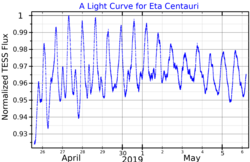
As a Be star,11 it has variable emissions in its hydrogen spectral lines. This emission can be modelled by a decretion disk of gas that has been ejected from the star by its rapid rotation and now follows a near-Keplerian orbit around the central body.12 Its brightness is also slightly variable, and it is classified as a Gamma Cassiopeiae variable star with multiple periods of variability.3 The International Variable Star Index lists Eta Centauri as both a Gamma Cassiopeiae variable and a Lambda Eridani variable with variations caused by its rotation and pulsations.13
Eta Centauri has about 12 times the mass of the Sun,7 placing it above the dividing line between stars that evolve into white dwarfs and those that turn into supernovae. It is radiating 8,7004 times the luminosity of the Sun from its outer atmosphere at an effective temperature of 25,700 K.4 At this temperature, the star glows with the blue-white hue common to B-type stars.14 Eta Centauri is a proper motion member of the Upper Centaurus–Lupus sub-group in the Scorpius–Centaurus OB association, the nearest such co-moving association of massive stars to the Sun.15
In traditional Chinese astronomy, Eta Centauri was known as 庫樓二16 (meaning: the Second (Star) of Koo Low).17
References
References
- van Leeuwen, F. (November 2007), "Validation of the new Hipparcos reduction", Astronomy and Astrophysics, 474 (2): 653–664, arXiv:0708.1752, Bibcode:2007A&A...474..653V, doi:10.1051/0004-6361:20078357, S2CID 18759600.
- Gutierrez-Moreno, Adelina; Moreno, Hugo (June 1968), "A photometric investigation of the Scorpio-Centaurus association", Astrophysical Journal Supplement Series, 15: 459, Bibcode:1968ApJS...15..459G, doi:10.1086/190168.
- Samus, N. N.; Durlevich, O. V.; et al. (2009), "VizieR Online Data Catalog: General Catalogue of Variable Stars (Samus+ 2007–2013)", VizieR On-line Data Catalog: B/GCVS, 1: 02025, Bibcode:2009yCat....102025S.
- Balona, L. A.; Dziembowski, W. A. (October 1999), "Excitation and visibility of high-degree modes in stars", Monthly Notices of the Royal Astronomical Society, 309 (1): 221–232, Bibcode:1999MNRAS.309..221B, doi:10.1046/j.1365-8711.1999.02821.x.
- Wielen, R.; et al. (1999), "Sixth Catalogue of Fundamental Stars (FK6). Part I. Basic fundamental stars with direct solutions", Veröff. Astron. Rechen-Inst. Heidelb, 35 (35), Astronomisches Rechen-Institut Heidelberg: 1, Bibcode:1999VeARI..35....1W.
- Anderson, E.; Francis, Ch. (2012), "XHIP: An extended hipparcos compilation", Astronomy Letters, 38 (5): 331, arXiv:1108.4971, Bibcode:2012AstL...38..331A, doi:10.1134/S1063773712050015. XHIP record for this object at VizieR.
- Tetzlaff, N.; et al. (January 2011), "A catalogue of young runaway Hipparcos stars within 3 kpc from the Sun", Monthly Notices of the Royal Astronomical Society, 410 (1): 190–200, arXiv:1007.4883, Bibcode:2011MNRAS.410..190T, doi:10.1111/j.1365-2966.2010.17434.x, S2CID 118629873.
- Arcos, C.; et al. (March 2018), "Stellar parameters and H α line profile variability of Be stars in the BeSOS survey", Monthly Notices of the Royal Astronomical Society, 474 (4): 5287–5299, arXiv:1711.08675, Bibcode:2018MNRAS.474.5287A, doi:10.1093/mnras/stx3075.
- "eta Cen", SIMBAD, Centre de données astronomiques de Strasbourg, retrieved 2012-03-03.
- MAST: Barbara A. Mikulski Archive for Space Telescopes, Space Telescope Science Institute, retrieved 8 December 2021.
- Janot-Pacheco, E., Leister NV, et al. (1999), "Multi-periodicity of the Be star η Centauri from spectroscopic and photometric observations", Astronomy and Astrophysics Supplement Series, 137 (3): 407, Bibcode:1999A&AS..137..407J, doi:10.1051/aas:1999256.
- Silaj, J.; et al. (March 2010), "A Systematic Study of Hα Profiles of Be Stars", Astrophysical Journal Supplement Series, 187 (1): 228–250, Bibcode:2010ApJS..187..228S, doi:10.1088/0067-0049/187/1/228, S2CID 122679154.
- Watson, C. L. (2006), "The International Variable Star Index (VSX)", The Society for Astronomical Sciences 25th Annual Symposium on Telescope Science. Held May 23–25, 25: 47, Bibcode:2006SASS...25...47W.
- "The Colour of Stars", Australia Telescope, Outreach and Education, Commonwealth Scientific and Industrial Research Organisation, December 21, 2004, archived from the original on 2012-03-18, retrieved 2012-01-16.
- de Geus, E. J.; et al. (June 1989), "Physical parameters of stars in the Scorpio-Centaurus OB association", Astronomy and Astrophysics, 216 (1–2): 44–61, Bibcode:1989A&A...216...44D.
- (in Chinese) 中國星座神話, written by 陳久金. Published by 台灣書房出版有限公司, 2005, ISBN 978-986-7332-25-7.
- Allen, R. H. (1963), Star Names: Their Lore and Meaning (Reprint ed.), New York, NY: Dover Publications Inc., p. 154.
External links
External links
- Kaler, James B. "ETA CEN (Eta Centauri)". University of Illinois. Retrieved 2018-09-16.
- Allen, Leah B. "Study of η Centauri" (1911) [Manuscript]. Project PHAEDRA: Preserving Harvard's Early Data and Research in Astronomy, ID: KG11365.685, pp. 1–50. Harvard College Observatory.