Eric Poe Xing | |
|---|---|
邢波 | |
 | |
| Born | Shanghai, China |
| Alma mater | Tsinghua University Rutgers University University of California, Berkeley |
| Spouse | Wei Wu |
| Scientific career | |
| Fields | Computer science |
| Institutions | Carnegie Mellon University Mohamed bin Zayed University of Artificial Intelligence |
| Thesis | Probabilistic graphical models and algorithms for genomic analysis (2004) |
| Richard Karp Michael I. Jordan Stuart J. Russell | |
| Website | cs |
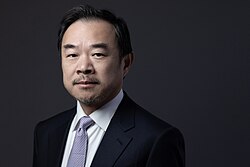
Eric Poe Xing (Chinese: 邢波) is an American computer scientist who has been serving as president of Mohamed bin Zayed University of Artificial Intelligence (MBZUAI) since January 2021. He is also a professor in the Carnegie Mellon University School of Computer Science where he founded the SAILING Lab in 2004, and is the co-founder of the AI companies Petuum and GenBio AI.
Xing's research focuses on statistical machine learning, probabilistic graphical models, and systems for distributed machine learning. He was elected a Fellow of the Institute of Electrical and Electronics Engineers in 2019 for "contributions to machine learning algorithms and systems"1 and a Fellow of the Association for Computing Machinery in 2022 for "contributions to algorithms, architectures, and applications in machine learning."2
Education
Xing earned a B.Sc. in physics from Tsinghua University in 1993, and an M.Sc. in computer science from Rutgers University in 1998.3
He earned a Ph.D. in molecular biology and biochemistry from Rutgers in 1999, supervised by molecular cancer researcher Chung S. Yang.4 His dissertation examined the inactivation of the Rb and p53 pathways in human esophageal squamous cell carcinoma.
He earned a second Ph.D. in computer science from the University of California, Berkeley in 2004, supervised by Richard Karp, Michael I. Jordan, and Stuart J. Russell.5 His thesis applied probabilistic graphical models to motif identification and haplotype inference in genomic data.
Career
Xing joined Carnegie Mellon University (CMU) as a faculty member in 2004, where he created the Statistical Artificial Intelligence and Integrative Genomics (SAILING) Lab.6
He held visiting appointments from 2010 to 2011, serving as a visiting research professor at Facebook Inc. and as a visiting associate professor in the Department of Statistics at Stanford University.789
He served as co-Program Chair of the International Conference on Machine Learning (ICML) in 2014 and General Chair in 2019.1011
Xing served as the founding director of CMU’s Center for Machine Learning and Health, established in 2015 as part of the Pittsburgh Health Data Alliance, a collaboration between CMU, the University of Pittsburgh, and the University of Pittsburgh Medical Center.1213
In 2016, Xing co-founded Petuum Inc., a US-based startup. In 2017, Petuum raised $93 million in a round of venture funding from SoftBank.14 In 2018 Petuum was named a World Economic Forum Technology Pioneer.15 In 2019, Xing received the Carnegie Science Award for Startup Entrepreneurs in recognition of his leadership of Petuum.16
On 29 November 2020, Xing was appointed president of the Mohamed bin Zayed University of Artificial Intelligence (MBZUAI), with the appointment taking effect in January 2021.17
In 2024, Xing co-founded GenBio AI1819 where he is chief scientist. The US-based startup, which he co-founded with David Baker, Ziv Bar-Joseph, Emma Lundberg, Le Song and Fred Hu, aims to create AI-driven digital organisms (AIDO) for the purposes of modeling medical treatments.20
Xing has overseen the launch of the MBZUAI Institute of Foundation Models (IFM), which focuses on research and development of large-scale foundation models.21 In 2025–2026, IFM released the open-source reasoning model K2 Think, which was covered internationally as part of the UAE’s push to develop domestically controlled (“sovereign”) AI capabilities.2223 IFM presented PAN as a “world model” research project and demonstrated related systems publicly.24 MBZUAI also collaborated with G42 and Cerebras Systems on the Jais language model, an open-source Arabic–English large language model released in 2023, according to Reuters.25
Awards and honors
Xing is a recipient of the National Science Foundation (NSF) Career Award26 27 and the Alfred P. Sloan Research Fellowship.28
Xing is an elected Fellow of the following institutes and associations:
- Association for the Advancement of Artificial Intelligence (AAAI) 201629
- Institute of Electrical and Electronics Engineers (IEEE) 2019 for "contributions to machine learning algorithms and systems"1
- American Statistical Association (ASA) 202230
- Association for Computing Machinery (ACM) 2022 for "contributions to algorithms, architectures, and applications in machine learning"2
- Institute of Mathematical Statistics (IMS) 202331
- International Society for Computational Biology (ISCB) 202632
Selected publications
- Eric P. Xing; Michael I. Jordan; Stuart J. Russell; Andrew Y. Ng (2003). "Distance Metric Learning with Application to Clustering with Side-Information" (PDF). Advances in Neural Information Processing Systems 15. Advances in Neural Information Processing Systems. Wikidata Q77691192.
- Edoardo M. Airoldi; David M. Blei; Stephen E Fienberg; Eric P Xing (1 September 2008). "Mixed Membership Stochastic Blockmodels". Journal of Machine Learning Research. 9: 1981–2014. ISSN 1533-7928. PMC 3119541. PMID 21701698. Wikidata Q35058357.
- Eric P. Xing; Michael I. Jordan; Richard M. Karp (28 June 2001), Feature selection for high-dimensional genomic microarray data, vol. 18, pp. 601–608, Wikidata Q138678867
- Xing EP; Karp RM (1 January 2001). "CLIFF: clustering of high-dimensional microarray data via iterative feature filtering using normalized cuts". Bioinformatics. 17 Suppl 1: S306-15. doi:10.1093/BIOINFORMATICS/17.SUPPL_1.S306. ISSN 1367-4803. PMID 11473022. Wikidata Q30657299.
References
References
- Carnegie Mellon University (December 2018). "Machine Learning Professor Eric Xing Named 2019 IEEE Fellow". Machine Learning Department, Carnegie Mellon University. Retrieved 16 March 2022.
- "Global computing association names 57 fellows for outstanding contributions that propel technology today". Association for Computing Machinery. January 18, 2023. Retrieved 18 January 2023.
- "Eric Xing". CMU Scholars. Carnegie Mellon University. Retrieved 28 April 2026.
- Xing, Eric Poe (1999). The molecular mechanisms of human esophageal carcinogenesis: Inactivation of both the Rb and p53 pathways in human esophageal squamous cell carcinoma. School of Graduate Studies (PhD thesis). Rutgers, The State University of New Jersey. Docket 9937501. ProQuest 304522107.
- "Probabilistic Graphical Models and Algorithms for Genomic Analysis". EECS Department, University of California, Berkeley. 2004. Retrieved 18 February 2026.
- "Sailing Lab". Sailing Lab. Archived from the original on 17 March 2022. Retrieved 17 March 2022.
- "UAE university vies for international recognition in AI education and research". Computer Weekly. 5 December 2023. Retrieved 14 March 2026.
- El Chmouri, Omar; Bergen, Mark (23 May 2025). "UAE's AI University Aims to Become Stanford of the Gulf". Bloomberg. Retrieved 14 March 2026.
- "MBZUAI appoints Professor Dr. Eric Xing as President". Abu Dhabi Media Office. 29 November 2020. Retrieved 14 March 2026.
- "ICML 2014 Program Committee". icml.cc. Retrieved April 14, 2026.
- "ICML 2019 Board". icml.cc. Retrieved April 14, 2026.
- "Pittsburgh Health Data Alliance Launched to Transform Health Care Through Data". UPMC. 16 March 2015. Retrieved 18 February 2026.
- "Foundations of Research Computing Distinguished Lecture Series: Dr. Eric Xing". Columbia Entrepreneurship, Columbia University. 8 November 2018. Retrieved 18 February 2026.
- Kolodny, Lora (10 October 2017). "A.I. startup Petuum is the latest company to get a big check from SoftBank". CNBC. NBCUniversal. Retrieved 17 March 2022.
- "Introducing the Technology Pioneers Cohort of 2018". World Economic Forum. Retrieved 13 March 2026.
- "Researchers, Entrepreneurs Named 2019 Carnegie Science Award winners". Carnegie Mellon University News. March 2019. Retrieved April 14, 2026.
- "MBZUAI appoints world-renowned academic Professor Eric Xing as President". Emirates News Agency. 29 November 2020. Retrieved 15 March 2026.
- "Davos 2025: The risks of a change in global order under Trump". France 24. France Médias Monde. 23 January 2025. Retrieved 13 March 2026.
- Guggenheim, Benjamin (21 April 2026). "AI & Tech Brief: The post-LLM era begins". The Washington Post. Retrieved 27 April 2026.
- Hu, Charlotte (16 January 2025). "Using AI To Predict Gene Expression". School of Computer Science. Carnegie Mellon University. Retrieved 15 March 2026.
- "Abu Dhabi launches low-cost AI reasoning model in challenge to OpenAI and DeepSeek". The New York Times. 9 September 2025. Retrieved 17 February 2026.
- "The United Arab Emirates releases a tiny but powerful AI model". WIRED. 9 September 2025. Retrieved 17 February 2026.
- "UAE launches 'sovereign' open AI model to counter Chinese rivals". Financial Times. 2 February 2026. Retrieved 17 February 2026.
- "A United Arab Emirates Lab Announces Frontier AI Projects—and a New Outpost in Silicon Valley". WIRED. 22 May 2025. Retrieved 17 February 2026.
- "UAE's G42 launches open source Arabic language AI model". Reuters. 30 August 2023. Retrieved 17 February 2026.
- "CAREER: Uncovering the Process and Mechanism of Regulatory Evolution – Novel Statistical Models and Computational Algorithms for Evolutionary Genomics (Award DBI-0546594)". National Science Foundation. Retrieved 19 February 2026.
- "SCS Faculty Awards". Carnegie Mellon University School of Computer Science. Retrieved 17 March 2022.
- "Fellows Database". Alfred P. Sloan Foundation. Retrieved 28 April 2026.
- "AAAI Fellows Elected in 2016". AAAI. 2016. Retrieved 2 February 2026.
- "ASA 2022 Fellows" (PDF). American Statistical Association. Retrieved 20 July 2022.
- "2023 IMS Fellows Announced". Institute of Mathematical Statistics. 2 May 2023. Retrieved 11 July 2023.
- "April 21, 2026: ISCB Announces the 2026 Class of Fellows!". International Society for Computational Biology. 21 April 2026. Retrieved 12 May 2026.