  | |
| Observation data Epoch J2000 Equinox J2000 | |
|---|---|
| Constellation | Libra |
| Right ascension | 15h 24m 11.89101s1 |
| Declination | −10° 19′ 20.1740″1 |
| Apparent magnitude (V) | 4.9222 |
| Characteristics | |
| Spectral type | F3 V3 or F5 IV4 |
| U−B color index | +0.0802 |
| B−V color index | +0.4512 |
| Astrometry | |
| Proper motion (μ) | RA: −66.521 mas/yr Dec.: −154.241 mas/yr |
| Parallax (π) | 32.02±0.72 mas1 |
| Distance | 102 ± 2 ly (31.2 ± 0.7 pc) |
| Absolute magnitude (MV) | 2.375 |
| Orbit6 | |
| Period (P) | 226.9437±0.0025 d |
| Semi-major axis (a) | 0.85192±0.00359 au |
| Eccentricity (e) | 0.6649±0.0014 |
| Inclination (i) | 52.6±9.47° |
| Periastron epoch (T) | 2453593.022 ± 0.041 HJD8 |
| Argument of periastron (ω) (secondary) | 339.84±0.15° |
| Details | |
| ε Lib A | |
| Mass | 1.17±0.026 M☉ |
| Radius | 2.1599 R☉ |
| Luminosity | 9.310 L☉ |
| Surface gravity (log g) | 4.1310 cgs |
| Temperature | 6,552±806 K |
| Metallicity [Fe/H] | +0.0910 dex |
| Rotational velocity (v sin i) | 105 km/s |
| Age | 1.510 Gyr |
| ε Lib B | |
| Mass | 0.410±0.0046 M☉ |
| Other designations | |
| ε Lib, 31 Lib, BD−09°4138, HD 137052, HIP 75379, HR 5723, SAO 15923411 | |
| Database references | |
| SIMBAD | data |
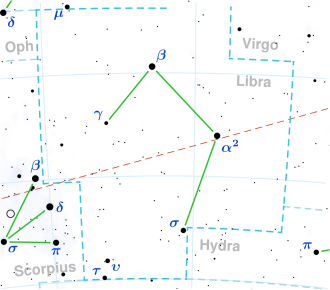
Epsilon Librae is a binary star system in the zodiac constellation Libra. Its name is a Bayer designation that is Latinized from ε Librae, and abbreviated Epsilon Lib or ε Lib. With an apparent visual magnitude of 4.922,2 it is bright enough to be seen with the naked eye. Based upon an annual parallax shift of 32.02 mas,1 it is located about 102 light years away from the Sun.
This is a single-lined spectroscopic binary star system. The pair orbit each other with a period of 226.9 days and an eccentricity of 0.66.6 The semimajor axis of their orbit is estimated to be 0.85 AU, or 85% of the distance from the Earth to the Sun. The primary, component A, has been catalogued with stellar classifications of F3 V3 and F5 IV,4 suggesting that it is an F-type star that either belongs to the main sequence or has evolved into a subgiant as the hydrogen at its core nears exhaustion.
The primary has 1.17 times the mass of the Sun6 and 2.16 times the Sun's radius.9 It is around 1.5 billion years old10 and is spinning with a projected rotational velocity of 105 km/s. The star radiates 9.3 times the solar luminosity10 from its outer atmosphere at an effective temperature of 6,552 K.6 The secondary, component B, has 41% of the Sun's mass.6
References
References
- van Leeuwen, F. (2007), "Validation of the new Hipparcos reduction", Astronomy and Astrophysics, 474 (2): 653–664, arXiv:0708.1752, Bibcode:2007A&A...474..653V, doi:10.1051/0004-6361:20078357, S2CID 18759600.
- Celis, L. (October 1975), "Photoelectric photometry of late-type variable stars", Astronomy and Astrophysics Supplement Series, 22: 9–17, Bibcode:1975A&AS...22....9C.
- Houk, N.; Swift, C. (1999), "Michigan catalogue of two-dimensional spectral types for the HD Stars", Michigan Spectral Survey, 5, Ann Arbor, Michigan: Department of Astronomy, University of Michigan, Bibcode:1999MSS...C05....0H.
- Malaroda, S. (August 1975), "Study of the F-type stars. I. MK spectral types", Astronomical Journal, 80: 637–641, Bibcode:1975AJ.....80..637M, doi:10.1086/111786.
- Takeda, Yoichi; et al. (February 2005), "High-Dispersion Spectra Collection of Nearby F--K Stars at Okayama Astrophysical Observatory: A Basis for Spectroscopic Abundance Standards", Publications of the Astronomical Society of Japan, 57 (1): 13–25, Bibcode:2005PASJ...57...13T, doi:10.1093/pasj/57.1.13.
- Katoh, Noriyuki; et al. (February 2013), "Determination of Orbital Elements of Spectroscopic Binaries Using High-dispersion Spectroscopy", The Astronomical Journal, 145 (2): 12, Bibcode:2013AJ....145...41K, doi:10.1088/0004-6256/145/2/41, 41.
- Jancart, S. (2005), "Astrometric orbits of SB9 stars", Astronomy and Astrophysics, 442 (1): 365–380, arXiv:astro-ph/0507695, Bibcode:2005A&A...442..365J, doi:10.1051/0004-6361:20053003, S2CID 15123997.
- Pourbaix, D.; Tokovinin, A. A.; Batten, A. H.; Fekel, F. C.; Hartkopf, W. I.; et al. (2004), "SB9: The ninth catalogue of spectroscopic binary orbits", Astronomy & Astrophysics, 424 (2): 727–732, arXiv:astro-ph/0406573, Bibcode:2004A&A...424..727P, doi:10.1051/0004-6361:20041213, S2CID 119387088.
- Stassun, Keivan G.; Oelkers, Ryan J.; Paegert, Martin; Torres, Guillermo; Pepper, Joshua; De Lee, Nathan; Collins, Kevin; Latham, David W.; Muirhead, Philip S.; Chittidi, Jay; Rojas-Ayala, Bárbara; Fleming, Scott W.; Rose, Mark E.; Tenenbaum, Peter; Ting, Eric B. (2019-10-01), "The Revised TESS Input Catalog and Candidate Target List", The Astronomical Journal, 158 (4): 138, arXiv:1905.10694, Bibcode:2019AJ....158..138S, doi:10.3847/1538-3881/ab3467, ISSN 0004-6256. Epsilon Librae's database entry at VizieR.
- Takeda, Yoichi (April 2007), "Fundamental Parameters and Elemental Abundances of 160 F-G-K Stars Based on OAO Spectrum Database", Publications of the Astronomical Society of Japan, 59 (2): 335–356, Bibcode:2007PASJ...59..335T, doi:10.1093/pasj/59.2.335.
- "eps Lib -- Spectroscopic binary", SIMBAD Astronomical Database, Centre de Données astronomiques de Strasbourg, retrieved 2017-01-30.