 | |
| Names | EOS-02 / Microsat-2A |
|---|---|
| Mission type | Earth observation |
| Operator | ISRO |
| Website | https://www.isro.gov.in/ |
| Mission duration | 55 minutes |
| Orbits completed | <1 |
| Spacecraft properties | |
| Spacecraft | EOS-02 |
| Manufacturer | ISRO |
| Launch mass | 135 kg |
| Start of mission | |
| Launch date | 03:48 UTC, 7 August 2022 |
| Rocket | Small Satellite Launch Vehicle |
| Launch site | Satish Dhawan Space Centre, First launch Pad (FLP) |
| Contractor | ISRO |
| End of mission | |
| Decay date | 7 August 2022 04:43 UTC |
| Orbital parameters | |
| Regime | Low Earth (intended) Transatmospheric (achieved) |
| Periapsis altitude | 76 km (47 mi) |
| Apoapsis altitude | 356 (221 mi) |
| Inclination | 37.2 |
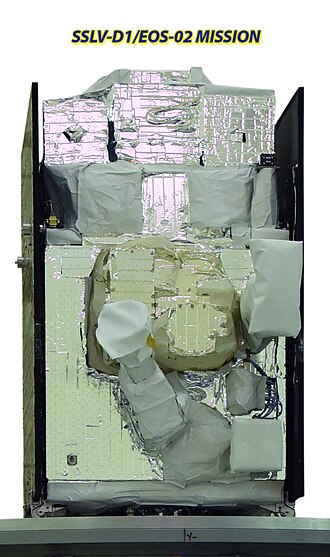
EOS-02 (formerly known as Microsat-2A) was an Indian Earth observation microsatellite developed by ISRO as a test payload on the maiden launch of the Small Satellite Launch Vehicle (SSLV).1 EOS-02 was based on Microsat-TD. The objective behind EOS-02 was to realize and fly an experimental imaging satellite with short turnaround time to showcase launch on demand capability.2
It was intended to be used for cartographic applications at a cadastral level, urban and rural management, coastal land use and regulation, utilities mapping, development and various other GIS applications. The satellite carried two payloads: a mid-wavelength and a long-wavelength infared camera with a 6m resolution.3
Launch
EOS-02 was launched on Small Satellite Launch Vehicle's maiden flight SSLV-D1 at 03:48 UTC / 09:18 IST on 7 August 2022,45 but due to the final VTM stage failure, the rocket entered a transatmospheric orbit of 356 km × 76 km (221 mi × 47 mi) instead of the planned circular 356 km (221 mi) circular orbit. As a result, both satellites onboard (EOS-02 and AzaadiSAT) were destroyed during reentry.6
References
References
- "India's GISAT-1, Microsat 2-A, GSAT-12R, RISAT-2BR2 satellites ready for launch, says senior ISRO official". DNA India. Retrieved 14 February 2022.
- "India Completes Maiden SSLV Mission, ISRO Says Orbit Achieved Was 'Less Than Expected'". News18. 7 August 2022. Retrieved 7 August 2022.
- "Annual Report 2019-20 (English)". www.isro.gov.in. Archived from the original on 6 April 2020. Retrieved 15 February 2022.
- "ISRO's next-gen rocket SSLV to have maiden launch by July-end". WION. 30 June 2022. Retrieved 2 July 2022.
- Indian Space Research Organisation [@ISRO] (1 August 2022). "The launch of the SSLV-D1/EOS-02 Mission is scheduled for Sunday, August 7, 2022, at 9:18 am (IST) from Satish Dhawan Space Centre (SDSC), Sriharikota. ISRO invites citizens to the Launch View Gallery at SDSC to witness the launch" (Tweet). Retrieved 1 August 2022 – via Twitter.
- Indian Space Research Organization [@isro] (7 August 2022). "SSLV-D1/EOS-02 Mission update: SSLV-D1 placed the satellites into 356 km x 76 km elliptical orbit instead of 356 km circular orbit. Satellites are no longer usable. Issue is reasonably identified. Failure of a logic to identify a sensor failure and go for a salvage action caused the deviation. A committee would analyse and recommend. With the implementation of the recommendations, ISRO will come back soon with SSLV-D2. A detailed statement by Chairman, ISRO will be uploaded soon" (Tweet) – via Twitter.