| 9-cube Enneract | |
|---|---|
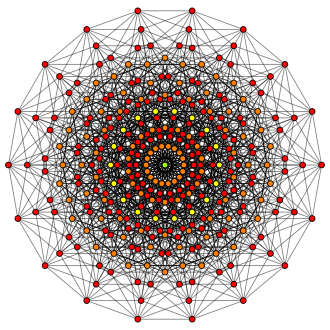 Orthogonal projection inside Petrie polygon. Orange vertices are doubled, yellow have 4, and the green center has 8. | |
| Type | Regular 9-polytope |
| Family | hypercube |
| Schläfli symbol | {4,37} |
| Coxeter-Dynkin diagram |    
|
| 8-faces | 18 {4,36} 
|
| 7-faces | 144 {4,35} 
|
| 6-faces | 672 {4,34} 
|
| 5-faces | 2016 {4,33} 
|
| 4-faces | 4032 {4,32} 
|
| Cells | 5376 {4,3} 
|
| Faces | 4608 {4} 
|
| Edges | 2304 |
| Vertices | 512 |
| Vertex figure | 8-simplex 
|
| Petrie polygon | octadecagon |
| Coxeter group | C9, [37,4] |
| Dual | 9-orthoplex 
|
| Properties | convex, Hanner polytope |
In geometry, a 9-cube is a nine-dimensional hypercube with 512 vertices, 2304 edges, 4608 square faces, 5376 cubic cells, 4032 tesseract 4-faces, 2016 5-cube 5-faces, 672 6-cube 6-faces, 144 7-cube 7-faces, and 18 8-cube 8-faces.
It can be named by its Schläfli symbol {4,37}, being composed of three 8-cubes around each 7-face. It is also called an enneract, a portmanteau of tesseract (the 4-cube) and enne for nine (dimensions) in Greek. It can also be called a regular octadeca-9-tope or octadecayotton, as a nine-dimensional polytope constructed with 18 regular facets. It was given acronym enne by J. Bowers.1
It is a part of an infinite family of polytopes, called hypercubes. The dual of a 9-cube can be called a 9-orthoplex, and is a part of the infinite family of cross-polytopes.
Cartesian coordinates
Cartesian coordinates for the vertices of a 9-cube centered at the origin and edge length 2 are
- (±1,±1,±1,±1,±1,±1,±1,±1,±1)
while the interior of the same consists of all points (x0, x1, x2, x3, x4, x5, x6, x7, x8) with −1 < xi < 1.
Projections
 This 9-cube graph is an orthogonal projection. This orientation shows columns of vertices positioned a vertex-edge-vertex distance from one vertex on the left to one vertex on the right, and edges attaching adjacent columns of vertices. The numbers of vertices in each column are a row of Pascal's triangle: 1, 9, 36, 84, 126, 126, 84, 36, 9, 1. |
Images
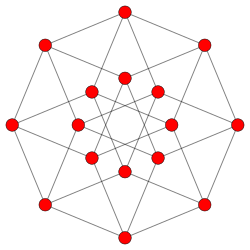
| B9 | B8 | B7 | |||
|---|---|---|---|---|---|

|

|

| |||
| [18] | [16] | [14] | |||
| B6 | B5 | ||||

|

| ||||
| [12] | [10] | ||||
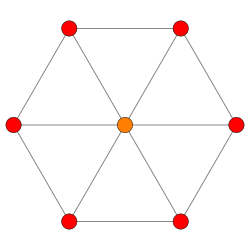
| B4 | B3 | B2 | |||
|
|

| |||
| [8] | [6] | [4] | |||
| A7 | A5 | A3 | |||

|

|

| |||
| [8] | [6] | [4] | |||
Derived polytopes
Applying an alternation operation, deleting alternating vertices of the 9-cube, creates another uniform polytope, called a 9-demicube, (part of an infinite family called demihypercubes), which has 18 8-demicube and 256 8-simplex facets.
References
References
- H.S.M. Coxeter:
- H.S.M. Coxeter, Regular Polytopes, 1973, 3rd edition, Dover, New York, pp. 294–295, Table I (iii): Regular Polytopes, three regular polytopes in n dimensions (n ≥ 5), ISBN 0-486-61480-8
- Kaleidoscopes: Selected Writings of H.S.M. Coxeter, edited by F. Arthur Sherk, Peter McMullen, Anthony C. Thompson, Asia Ivić Weiss, Wiley-Interscience Publication, 1995, wiley.com, ISBN 978-0-471-01003-6
- (Paper 22) H.S.M. Coxeter, Regular and Semi-Regular Polytopes I, [Math. Zeit. 46 (1940) 380–407, MR 2,10]
- (Paper 23) H.S.M. Coxeter, Regular and Semi-Regular Polytopes II, [Math. Zeit. 188 (1985) 559–591]
- (Paper 24) H.S.M. Coxeter, Regular and Semi-Regular Polytopes III, [Math. Zeit. 200 (1988) 3–45]
- Norman Johnson Uniform Polytopes, Manuscript (1991)
- N.W. Johnson: The Theory of Uniform Polytopes and Honeycombs, Ph.D. (1966)
- Klitzing, Richard. "9D uniform polytopes (polyyotta) o3o3o3o3o3o3o3o4x - enne".
External links
External links
- Weisstein, Eric W. "Hypercube". MathWorld.
- Olshevsky, George. "Measure polytope". Glossary for Hyperspace. Archived from the original on 4 February 2007.
- Multi-dimensional Glossary: hypercube Garrett Jones