Engen (延元) was a Japanese era of the Southern Court during the Era of Northern and Southern Courts after Kenmu and before Kōkoku, lasting from February 1336 to April 1340.1 The reigning Emperors were Emperor Go-Daigo and Emperor Go-Murakami in the south and Emperor Kōmyō in the north.
Nanboku-chō overview
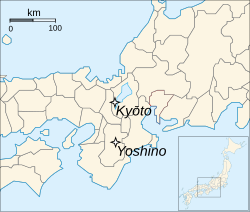
During the Meiji period, an Imperial decree dated March 3, 1911 established that the legitimate reigning monarchs of this period were the direct descendants of Emperor Go-Daigo through Emperor Go-Murakami, whose Southern Court (南朝, nanchō) had been established in exile in Yoshino, near Nara.2
Until the end of the Edo period, the militarily superior pretender-Emperors supported by the Ashikaga shogunate had been mistakenly incorporated in Imperial chronologies despite the undisputed fact that the Imperial Regalia were not in their possession.2
This illegitimate Northern Court (北朝, hokuchō) had been established in Kyoto by Ashikaga Takauji.2
Northern Court Equivalents
References
References
- Nussbaum, Louis-Frédéric. (2005). "Engen" in Japan encyclopedia, p. 178; n.b., Louis-Frédéric is pseudonym of Louis-Frédéric Nussbaum, see Deutsche Nationalbibliothek Authority File.
- Thomas, Julia Adeney. (2001). Reconfiguring modernity: concepts of nature in Japanese political ideology, p. 199 n57, citing Mehl, Margaret. (1997). History and the State in Nineteenth-Century Japan. p. 140-147.
External links
External links
- National Diet Library, "The Japanese Calendar" – historical overview plus illustrative images from library's collection
- Titsingh, Isaac. (1834). Nihon Ōdai Ichiran; ou, Annales des empereurs du Japon. Paris: Royal Asiatic Society, Oriental Translation Fund of Great Britain and Ireland. OCLC 5850691