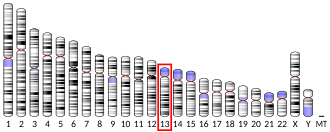



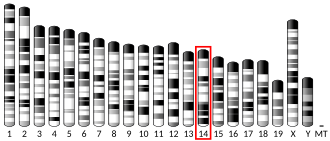

E74-like factor 1 (ets domain transcription factor) is a protein that in humans is encoded by the ELF1 gene.5 It was named for its similarity to E74, an ecdysone-inducible transcription factor from Drosophila.6
Function
This gene encodes an E26 transformation-specific related transcription factor. The encoded protein is primarily expressed in lymphoid cells and can act as both an enhancer and a repressor to regulate transcription of various genes. Alternative splicing results in multiple transcript variants.5
References
References
- GRCh38: Ensembl release 89: ENSG00000120690 – Ensembl, May 2017
- GRCm38: Ensembl release 89: ENSMUSG00000036461 – Ensembl, May 2017
- "Human PubMed Reference:". National Center for Biotechnology Information, U.S. National Library of Medicine.
- "Mouse PubMed Reference:". National Center for Biotechnology Information, U.S. National Library of Medicine.
- "Entrez Gene: E74-like factor 1 (ets domain transcription factor)".
- Thompson CB, Wang CY, Ho IC, Bohjanen PR, Petryniak B, June CH, Miesfeldt S, Zhang L, Nabel GJ, Karpinski B (Mar 1992). "cis-acting sequences required for inducible interleukin-2 enhancer function bind a novel Ets-related protein, Elf-1". Molecular and Cellular Biology. 12 (3): 1043–53. doi:10.1128/mcb.12.3.1043. PMC 369536. PMID 1545787.
Further reading
Further reading
- Xiang P, Lo C, Argiropoulos B, Lai CB, Rouhi A, Imren S, Jiang X, Mager D, Humphries RK (Sep 2010). "Identification of E74-like factor 1 (ELF1) as a transcriptional regulator of the Hox cofactor MEIS1". Experimental Hematology. 38 (9): 798–8, 808.e1-2. doi:10.1016/j.exphem.2010.06.006. PMC 3887005. PMID 20600580.
- Juang YT, Solomou EE, Rellahan B, Tsokos GC (Mar 2002). "Phosphorylation and O-linked glycosylation of Elf-1 leads to its translocation to the nucleus and binding to the promoter of the TCR zeta-chain". Journal of Immunology. 168 (6): 2865–71. doi:10.4049/jimmunol.168.6.2865. PMID 11884456.
- Mao S, Frank RC, Zhang J, Miyazaki Y, Nimer SD (May 1999). "Functional and physical interactions between AML1 proteins and an ETS protein, MEF: implications for the pathogenesis of t(8;21)-positive leukemias". Molecular and Cellular Biology. 19 (5): 3635–44. doi:10.1128/mcb.19.5.3635. PMC 84165. PMID 10207087.
- Nishiyama C, Takahashi K, Nishiyama M, Okumura K, Ra C, Ohtake Y, Yokota T (Dec 2000). "Splice isoforms of transcription factor Elf-1 affecting its regulatory function in transcription-molecular cloning of rat Elf-1". Bioscience, Biotechnology, and Biochemistry. 64 (12): 2601–7. doi:10.1271/bbb.64.2601. PMID 11210123.
- Tsokos GC, Nambiar MP, Juang YT (Apr 2003). "Activation of the Ets transcription factor Elf-1 requires phosphorylation and glycosylation: defective expression of activated Elf-1 is involved in the decreased TCR zeta chain gene expression in patients with systemic lupus erythematosus". Annals of the New York Academy of Sciences. 987: 240–5. doi:10.1111/j.1749-6632.2003.tb06054.x. PMID 12727645. S2CID 42190457.
- Gunther M, Laithier M, Brison O (Jul 2000). "A set of proteins interacting with transcription factor Sp1 identified in a two-hybrid screening". Molecular and Cellular Biochemistry. 210 (1–2): 131–42. doi:10.1023/A:1007177623283. PMID 10976766. S2CID 1339642.
- Yang W, Tang H, Zhang Y, Tang X, Zhang J, Sun L, et al. (Jan 2013). "Meta-analysis followed by replication identifies loci in or near CDKN1B, TET3, CD80, DRAM1, and ARID5B as associated with systemic lupus erythematosus in Asians". American Journal of Human Genetics. 92 (1): 41–51. doi:10.1016/j.ajhg.2012.11.018. PMC 3542470. PMID 23273568.
- Bassuk AG, Anandappa RT, Leiden JM (May 1997). "Physical interactions between Ets and NF-kappaB/NFAT proteins play an important role in their cooperative activation of the human immunodeficiency virus enhancer in T cells". Journal of Virology. 71 (5): 3563–73. doi:10.1128/JVI.71.5.3563-3573.1997. PMC 191503. PMID 9094628.
This article incorporates text from the United States National Library of Medicine, which is in the public domain.