| Electroclash | |
|---|---|
| Other names |
|
| Stylistic origins | |
| Cultural origins | Late 1990s,1 Netherlands, France, Austria, Germany (Munich4) and United States (Detroit and New York5) |
| Derivative forms | |
| Other topics | |
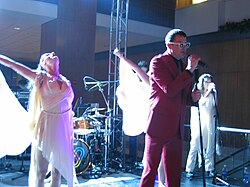
Electroclash (also known as synthcore, retro-electro, tech-pop, nouveau disco3) is a genre of popular music that incorporates 1980s electro music, new wave, synth-pop, electropop, techno and broad electronic dance music in general.678 It emerged in the late 1990s and was pioneered by and associated with acts such as I-F, DJ Hell, Miss Kittin and The Hacker, and Fischerspooner.910
Terminology and characteristics
The term electroclash is agreed to have been coined to describe the convergence of synthpop, techno, punk and performance art in club scenes in the 1990s and 2000s.6 It was described by The Guardian as one of "the two most significant upheavals in recent dance music history".11 DJ Hell is widely credited as inventor and name giver of the genre,121314 while DJ and promoter Larry Tee later popularized the term in the US by naming the Electroclash 2001 Festival in New York15 after it.168
History
Role of International Deejay Gigolos
Electroclash emerged in the late 1990s. The Munich-based label International DeeJay Gigolo Records, founded by DJ Hell, is considered the "germ cell" and "THE home" of the electroclash sound.17181920 Gigolo featured many of the early electroclash songs, including Christopher Just's "I'm a Disco Dancer" and Chris Korda's "Save the Planet, Kill Yourself".2122 Then in 1998, Gigolo released the songs "1982" and "Frank Sinatra" by French recording duo Miss Kittin & The Hacker, which were among the most successful early hits of the new genre.10239 This was followed by the hit "Emerge" by New York duo Fischerspooner,24 as well as the remake of Corey Hart's "Sunglasses at Night" by Canadian duo Tiga & Zyntherius, both released on Gigolo in 2001.2526 DJ Hell brought the artists of the new genre together on the label and acted primarily as their mentor.26 But also Hell's own releases like the album Munich Machine from 1998 are seen as groundbreaking for the genre Electroclash.27 In the widely recognized film documentary Welcome to the club! 25 years of electronic dance music by European television network Arte, Miss Kittin describes the origination of the first songs of the new style together with DJ Hell and declares him the inventor of the Electroclash genre.14 Since DJ Hell gathered the international artists of the new genre at Gigolo in Munich and many of them gave their first performances in the city's nightclubs, Munich is considered the city in which electroclash "was significantly co-invented, if not invented".418 Soon the new style of music also spread to other cities such as Berlin, London and New York.28
Other early artists
I-F's track "Space Invaders Are Smoking Grass", released in 1998 on Disko B, with its "old-fashioned verse-chorus dynamics to burbling electro in a vocodered homage to Atari-era hi-jinks" is considered one of the pioneering tracks of the electroclash genre.629 Further early artists include Chicks on Speed, Peaches, Electrosexual ADULT. and Toktok vs. Soffy O with their 2000 track "Missy Queen's Gonna Die".28193031
Ladytron were labeled as electroclash as they were garnering attention, but this was disputed by fans9 and the group also rejected the tag themselves.3218 Goldfrapp's albums Black Cherry (2003) and Supernature (2005) incorporated electroclash influences.3334
Revival
In the U.S.
In the U.S., the genre gained media attention when the Electroclash Festival was held in New York in October 2001, aiming to "make a local breakthrough with this scene, presenting a select group of superstar and pioneer artists from Europe and the U.S."159 The Electroclash Festival returned in 2002, followed by live tours across the US and Europe in 2003 and 2004. Notable artists who performed at the festival and subsequent tours include Scissor Sisters, ADULT., Erol Alkan, Princess Superstar, Mignon, Mount Sims, Tiga and Spalding Rockwell. Additionally, the British label City Rockers distributed Damian Lazarus' Futurism DJ mix CDs, which prominently featured many of these artists and other more common names.
2020s revival
In the 2020s, both electroclash and bloghouse experienced a resurgence strongly associated with the indie sleaze revival.3536 DJ Hell launched a new electroclash tour, and Norbert Thunder contributed to the revival with his Fembot Actress EP in 2022, which included the festival hit track "Groove, Style, Lights, Euphoria." Marketed as an effort to reintroduce the electroclash sound to contemporary audiences, the EP gained notable attention. Several record labels also began releasing electroclash vinyl records and EPs, including the Spanish label Veintidós Rec. and the Italian label Rapid Eye Movement Records.37
Criticism
The electroclash label and the hype around it were criticized by DJs, musicians, producers, show organizers and promoters alike in the early 2000s. For example, I-F and other artists signed an "Anti-Electroclash-Manifest", where they declared that it was designed to "rule the media waves" and only "sell the old freshly packaged".2830 In 2002, Toktok vs. Soffy O. stated that when they were first asked about electroclash, they thought it was "nothing else than what we've known for at least five years and what is now reaching the recycling peak for the third or fourth time".30
References
References
- Ishkur (2019). "Ishkur's Guide: Electroclash". Ishkur's Guide to Electronic Music. Retrieved November 16, 2023.
- David Madden (2012). "Crossdressing to Backbeats: The Status of the Electroclash Producer and the Politics of Electronic Music". Dancecult: Journal of Electronic Dance Music Culture: 27–47. Retrieved January 3, 2015.
Electroclash combines the extended pulsing sections of techno, house and other dance musics with the trashier energy of rock and new wave.
- Carpenter, Susan (July 28, 2002). "New Songs, Old Beats". Los Angeles Times. Retrieved June 9, 2022.
- Hecktor, Mirko; von Uslar, Moritz; Smith, Patti; Neumeister, Andreas (1 November 2008). Mjunik Disco – from 1949 to now (in German). Blumenbar. p. 8. ISBN 978-3936738476.
- Reynolds, Simon (2013). Energy Flash: A Journey Through Rave Music and Dance Culture. Soft Skull Press.
Go to Berliniamsburg, the Brooklyn club at the epicentre of New York's eighties-inspired 'electroclash' scene, and you feel a peculiar sensation: it's not exactly like time travel, more like you've stepped into a parallel universe, an alternative history scenario where rave never happened.
- D. Lynskey (22 March 2002). "Out with the old, in with the older". Guardian.co.uk. Archived from the original on 15 October 2014.
- "The Electroclash Mix by Larry Tee". Entertainment Weekly. Archived from the original on 30 September 2012. Retrieved 18 April 2015.
- Kellman, Andy. "Larry Tee Biography on Yahoo! Music". Yahoo! Music. Archived from the original on 18 March 2007. Retrieved 2016-08-26.
- Juzwiak, Richard Moroder (30 September 2002). "Electroclash: In Limousines We Have Sex/In NYC We Have Clash - Article". Stylus Magazine. Archived from the original on 2 December 2010. Retrieved 11 August 2016.
- Gagne, Justin (2011). "Velle - Couture Soundtracks - Winter 2010". Velle. Retrieved 11 August 2016.
- "The female techno takeover", The Guardian, May 24, 2008
- "The gentleman of electronic music" (in German). Pure FM. 11 June 2014. Archived from the original on 1 January 2015. Retrieved 11 August 2016.
- "DJ Hell – Electronic Music Megastar" (in German). FAZEmag. 6 April 2012. Retrieved 26 August 2016.
- Pailhe, Dimitri (Director), Marx, Jean-Claude, Alary, Romain, Sève, Thibault (2014). Bienvenue au club : 25 ans de musiques électroniques [Welcome to the club! 25 years of electronic dance music] (Motion picture) (in French). France: Arte France, Bellota Films.
- "Electroclash 2001 Festival: Bringing Innovative Music to NYC". FREEwilliamsburg, Issue 19, 2001. October 2001. Retrieved 26 August 2016.
- Paoletta, Michael (27 July 2002). "Nü-Electro Sound Emerges". Billboard. Vol. 30, no. 114. New York: Nielsen Business Media Inc. pp. 66–68. ISSN 0006-2510.
- Sources:
- Ulf Lippitz (18 November 2003). "DJ Hell: Vokuhila, Koks und Schampus" [DJ Hell: Mullet, coke and champers]. Der Spiegel (in German).
- Tony Naylor (2 March 2009). "DJ Hell creates dance music heaven at last". The Guardian.
- Joe Muggs (7 March 2014). "Save the Planet, Kill Yourself: remembering Electroclash". FACT Magazine.
- Von Kraehahn and Christoph Dallach (31 March 2003). "Aufgewärmte Kälte – Das Revival findet doch statt: Ladytron macht aus Klängen der Achtziger Electroclash" [Warmed up cold – The revival takes place after all: Ladytron turn the sounds of the eighties into electroclash]. Der Spiegel (in German).
- Josh Baines (10 February 2016). "A Bullshitter's Guide to Electroclash". VICE.
- "Dj Hell Interview: Power and Innovation". Skiddle. 20 October 2015. Retrieved 26 August 2016.
- Joe Muggs (7 March 2014). "Save the Planet, Kill Yourself: remembering Electroclash". FACT Magazine.
- "Chris Korda – Save The Planet, Kill Yourself". Discogs. Zinc Media, Inc. 1993. Retrieved 20 August 2016.
- "Miss Kittin And The Hacker* - Champagne! E.P." Discogs. Zinc Media, Inc. 1998. Retrieved 11 August 2016.
- "Fischerspooner – Emerge". Discogs. Zinc Media, Inc. 30 July 2001. Retrieved 29 December 2020.
- "Tiga & Zyntherius – Sunglasses EP". Discogs. Zinc Media, Inc. 4 September 2001. Retrieved 29 December 2020.
- Kleinfeld, Justin (3 February 2003). "Artist Spotlight:Tiga". CMJ New Music Report. Vol. 74, no. 799. New York: The CMJ Network Inc. p. 20. ISSN 0890-0795.
- Tony Naylor (2 March 2009). "DJ Hell creates dance music heaven at last". The Guardian. Retrieved 29 December 2020.
- Andreas Hartmann (17 January 2003). "The Great Gigolo Swindle". Die Tageszeitung (in German). Archived from the original on 25 February 2020. Retrieved 24 August 2016.
- "I-f – Fucking Consumer". Discogs. Zinc Media, Inc. 28 March 1998. Retrieved 29 December 2020.
- Sonja Eismann (27 September 2002). "The moment after: Toktok vs. Soffy O." (in German). Intro Magazine. Archived from the original on 27 August 2016. Retrieved 24 August 2016.
- J. Walker (5 October 2002). "Popmatters concert review: ELECTROCLASH 2002 Artists: Peaches, Chicks on Speed, W.I.T., and Tracy and the Plastics". The Boston Globe. Archived from the original on 13 May 2011..
- "3/29 - Ladytron - 'Best Of: 00 - 10'". nettskinny.com. Archived from the original on 24 December 2013. Retrieved 18 April 2015.
- Phares, Heather. "Black Cherry – Goldfrapp". AllMusic. Rovi Corporation. Retrieved 11 October 2011.
- Oculicz, Edward (23 August 2005). "Goldfrapp – Supernature". Stylus Magazine. Archived from the original on 3 March 2016. Retrieved 11 October 2011.
- v.schutz@numero.com (2025-01-12). "Indie sleaze: the trend of the 2010s is back in fashion". Numéro. Retrieved 2026-05-12.
- "The Return of Electroclash". Paste Magazine. Retrieved 2026-01-28.
- Petridis, Alexis (2025-09-17). "'The epitome of amazingness': how electroclash brought glamour, filth and fun back to 00s music". The Guardian. ISSN 0261-3077. Retrieved 2026-01-28.