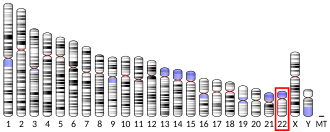
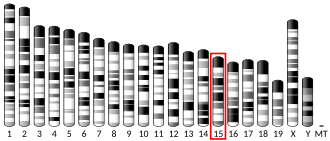
Eukaryotic translation initiation factor 3 subunit D (eIF3d) is a protein that in humans is encoded by the EIF3D gene.56
Function
Eukaryotic translation initiation factor-3 (eIF3), the largest of the eIFs, is a multiprotein complex composed of at least ten nonidentical subunits. The complex binds to the 40S ribosome and helps maintain the 40S and 60S ribosomal subunits in a dissociated state. It is also thought to play a role in the formation of the 40S initiation complex by interacting with the ternary complex of eIF2/GTP/methionyl-tRNA, and by promoting mRNA binding. The protein encoded by this gene is the major RNA binding subunit of the eIF3 complex.6
Interactions
EIF3D has been shown to interact with PHLDA17 and EIF3A.8910
EIF3D has also been shown to interact with c-Jun mRNA via a non-canonical mechanism. Instead of the EIF4G protein acting as a cap-binding protein to mediate translation, EIF3D has been shown to be a cap binding protein for certain mRNAs such as c-Jun as detected by biochemical assays, although the structure of this complex (eIF3d-m7G cap) has not been resolved. c-Jun has structures at the 5' UTR inhibiting binding of EIF4G and promoting binding of EIF3D.11 EIF3D as a cap binding protein has been thought of as critical to regulating gene expression under cell stress such as during glucose deprivation. For translation of c-Jun under glucose starved conditions, the cap binding activity of EIF3D increased by 10-fold.1213. In addition, eIF3d can increase translation of capped mRNAs encoding matrix metalloproteinase 1 and cyclin-dependent kinase 12 by interacting with EIF4G2 (also known as DAP5.) in a subset of immune cells. eIF3d is also overexpressed in many cancer types, being involved in cell cycle regulation, and previous research demonstrated it can act as a N6-Methyladenosine reader on mRNAs.
See also
See also
References
References
- GRCh38: Ensembl release 89: ENSG00000100353 – Ensembl, May 2017
- GRCm38: Ensembl release 89: ENSMUSG00000016554 – Ensembl, May 2017
- "Human PubMed Reference:". National Center for Biotechnology Information, U.S. National Library of Medicine.
- "Mouse PubMed Reference:". National Center for Biotechnology Information, U.S. National Library of Medicine.
- Asano K, Vornlocher HP, Richter-Cook NJ, Merrick WC, Hinnebusch AG, Hershey JW (October 1997). "Structure of cDNAs encoding human eukaryotic initiation factor 3 subunits. Possible roles in RNA binding and macromolecular assembly". The Journal of Biological Chemistry. 272 (43): 27042–27052. doi:10.1074/jbc.272.43.27042. PMID 9341143.
- "Entrez Gene: EIF3S7 eukaryotic translation initiation factor 3, subunit 7 zeta, 66/67kDa".
- Hinz T, Flindt S, Marx A, Janssen O, Kabelitz D (May 2001). "Inhibition of protein synthesis by the T cell receptor-inducible human TDAG51 gene product". Cellular Signalling. 13 (5): 345–352. doi:10.1016/S0898-6568(01)00141-3. PMID 11369516.
- Ewing RM, Chu P, Elisma F, Li H, Taylor P, Climie S, et al. (2007). "Large-scale mapping of human protein-protein interactions by mass spectrometry". Molecular Systems Biology. 3 (1): 89. doi:10.1038/msb4100134. PMC 1847948. PMID 17353931.
- Mayeur GL, Fraser CS, Peiretti F, Block KL, Hershey JW (October 2003). "Characterization of eIF3k: a newly discovered subunit of mammalian translation initiation factor elF3". European Journal of Biochemistry. 270 (20): 4133–4139. doi:10.1046/j.1432-1033.2003.03807.x. PMID 14519125.
- Block KL, Vornlocher HP, Hershey JW (November 1998). "Characterization of cDNAs encoding the p44 and p35 subunits of human translation initiation factor eIF3". The Journal of Biological Chemistry. 273 (48): 31901–31908. doi:10.1074/jbc.273.48.31901. PMID 9822659.
- Lee AS, Kranzusch PJ, Doudna JA, Cate JH (August 2016). "eIF3d is an mRNA cap-binding protein that is required for specialized translation initiation". Nature. 536 (7614): 96–99. Bibcode:2016Natur.536...96L. doi:10.1038/nature18954. PMC 5003174. PMID 27462815.
- Jia L, Qian SB (January 2021). "A Versatile eIF3d in Translational Control of Stress Adaptation". Molecular Cell. 81 (1): 10–12. doi:10.1016/j.molcel.2020.12.016. PMID 33417853. S2CID 231303797.
- Lamper AM, Fleming RH, Ladd KM, Lee AS (November 2020). "A phosphorylation-regulated eIF3d translation switch mediates cellular adaptation to metabolic stress". Science. 370 (6518): 853–856. Bibcode:2020Sci...370..853L. doi:10.1126/science.abb0993. PMID 33184215. S2CID 226308112.
Further reading
Further reading
- Asano K, Kinzy TG, Merrick WC, Hershey JW (January 1997). "Conservation and diversity of eukaryotic translation initiation factor eIF3". The Journal of Biological Chemistry. 272 (2): 1101–1109. doi:10.1074/jbc.272.2.1101. PMID 8995409.
- Méthot N, Rom E, Olsen H, Sonenberg N (January 1997). "The human homologue of the yeast Prt1 protein is an integral part of the eukaryotic initiation factor 3 complex and interacts with p170". The Journal of Biological Chemistry. 272 (2): 1110–1116. doi:10.1074/jbc.272.2.1110. PMID 8995410.
- Block KL, Vornlocher HP, Hershey JW (November 1998). "Characterization of cDNAs encoding the p44 and p35 subunits of human translation initiation factor eIF3". The Journal of Biological Chemistry. 273 (48): 31901–31908. doi:10.1074/jbc.273.48.31901. PMID 9822659.
- Dunham I, Shimizu N, Roe BA, Chissoe S, Hunt AR, Collins JE, et al. (December 1999). "The DNA sequence of human chromosome 22". Nature. 402 (6761): 489–495. Bibcode:1999Natur.402..489D. doi:10.1038/990031. PMID 10591208.
- Asano K, Shalev A, Phan L, Nielsen K, Clayton J, Valásek L, et al. (May 2001). "Multiple roles for the C-terminal domain of eIF5 in translation initiation complex assembly and GTPase activation". The EMBO Journal. 20 (9): 2326–2337. doi:10.1093/emboj/20.9.2326. PMC 125443. PMID 11331597.
- Hinz T, Flindt S, Marx A, Janssen O, Kabelitz D (May 2001). "Inhibition of protein synthesis by the T cell receptor-inducible human TDAG51 gene product". Cellular Signalling. 13 (5): 345–352. doi:10.1016/S0898-6568(01)00141-3. PMID 11369516.
- Morris-Desbois C, Réty S, Ferro M, Garin J, Jalinot P (December 2001). "The human protein HSPC021 interacts with Int-6 and is associated with eukaryotic translation initiation factor 3". The Journal of Biological Chemistry. 276 (49): 45988–45995. doi:10.1074/jbc.M104966200. PMID 11590142.
- Mayeur GL, Fraser CS, Peiretti F, Block KL, Hershey JW (October 2003). "Characterization of eIF3k: a newly discovered subunit of mammalian translation initiation factor elF3". European Journal of Biochemistry. 270 (20): 4133–4139. doi:10.1046/j.1432-1033.2003.03807.x. PMID 14519125.
- Collins JE, Wright CL, Edwards CA, Davis MP, Grinham JA, Cole CG, et al. (2004). "A genome annotation-driven approach to cloning the human ORFeome". Genome Biology. 5 (10): R84. doi:10.1186/gb-2004-5-10-r84. PMC 545604. PMID 15461802.
- Rush J, Moritz A, Lee KA, Guo A, Goss VL, Spek EJ, et al. (January 2005). "Immunoaffinity profiling of tyrosine phosphorylation in cancer cells". Nature Biotechnology. 23 (1): 94–101. doi:10.1038/nbt1046. PMID 15592455. S2CID 7200157.
- Ewing RM, Chu P, Elisma F, Li H, Taylor P, Climie S, et al. (2007). "Large-scale mapping of human protein-protein interactions by mass spectrometry". Molecular Systems Biology. 3 (1): 89. doi:10.1038/msb4100134. PMC 1847948. PMID 17353931.