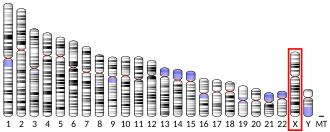



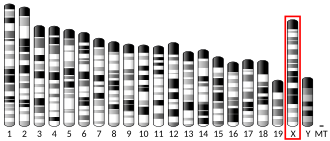


Ephrin B1 is a protein that in humans is encoded by the EFNB1 gene.56 It is a member of the ephrin family. The encoded protein is a type I membrane protein and a ligand of Eph-related receptor tyrosine kinases. It may play a role in cell adhesion and function in the development or maintenance of the nervous system.7
Clinical significance
Mutations in this protein are responsible for most cases of craniofrontonasal syndrome.8910
Interactions
EFNB1 has been shown to interact with SDCBP.11
References
References
- GRCh38: Ensembl release 89: ENSG00000090776 – Ensembl, May 2017
- GRCm38: Ensembl release 89: ENSMUSG00000031217 – Ensembl, May 2017
- "Human PubMed Reference:". National Center for Biotechnology Information, U.S. National Library of Medicine.
- "Mouse PubMed Reference:". National Center for Biotechnology Information, U.S. National Library of Medicine.
- Fletcher FA, Huebner K, Shaffer LG, Fairweather ND, Monaco AP, Muller U, Druck T, Simoneaux DK, Chelly J, Belmont JW, et al. (Jul 1995). "Assignment of the gene (EPLG2) encoding a high-affinity binding protein for the receptor tyrosine kinase Elk to a 200-kilobasepair region in human chromosome Xq12". Genomics. 25 (1): 334–5. doi:10.1016/0888-7543(95)80156-G. PMID 7774950.
- Shotelersuk V, Siriwan P, Ausavarat S (Mar 2006). "A novel mutation in EFNB1, probably with a dominant negative effect, underlying craniofrontonasal syndrome". Cleft Palate Craniofac J. 43 (2): 152–4. doi:10.1597/05-014.1. PMID 16526919. S2CID 10737616.
- "Entrez Gene: EFNB1 ephrin-B1".
- Wieland I, Weidner C, Ciccone R, et al. (December 2007). "Contiguous gene deletions involving EFNB1, OPHN1, PJA1 and EDA in patients with craniofrontonasal syndrome". Clin. Genet. 72 (6): 506–16. doi:10.1111/j.1399-0004.2007.00905.x. PMID 17941886. S2CID 33823266.
- Twigg SR, Kan R, Babbs C, Bochukova EG, Robertson SP, Wall SA, Morriss-Kay GM, Wilkie AO (Jun 2004). "Mutations of ephrin-B1 (EFNB1), a marker of tissue boundary formation, cause craniofrontonasal syndrome". Proc Natl Acad Sci U S A. 101 (23): 8652–7. Bibcode:2004PNAS..101.8652T. doi:10.1073/pnas.0402819101. PMC 423250. PMID 15166289.
- Wieland I, Jakubiczka S, Muschke P, Cohen M, Thiele H, Gerlach KL, Adams RH, Wieacker P (Jun 2004). "Mutations of the ephrin-B1 gene cause craniofrontonasal syndrome". Am J Hum Genet. 74 (6): 1209–15. doi:10.1086/421532. PMC 1182084. PMID 15124102.
- Lin, D; Gish G D; Songyang Z; Pawson T (Feb 1999). "The carboxyl terminus of B class ephrins constitutes a PDZ domain binding motif". J. Biol. Chem. 274 (6): 3726–33. doi:10.1074/jbc.274.6.3726. ISSN 0021-9258. PMID 9920925.
Further reading
Further reading
- Flanagan JG, Vanderhaeghen P (1998). "The ephrins and Eph receptors in neural development". Annu. Rev. Neurosci. 21: 309–45. doi:10.1146/annurev.neuro.21.1.309. PMID 9530499. S2CID 1278600.
- Zhou R (1998). "The Eph family receptors and ligands". Pharmacol. Ther. 77 (3): 151–81. doi:10.1016/S0163-7258(97)00112-5. PMID 9576626.
- Holder N, Klein R (1999). "Eph receptors and ephrins: effectors of morphogenesis". Development. 126 (10): 2033–44. doi:10.1242/dev.126.10.2033. PMID 10207129.
- Wilkinson DG (2000). "Eph receptors and ephrins: Regulators of guidance and assembly". A Survey of Cell Biology. International Review of Cytology. Vol. 196. pp. 177–244. doi:10.1016/S0074-7696(00)96005-4. ISBN 9780123646002. PMID 10730216.
{{cite book}}:|journal=ignored (help) - Xu Q, Mellitzer G, Wilkinson DG (2001). "Roles of Eph receptors and ephrins in segmental patterning". Philos. Trans. R. Soc. Lond. B Biol. Sci. 355 (1399): 993–1002. doi:10.1098/rstb.2000.0635. PMC 1692797. PMID 11128993.
- Wilkinson DG (2001). "Multiple roles of EPH receptors and ephrins in neural development". Nat. Rev. Neurosci. 2 (3): 155–64. doi:10.1038/35058515. PMID 11256076. S2CID 205014301.
- Davis S, Gale NW, Aldrich TH, et al. (1994). "Ligands for EPH-related receptor tyrosine kinases that require membrane attachment or clustering for activity". Science. 266 (5186): 816–9. Bibcode:1994Sci...266..816D. doi:10.1126/science.7973638. PMID 7973638.
- Beckmann MP, Cerretti DP, Baum P, et al. (1994). "Molecular characterization of a family of ligands for eph-related tyrosine kinase receptors". EMBO J. 13 (16): 3757–62. doi:10.1002/j.1460-2075.1994.tb06685.x. PMC 395287. PMID 8070404.
- Cerretti DP, Lyman SD, Kozlosky CJ, et al. (1997). "The genes encoding the eph-related receptor tyrosine kinase ligands LERK-1 (EPLG1, Epl1), LERK-3 (EPLG3, Epl3), and LERK-4 (EPLG4, Epl4) are clustered on human chromosome 1 and mouse chromosome 3". Genomics. 33 (2): 277–82. doi:10.1006/geno.1996.0192. PMID 8660976.
- Gale NW, Holland SJ, Valenzuela DM, et al. (1996). "Eph receptors and ligands comprise two major specificity subclasses and are reciprocally compartmentalized during embryogenesis". Neuron. 17 (1): 9–19. doi:10.1016/S0896-6273(00)80276-7. PMID 8755474.
- Böhme B, VandenBos T, Cerretti DP, et al. (1996). "Cell-cell adhesion mediated by binding of membrane-anchored ligand LERK-2 to the EPH-related receptor human embryonal kinase 2 promotes tyrosine kinase activity". J. Biol. Chem. 271 (40): 24747–52. doi:10.1074/jbc.271.40.24747. PMID 8798744.
- Holland SJ, Gale NW, Mbamalu G, et al. (1996). "Bidirectional signalling through the EPH-family receptor Nuk and its transmembrane ligands". Nature. 383 (6602): 722–5. Bibcode:1996Natur.383..722H. doi:10.1038/383722a0. hdl:1807/9444. PMID 8878483. S2CID 4349898.
- Ephnomenclaturecommittee (1997). "Unified nomenclature for Eph family receptors and their ligands, the ephrins. Eph Nomenclature Committee". Cell. 90 (3): 403–4. doi:10.1016/S0092-8674(00)80500-0. PMID 9267020.
- Feldman GJ, Ward DE, Lajeunie-Renier E, et al. (1998). "A novel phenotypic pattern in X-linked inheritance: craniofrontonasal syndrome maps to Xp22". Hum. Mol. Genet. 6 (11): 1937–41. doi:10.1093/hmg/6.11.1937. PMID 9302274.
- Torres R, Firestein BL, Dong H, et al. (1999). "PDZ proteins bind, cluster, and synaptically colocalize with Eph receptors and their ephrin ligands". Neuron. 21 (6): 1453–63. doi:10.1016/S0896-6273(00)80663-7. PMID 9883737.
- Lin D, Gish GD, Songyang Z, Pawson T (1999). "The carboxyl terminus of B class ephrins constitutes a PDZ domain binding motif". J. Biol. Chem. 274 (6): 3726–33. doi:10.1074/jbc.274.6.3726. PMID 9920925.
- Brückner K, Pablo Labrador J, Scheiffele P, et al. (1999). "EphrinB ligands recruit GRIP family PDZ adaptor proteins into raft membrane microdomains". Neuron. 22 (3): 511–24. doi:10.1016/S0896-6273(00)80706-0. PMID 10197531.