 | |
 | |
| Clinical data | |
|---|---|
| Other names | 2,4,5-Triethoxyamphetamine; TMA2-2,4,5-TriEtO; TMA2-TriEtO |
| Routes of administration | Unknown1 |
| ATC code |
|
| Pharmacokinetic data | |
| Duration of action | Unknown1 |
| Identifiers | |
| |
| CAS Number | |
| PubChem CID | |
| ChemSpider |
|
| UNII | |
| CompTox Dashboard (EPA) | |
| Chemical and physical data | |
| Formula | C15H25NO3 |
| Molar mass | 267.369 g·mol−1 |
| 3D model (JSmol) | |
| |
| |
| (verify) | |

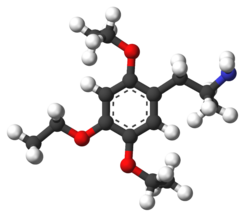
EEE, also known as 2,4,5-triethoxyamphetamine or as TMA2-2,4,5-TriEtO, is a chemical compound of the phenethylamine, amphetamine, and DOx families.1234 It is the analogue of TMA-2 in which the three methoxy groups on the phenyl ring have been replaced with ethoxy groups.134 In his book PiHKAL (Phenethylamines I Have Known and Loved), Alexander Shulgin lists EEE's dose and duration as unknown.1 Shulgin stated that EEE has never been tested in humans.12 The chemical synthesis of EEE has been described.13 EEE was first described in the scientific literature by Shulgin in 1968.3 Subsequently, it was described in greater detail by Shulgin in PiHKAL in 1991.1
References
References
- Shulgin AT, Shulgin A (1991). "EEE". PiHKAL: A Chemical Love Story (1st ed.). Berkeley, CA: Transform Press. ISBN 978-0-9630096-0-9. OL 22859055M.
- Shulgin AT (2003). "Basic Pharmacology and Effects". In Laing RR (ed.). Hallucinogens: A Forensic Drug Handbook. Forensic Drug Handbook Series. Elsevier Science. pp. 67–137. ISBN 978-0-12-433951-4. Archived from the original on 13 July 2025.
- Shulgin AT (January 1968). "The ethyl homologs of 2,4,5-trimethoxyphenylisopropylamine". J Med Chem. 11 (1): 186–187. doi:10.1021/jm00307a056. PMID 5637180. Archived from the original on 2025-07-12.
- Shulgin AT, Sargent T, Naranjo C (February 1969). "Structure–activity relationships of one-ring psychotomimetics". Nature. 221 (5180): 537–541. Bibcode:1969Natur.221..537S. doi:10.1038/221537a0. PMID 5789297. Archived from the original on 2025-07-12.