| Edaphosauridae Temporal range: Late Carboniferous to Early Permian, ~
| |
|---|---|
| |
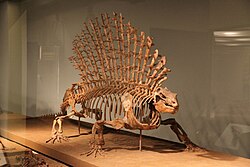
| Mounted skeleton of Edaphosaurus pogonias in the Field Museum of Natural History | |
Scientific classification 
| |
| Kingdom: | Animalia |
| Phylum: | Chordata |
| Clade: | Synapsida |
| Clade: | Sphenacomorpha |
| Family: | †Edaphosauridae Cope, 1882 |
| Type species | |
| †Edaphosaurus pogonias Cope, 1882
| |
| Genera | |
| |
Edaphosauridae is a family of mostly large (up to 3 m (9.8 ft) or more) Late Carboniferous to Early Permian synapsids. Edaphosaur fossils are so far known only from North America and Europe. Edaphosaurids transitioned from being small carnivores in their most primitive members into some of the earliest large terrestrial herbivores. They are noted for their neural spine sails on their backs, which unlike those of Dimetrodon exhibit distinctive outwards facing growths.
Characteristics


Edaphosaurids saw a transition from being small insectivores/carnivores in the most primitive members of the group like Ianthasaurus, towards being large specialised herbivores in later members of the group like Edaphosaurus. They were the earliest known herbivorous amniotes and, along with the Diadectidae, the earliest known herbivorous tetrapods.1 The palatal dentition on the roof of the mouth changed from being relatively unspecialised in early members like Ianthasaurus, towards being modified into specialised raised batteries, which interlocked with a similar battery on the lower jaw in Edaphosaurus, which served to grind plant material.13 The upper surface of the body has a large neural spine sail formed from elongated neural spines of the back vertebrae, with this sail having varied from semi-circular to sloping at the front.4 The neural spines at the front of the sail generally lean forwards (anteriorly), while those towards the back of the sail lean posteriorly.5 The elongate neural spines of the sail had laterally (facing directly outwards to the side) directed tuberculate growths, unlike the neural spines of sphenacodontids like Dimetrodon. These tubercules vary considerably in the patterns of their arrangement between edaphosaurid species. The purpose of the sail is unknown, but have been variously suggested to have served for thermoregulation (though the supporting evidence for this has been criticised), defense, individual/species recognition, and/or display for intraspecific competition.6
Classification
The interrelationships of Edaphosauridae was investigated in details by David M. Mazierski and Robert R. Reisz (2010). The cladogram below is modified after their phylogenetic analysis.7
| Edaphosauridae | |
Edaphosauridae is generally placed as closely related to Sphenacodontia as part of the clade Sphenacomorpha.8 Below is a cladogram modified from the analysis of Benson (2012):9
References
References
- Mann, Arjan; Henrici, Amy C.; Sues, Hans-Dieter; Pierce, Stephanie E. (2023). "A new Carboniferous edaphosaurid and the origin of herbivory in mammal forerunners". Scientific Reports. 13 (1) 4459. Bibcode:2023NatSR..13.4459M. doi:10.1038/s41598-023-30626-8. PMC 10076360. PMID 37019927.
- Spindler, Frederik; Voigt, Sebastian; Fischer, Jan (2020). "Edaphosauridae (Synapsida, Eupelycosauria) from Europe and their relationship to North American representatives". PalZ. 94 (1): 125–153. Bibcode:2020PalZ...94..125S. doi:10.1007/s12542-019-00453-2.
- Modesto SP (1995) The skull of the herbivorous synapsid Edaphosaurus boanerges from the Lower Permian of Texas. Palaeontology 38, 213–239.
- Spencer G., Lucas; Rinehart, Larry; Celeskey, Matthew D. (November 2018). "The oldest specialized tetrapod herbivore: A new eupelycosaur from the Permian of New Mexico, USA". Palaeontologia Electronica. 21.3.39A (3): 899. Bibcode:2018PalEl..21..899L. doi:10.26879/899.
- "Autapomorphies of the main clades of synapsids". Tolweb. Archived from the original on October 27, 2023.
- Huttenlocker, Adam K.; Mazierski, David; Reisz, Robert R. (May 2011). "Comparative osteohistology of hyperelongate neural spines in the Edaphosauridae (Amniota: Synapsida)". Palaeontology. 54 (3): 573–590. Bibcode:2011Palgy..54..573H. doi:10.1111/j.1475-4983.2011.01047.x. ISSN 0031-0239.
- Mazierski, David M.; Reisz, Robert R. (2010). "Description of a new specimen of Ianthasaurus hardestiorum (Eupelycosauria: Edaphosauridae) and a re-evaluation of edaphosaurid phylogeny". Journal of Vertebrate Paleontology. 47 (6): 901–912. Bibcode:2010CaJES..47..901M. doi:10.1139/E10-017.
- Huttenlocker, Adam K.; Singh, Suresh A.; Henrici, Amy C.; Sumida, Stuart S. (December 2021). "A Carboniferous synapsid with caniniform teeth and a reappraisal of mandibular size-shape heterodonty in the origin of mammals". Royal Society Open Science. 8 (12) 211237. Bibcode:2021RSOS....811237H. doi:10.1098/rsos.211237. ISSN 2054-5703. PMC 8672069. PMID 34925870.
- Benson, R.J. (2012). "Interrelationships of basal synapsids: cranial and postcranial morphological partitions suggest different topologies". Journal of Systematic Palaeontology. 10 (4): 601–624. Bibcode:2012JSPal..10..601B. doi:10.1080/14772019.2011.631042. S2CID 84706899.
- Carroll, R. L. (1988), Vertebrate Paleontology and Evolution, WH Freeman & Co.
- Reisz, R. R., 1986, Handbuch der Paläoherpetologie – Encyclopedia of Paleoherpetology, Part 17A Pelycosauria Verlag Dr. Friedrich Pfeil, ISBN 3-89937-032-5