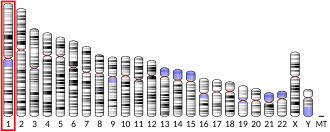





Extracellular matrix protein 1 is a protein that in humans is encoded by the ECM1 gene.567
This gene encodes an extracellular protein containing motifs with a cysteine pattern characteristic of the cysteine pattern of the ligand-binding "double-loop" domains of the albumin protein family. This gene maps outside the epidermal differentiation complex (EDC), a cluster of three gene families involved in epidermal differentiation. Alternatively spliced transcript variants encoding distinct isoforms have been described.7
Diseases
ECM1 is implicated in breast cancer, thyroid cancer, hepatocellular carcinoma, and other cancers, and also in ulcerative colitis8 Germline mutations in ECM-1 cause the genetic disease lipoid proteinosis. Autoimmune attack on ECM-1 is responsible for lichen sclerosus. (see the Atlas of Genetics and Cytogenetics in Oncology and Haematology9).
References
References
- GRCh38: Ensembl release 89: ENSG00000143369 – Ensembl, May 2017
- GRCm38: Ensembl release 89: ENSMUSG00000028108 – Ensembl, May 2017
- "Human PubMed Reference:". National Center for Biotechnology Information, U.S. National Library of Medicine.
- "Mouse PubMed Reference:". National Center for Biotechnology Information, U.S. National Library of Medicine.
- Smits P, Ni J, Feng P, Wauters J, Van Hul W, Boutaibi ME, Dillon PJ, Merregaert J (Jan 1998). "The human extracellular matrix gene 1 (ECM1): genomic structure, cDNA cloning, expression pattern, and chromosomal localization". Genomics. 45 (3): 487–95. doi:10.1006/geno.1997.4918. PMID 9367673.
- Johnson MR, Wilkin DJ, Vos HL, Ortiz de Luna RI, Dehejia AM, Polymeropoulos MH, Francomano CA (May 1998). "Characterization of the human extracellular matrix protein 1 gene on chromosome 1q21". Matrix Biol. 16 (5): 289–92. doi:10.1016/S0945-053X(97)90017-2. PMID 9501329.
- "Entrez Gene: ECM1 extracellular matrix protein 1".
- "ECM1 (Extracellular matrix protein 1)"..
- "Atlas of Genetics and Cytogenetics in Oncology and Haematology". atlasgeneticsoncology.org.
Further reading
Further reading
- Viliavin GD, Panchenko KP, Nishanov F, Budaev KD (1978). "[Acid-producing function of the stomach in pyloric ulcers]". Sovetskaia Meditsina (12): 43–5. PMID 601588.
- Smits P, Poumay Y, Karperien M, et al. (2000). "Differentiation-dependent alternative splicing and expression of the extracellular matrix protein 1 gene in human keratinocytes". J. Invest. Dermatol. 114 (4): 718–24. doi:10.1046/j.1523-1747.2000.00916.x. PMID 10733679.
- Hamada T, McLean WH, Ramsay M, et al. (2002). "Lipoid proteinosis maps to 1q21 and is caused by mutations in the extracellular matrix protein 1 gene (ECM1)". Hum. Mol. Genet. 11 (7): 833–40. doi:10.1093/hmg/11.7.833. PMID 11929856.
- Strausberg RL, Feingold EA, Grouse LH, et al. (2003). "Generation and initial analysis of more than 15,000 full-length human and mouse cDNA sequences". Proc. Natl. Acad. Sci. U.S.A. 99 (26): 16899–903. Bibcode:2002PNAS...9916899M. doi:10.1073/pnas.242603899. PMC 139241. PMID 12477932.
- Hamada T, Wessagowit V, South AP, et al. (2003). "Extracellular matrix protein 1 gene (ECM1) mutations in lipoid proteinosis and genotype-phenotype correlation". J. Invest. Dermatol. 120 (3): 345–50. doi:10.1046/j.1523-1747.2003.12073.x. PMID 12603844.
- Matsuda A, Suzuki Y, Honda G, et al. (2003). "Large-scale identification and characterization of human genes that activate NF-kappaB and MAPK signaling pathways". Oncogene. 22 (21): 3307–18. doi:10.1038/sj.onc.1206406. PMID 12761501.
- Wang L, Yu J, Ni J, et al. (2003). "Extracellular matrix protein 1 (ECM1) is over-expressed in malignant epithelial tumors". Cancer Lett. 200 (1): 57–67. doi:10.1016/S0304-3835(03)00350-1. PMID 14550953.
- Ota T, Suzuki Y, Nishikawa T, et al. (2004). "Complete sequencing and characterization of 21,243 full-length human cDNAs". Nat. Genet. 36 (1): 40–5. doi:10.1038/ng1285. PMID 14702039.
- Horev L, Potikha T, Ayalon S, et al. (2006). "A novel splice-site mutation in ECM-1 gene in a consanguineous family with lipoid proteinosis". Exp. Dermatol. 14 (12): 891–7. doi:10.1111/j.1600-0625.2005.00374.x. PMID 16274456. S2CID 25598548.
- Liu T, Qian WJ, Gritsenko MA, et al. (2006). "Human plasma N-glycoproteome analysis by immunoaffinity subtraction, hydrazide chemistry, and mass spectrometry". J. Proteome Res. 4 (6): 2070–80. doi:10.1021/pr0502065. PMC 1850943. PMID 16335952.
- Fujimoto N, Terlizzi J, Aho S, et al. (2006). "Extracellular matrix protein 1 inhibits the activity of matrix metalloproteinase 9 through high-affinity protein/protein interactions". Exp. Dermatol. 15 (4): 300–7. doi:10.1111/j.0906-6705.2006.00409.x. PMID 16512877. S2CID 40715604.
- Lim J, Hao T, Shaw C, et al. (2006). "A protein-protein interaction network for human inherited ataxias and disorders of Purkinje cell degeneration". Cell. 125 (4): 801–14. doi:10.1016/j.cell.2006.03.032. PMID 16713569. S2CID 13709685.
- Han B, Zhang X, Liu Q, et al. (2007). "Homozygous missense mutation in the ECM1 gene in Chinese siblings with lipoid proteinosis". Acta Derm. Venereol. 87 (5): 387–9. doi:10.2340/00015555-0292. PMID 17721643.