| Early Assamese | |
|---|---|
| Region | Assam |
| Era | 14th-16th centuries |
Indo-European
| |
Early form | |
| Dialects | |
| Eastern Nagari | |
| Language codes | |
| ISO 639-3 | – |
| Glottolog | None |
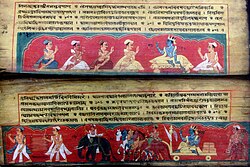
Early Assamese or Proto-Eastern Kamarupa1 is an ancestor of the modern Assamese language. It is found in the literature from the 14th century to the end of 16th century23 in Kamata kingdom and rest the Brahmaputra Valley of Assam.
Literature
Early Assamese literature period can be split into: a) The Pre-Vaishnavite period and b) The Vaishnavite sub periods.4 The Pre-Vaishnavite period covers the period before the advent of Sankardeva and the Vaishnavite period initiated by his literary activities. The earliest Assamese writer, viz. Hema Saraswati and Harivara Vipra who composed Prahlada Charitra and Babruvahana parva respectively wrote under the patronage of King Durlabhanarayana of Kamata-mandala who ruled sometime between the late 14th and early 15th century. The next two important poets of the same period are Rudra Kandali and Kaviratna Saraswati who composed Drona parva and Jayadratha vadha. But the towering poet of this period is Madhava Kandali who is respectfully referred to by Sankardeva as his predecessor. Madhava Kandali flourished towards the end of the 14th century and translated the entire Ramayana under the patronage of Mahamanikya, the then Kachari king of Varāha lineage whose territory covered parts of Central Assam.5
Writing system


Early Assamese was written in the Eastern Nagari script.
Morphology and Grammar
Pronouns
| Person67 | Singular nominative | Singular oblique | Plural nominative | Plural oblique |
|---|---|---|---|---|
| 1st | mai, maĩ, āmi | mo-, moho- | āmi, āmarā | āmā-, āmhā-, āmāsā- |
| 2nd informal | tai, taĩ | to-, toho- | torā | torā- |
| 2nd familiar | tumi | tomā-, tomhā | tomarā | tomāsā- |
| 3rd inf., prox., m. | i, ito | ihā-, ā- | ārā | ārā-, esambā- |
| 3rd inf. dist. f. | ei | ei- | ārā | ārā-, esambā- |
| 3rd hon., prox. | ehe, eho | ehante, ehanto | esambā- | |
| 3rd inf., dist., m. | si, sito | tā-, tāhā- | tārā | tārā-, tāsambā- |
| 3rd inf. dist. f. | tāi | tāi- | ||
| 3rd hon. dist. | tehõ, tehẽ, tehã | tehante, tehento, tesambe | tāsambā- |
Notes
Notes
- Toulmin 2006
- (Kakati 1941:48)
- "The history of Assamese language, as preserved in literature, may be conveniently divided into three periods:- (1) Early Assamese: from the fourteenth to the end of the sixteenth century." (Kakati 1953:5)
- Kakati 1941
- (Kakati 1953:5)
- (Bez 2012)
- Kakati 1941
References
References
- Bez, Gitanjali (2012). Grammatical Categories in Madhav Kandali's Ramayana (Ph.D.). Gauhati University. hdl:10603/116370.
- Kakati, Banikanta (1941), Assamese: Its Formation and Development, Gauhati, Assam: Government of Assam
- Kakati, Banikanta (1953), "The Assamese Language", in Kakati, Banikanta (ed.), Aspects of Early Assamese Literature, Gauhati: Gauhati University, pp. 1–16
- Toulmin, Mathew W S (2006). Reconstructing linguistic history in a dialect continuum: The Kamta, Rajbanshi, and Northern Deshi Bangla subgroup of Indo-Aryan (Ph.D.). The Australian National University.