Eğil | |
|---|---|
District and municipality | |
 | |
 Map showing Eğil District in Diyarbakır Province | |
Eğil Location in Turkey | |
| Coordinates: 38°15′26″N 40°05′05″E / 38.25722°N 40.08472°E / 38.25722; 40.08472 | |
| Country | Turkey |
| Province | Diyarbakır |
Area | 449 km2 (173 sq mi) |
| Population (2022)1 | 21,434 |
| • Density | 47.7/km2 (124/sq mi) |
| Time zone | UTC+3 (TRT) |
| Postal code | 21470 |
| Area code | 0412 |
| Website | www |
Eğil (Hittite: 𒅔𒃲𒀀𒉿, romanized: Ingalawa; Ottoman Turkish: اکيل;2 Kurdish: Gêl)3 is a municipality and district of Diyarbakır Province, Turkey.4 Its area is 449 km2,5 and its population is 21,434 (2022).1 It is populated by Kurds.3
The elected mayor Mustafa Akkul of the Peoples' Democratic Party (HDP) was dismissed on the 23 March 2020 and replaced by a trustee.6 The current Kaymakam is Volkan Hür.
Eğil is an ancient city 50 km away from Diyarbakır with many ancient forts and caves dating to the time of the Armenian kingdom of Sophene. It is identified with Carcathiocerta, the capital of the Kingdom of Sophene, and the ancient Armenian religious center of Angegh-tun (Angełtun).7
In 2018 parts of a village re-emerged in Eğil in the Çakırören neighbourhood, after the Dicle Dam suffered water level decrease due to a burst of one of the gates.8 It is also the location of a supposed tomb of Elisha, which is located in the Kale neighborhood of Eğil.9
History
Most scholars identify Eğil with the ancient city of Carcathiocerta (Armenian: Կարկաթիոկերտ, Karkatiokert or Արկաթիակերտ, Arkatiakert; Ancient Greek: Καρκαθιόκερτα, Karkathiokerta).10 It was the first capital of Sophene until Arsames I founded the new capital Arshamshat around 230 BCE. Its original site is located on a rocky plateau just east of Eğil (38°15′17″N 40°05′34″E / 38.2547624°N 40.092802°E / 38.2547624; 40.092802).1112 The Seleucid king Antiochus IV Epiphanes renamed the city into Epiphania. Strabo in his Geography, calls it "The royal city of Sophene".13 It was assigned to the late Roman province of Mesopotamia.12 It also bore the names Artagigarta, Baras, Basileon Phrourion, and Ingila.11 Under the name Ingila, it became a bishopric; no longer the seat of a residential bishop, it remains a titular see of the Roman Catholic Church.14
The city was known as Ingalawa by the Hittites.15
The city, with its strategic location overlooking the west bank of the Tigris, is the oldest in the region, with remains dating back to the Assyrian and Hellenistic periods. Later on, the city was known in Armenian as Angł, capital of the district of Angełtun, which was known as Ingilene in Greco-Roman sources. It was part of the larger province of Sophene. Armenian sources described Angł as housing "the tombs of the former kings of Armenia", apparently taking the rulers of Sophene as a branch of the Armenian kings' dynasty. The rock-cut tombs still exist today at Eğil.10
Composition
There are 30 neighbourhoods in Eğil District:16
Notable people
- Muammer Yıldırım, footballer
- Zelal Baturay, Footballer
Gallery
-
 Eğil Dam Reservoir
 -
 Eğil Dam Reservoir
 -
 Eğil King Tombs
 -
 Eğil King Tombs
 -
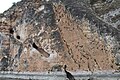 Eğil King Tombs
 -
 Eğil
Eğil
References
References
- "Address-based population registration system (ADNKS) results dated 31 December 2022, Favorite Reports" (XLS). TÜİK. Retrieved 12 July 2023.
- Tahir Sezen, Osmanlı Yer Adları (Alfabetik Sırayla), T.C. Başbakanlık Devlet Arşivleri Genel Müdürlüğü, Yayın Nu 21, Ankara, p. 163.
- Malmîsanij, Mehemed (1988). Pîro; Baran; Şêxbizinî (eds.). "Bazı yörelerde Dımıli ve Kurmanci lehçelerinin köylere göre dağılımı". Berhem (in Turkish). 2: 17. ISSN 1100-0910.
- Büyükşehir İlçe Belediyesi, Turkey Civil Administration Departments Inventory. Retrieved 12 July 2023.
- "İl ve İlçe Yüz ölçümleri". General Directorate of Mapping. Retrieved 12 July 2023.
- "HDP's Eğil Co-Mayor Arrested".
- Marciak, Michał (2017). Sophene, Gordyene, and Adiabene: Three Regna Minora of Northern Mesopotamia Between East and West. Brill. pp. 43–44. ISBN 9789004350724.
- AA, Daily Sabah with (2018-12-20). "Drop in dam water reveals submerged village, Elisha's tomb in SE Turkey's Diyarbakır". Daily Sabah. Retrieved 2020-03-25.
- "Ancient Underwater Village Has Been Revealed in Turkey (photos)". armedia.am. Retrieved 2020-03-25.
- Marciak, Michał (2014). "The Historical Geography of Sophene". Acta Antiqua. 52 (4): 295–338. doi:10.1556/aant.52.2012.4.1.
- Talbert, Richard, ed. (2000). Barrington Atlas of the Greek and Roman World. Princeton University Press. p. 89. ISBN 978-0-691-03169-9, with accompanying Map-by-Map Directory.
- Lund University. Digital Atlas of the Roman Empire.
- Strabo. Geographica. Vol. 11.14.2. Page numbers refer to those of Isaac Casaubon's edition.
- Catholic Hierarchy
- Russell, James (1997). "The Formation of the Armenian Nation". In Hovannisian, Richard G. (ed.). The Armenian People from Ancient to Modern Times: Volume I: The Dynastic Periods: From Antiquity to the Fourteenth Century. Palgrave Macmillan. p. 31.
- Mahalle, Turkey Civil Administration Departments Inventory. Retrieved 12 July 2023.