 | |
 | |
| Names | |
|---|---|
| Preferred IUPAC name
Potassium propanoate | |
| Other names
Potassium propionate; E283
| |
| Identifiers | |
| |
3D model (JSmol)
|
|
| ChemSpider |
|
| ECHA InfoCard | 100.005.749 |
| EC Number |
|
| E number | E283 (preservatives) |
PubChem CID
|
|
| UNII | |
CompTox Dashboard (EPA)
|
|
| |
| |
| Properties | |
| C3H5KO2 | |
| Molar mass | 112.1689 g/mol |
| Appearance | Colorless crystalline platelets1 |
| Melting point | 358 to 366 °C; 676 to 691 °F; 631 to 639 K2 |
| soluble1 | |
| Solubility in ethanol | soluble1 |
| Thermochemistry | |
Enthalpy of fusion (ΔfH⦵fus)
|
179 kJ/kg2 |
| Hazards | |
| GHS labelling:3 | |

| |
| Warning | |
| H302, H317, H319 | |
| P261, P264, P264+P265, P270, P272, P280, P301+P317, P302+P352, P305+P351+P338, P321, P330, P333+P317, P337+P317, P362+P364, P501 | |
Except where otherwise noted, data are given for materials in their standard state (at 25 °C [77 °F], 100 kPa).
| |


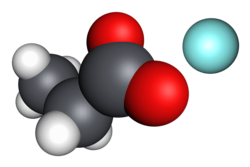
Potassium propanoate or potassium propionate is a chemical compound with the chemical formula K(C2H5COO). It is the potassium salt of propanoic acid.
Preparation
Potassium propanoate can be prepared by treating potassium carbonate with propanoic acid.2
Use
It is used as a food preservative and is represented by the food labeling E number E283 in Europe4 and by the INS number 283 in Australia and New Zealand.5
Reactions
Decomposition takes place via ketonization, yielding the symmetric ketone (3-pentanone) and potassium carbonate:2
- 2K(O2CEt) → K2CO3 + Et(CO)Et
References
References
- J. I. G. Cadogan, J. Buckingham, F. MacDonald: Dictionary of Organic Compounds: First Supplement. CRC Press, 1996, ISBN 978-0-412-54110-0
- Bui, Ly Huong; de Klerk, Arno (2014-02-13). "Thermal Behavior of Potassium C1–C12 n-Alkanoates and Its Relevance to Fischer–Tropsch". Journal of Chemical & Engineering Data. 59 (2): 400–411. doi:10.1021/je400874d. ISSN 0021-9568.
- PubChem. "Potassium propionate". pubchem.ncbi.nlm.nih.gov. Retrieved 2026-02-01.
- UK Food Standards Agency: "Current EU approved additives and their E Numbers". Retrieved 2011-10-27.
- Australia New Zealand Food Standards Code"Standard 1.2.4 - Labelling of ingredients". 8 September 2011. Retrieved 2011-10-27.