| Duesenberg Model A | |
|---|---|
 1923 Duesenberg Model A with touring car body by Leon Rubay | |
| Overview | |
| Manufacturer | Duesenberg |
| Also called | Duesenberg Straight Eight1 |
| Production | 1921–192623 |
| Assembly | Indianapolis, Indiana, United States |
| Designer | Fred and August Duesenberg |
| Body and chassis | |
| Class | Luxury car |
| Body style | by arrangement with coachbuilder |
| Layout | FR |
| Related | Duesenberg Model X |
| Powertrain | |
| Engine | 4.3 L (260 cu in) OHC straight-eight engine45 |
| Transmission | 3 speed manual1 |
| Dimensions | |
| Wheelbase | standard: 3,403.6 mm (134 in) long: 3,581.4 mm (141 in)4 |
| Chronology | |
| Successor | Duesenberg Model X4 |
| Duesenberg Straight 85 | |
|---|---|
| Overview | |
| Manufacturer | Duesenberg |
| Production | 1921–19262 |
| Layout | |
| Configuration | straight-eight engine |
| Displacement | 4.3 L (260 cu in)4 |
| Cylinder bore | 73.0 mm (2.875 in)6 |
| Piston stroke | 127.0 mm (5.0 in)6 |
| Cylinder block material | cast iron, 3 bearings6 |
| Cylinder head material | cast iron, detachable6 |
| Valvetrain | Shaft-driven SOHC, 2 valves/cyl. |
| Compression ratio | 5:1 |
| Combustion | |
| Fuel system | Single updraft Schebler 1+1⁄2 in carburetor |
| Management | Delco coil and points, distributor mounted at end of starter/generator unit |
| Fuel type | Gasoline |
| Oil system | Wet sump, full pressure lubrication |
| Cooling system | water cooled |
| Output | |
| Power output | 88 bhp (66 kW) @ 3600 rpm |
| Torque output | 170 lb⋅ft (230 N⋅m) at 1500 rpm6 |
| Chronology | |
| Successor | Duesenberg Model X4 |
The Duesenberg Model A was the first automobile in series production to have hydraulic brakes and the first automobile in series production in the United States with a straight-eight engine. Officially known as the Duesenberg Straight Eight, the Model A was first shown in late 1920 in New York City. Production was delayed by substantial changes to the design of the car, including a change in the engine valvetrain from horizontal overhead valves to an overhead camshaft; also during this time, the company had moved its headquarters and factory from New Jersey to Indiana. The Model A was manufactured in Indianapolis, Indiana, from 1921 to 1925 by the Duesenberg Automobiles and Motors Company and from 1925 to 1926 at the same factory by the restructured Duesenberg Motor Company. The successors to the company began referring to the car as the Model A when the Model J was introduced.
Background
Fred and August Duesenberg built aircraft and marine engines during World War I and used this expertise to design and build racing engines and to design a car.7 The Duesenberg Automobiles and Motors Company was incorporated in Delaware and founded to manufacture and market the production car while Duesenberg Brothers, a separate organization, built racing cars and engines.8
Introduction and delay
The Duesenberg Straight Eight was introduced in late 1920 at the Commodore Hotel in New York City,910 but production of the Straight Eight did not begin until late 1921. The main reason for the delay was Fred Duesenberg's decision to redesign several aspects of the car, including the valvetrain.11 The headquarters and manufacturing facilities of the Duesenberg Automobiles and Motors Company were relocated from Newark, New Jersey, to Indianapolis, Indiana during this time. The move was completed in May 1921, but the redesign was not.12
Design and engineering
Drivetrain
The Straight Eight was the first car in series production in the United States with a straight-eight engine.19 The engine had a cast iron block, a detachable cast iron cylinder head, and an aluminum lower crankcase and oil pan.56 The crankshaft ran in three main bearings.56 While the prototype Straight Eight shown at the model's introduction had horizontal valves of the type used in earlier Duesenberg-designed marine and racing engines,113 the model that entered production had a shaft-driven5 single overhead camshaft156 which used rockers to operate two valves per cylinder6 in a hemispheric combustion chamber.46
The engine used a single updraft carburetor;56 early versions used a Stromberg unit, which was replaced by a Schebler unit.6 The carburetor was on the right side of the engine, the mixture went into a passage through the engine block to the intake manifold on the left side of the engine. Ignition was by Delco coil and breaker points, with the distributor at the end of the generator/starter unit.5
With a 2.875 in (73.0 mm) bore and a 5 in (127.0 mm) stroke,6 the engine had a displacement of 260 cu in (4.3 L).456 The standard compression ratio of five to one yielded 88 hp (66 kW) at 3600 rpm5 and 170 lb⋅ft (230 N⋅m) of torque at 1500 rpm.6 This gave the Model A a top speed of 71 miles per hour or 114 kilometres per hour.
A single dry-plate clutch and an unsynchronized three-speed gearbox were bolted to the engine. The gearbox was operated directly with a central shift lever. The drive shaft was enclosed in a torque tube and drove the live rear axle through a spiral bevel drive.6
Chassis
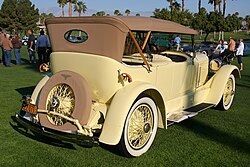
The chassis was based on a pressed steel ladder frame with channel-section side members and fabricated and tubular cross members. Suspension was by semi-elliptic leaf springs and Watson Stabilator dampers front and rear, with a tubular beam axle at the front and a live axle and radius rods at the rear.6 The standard wheelbase was 134 inches (3,400 mm),456 with a wheelbase of 141 inches (3,600 mm) available for seven-passenger bodies.4 The front and rear tracks were both 56 inches (1,400 mm) wide.6 Center-locking wire wheels with 5" x 33" tires were used front and rear.6
The Duesenberg Straight Eight was the first production automobile to use Lockheed Corporation Hydraulic brakes on all four wheels.11415 The brakes on the front wheels were 16 inches (410 mm) in diameter and were finned to dissipate heat. The fluid used in the system was a mixture of glycerine and water.1
Reception
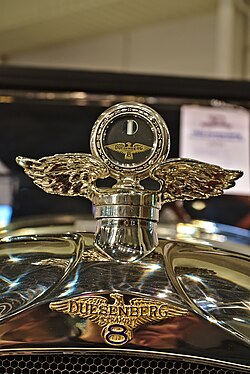
The initial production target was 100 cars per month. By the end of 1922, after slightly more than a year of production, fewer than 150 Duesenberg Straight Eights had been built.1617 Production of the Straight Eight continued through several changes in management,1718 placement of the Duesenberg Automobiles and Motors Company into receivership in January 1924,21719 and the restructuring of the company into the Duesenberg Motor Company in February 1925,21720 until the purchase of the company by E. L. Cord in October 1926.21421 About 650 Straight Eights had been built when Cord ended production in 1926.222
Legacy
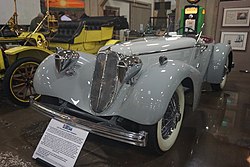
The Duesenberg Model X, a derivative of the Straight Eight, had a short production run in 1927. About twelve were built.222 The Model X had an engine with the same bore and stroke as the Straight Eight23 but with a non-crossflow head. The engine delivered 100 horsepower (75 kW). The chassis had a wheelbase of 135 inches (3,400 mm).2
Despite its regional and worldwide automotive firsts, the Straight Eight has been obscured by the later Model J.24 It is no longer widely known by the Straight Eight name under which it was marketed and sold, having been renamed the "Model A" after the introduction of the Model J.232526
Notes
Notes
- Posthumus 1977, p. 76.
- Mueller 2006, p. 52.
- Robson 2001, p. 181.
- Kimes 1990, p. 231.
- Mueller 2006, p. 51.
- Robson 2001, p. 180.
- Adler 2004, pp. 56–57, 59–60.
- Adler 2004, pp. 60, 62.
- Kimes 1990, p. 230.
- Adler 2004, p. 62.
- Adler 2004, pp. 62, 64.
- Adler 2004, p. 65.
- Adler 2004, p. 64.
- Borgeson 2005, p. 40.
- Sedgwick 1972, p. 65.
- Adler 2004, p. 67.
- Borgeson 2005, p. 42.
- Adler 2004, pp. 66–68.
- Adler 2004, p. 71.
- Adler 2004, pp. 72, 74.
- Adler 2004, p. 77.
- Adler 2004, p. 78.
- Borgeson 2005, p. 182.
- Vance 2005.
- Adler 2004, p. 53.
- Adler 2004, p. 54.
References
References
- Adler, Dennis (2004). "Chapter Four: The Power of the Hour". Duesenberg. Krause Publications. pp. 53–82. ISBN 0-87349-388-5. LCCN 2004101588. Retrieved 2014-01-11.
- Borgeson, Griffith (2005) [1984]. "Chapter Four Duesenberg — The J Is Born". Errett Lobban Cord: His Empire, His Motor Cars: Auburn, Cord, Duesenberg. New Albany, Indiana: Automobile Heritage Publishing. pp. 40–47. ISBN 0-9711468-7-X. LCCN 2003114944. Retrieved 2014-01-11.
- Kimes, Beverly Rae, ed. (1990). "Duesenberg". The Classic Car. Des Plaines, IL USA: Classic Car Club of America. pp. 229–269. ISBN 0-9627868-0-2. LCCN 90084421.
- Mueller, Mike (2006). "Chapter 6 - Chariot of the Gods Duesenberg Straight Eight". American Horsepower 100 Years of Great Car Engines. St. Paul, MN USA: Motorbooks. pp. 49–54. ISBN 978-0-7603-2327-4. LCCN 2006017040. Retrieved 2014-01-11.
- Posthumus, Cyril (1977) [1977]. "Slump and Recovery". The story of Veteran & Vintage Cars. John Wood, illustrator (Phoebus 1977 ed.). London: Hamlyn / Phoebus. pp. 74–85. ISBN 0-600-39155-8.
- Robson, Graham (2001). "Duesenberg Model A". The Illustrated Directory of Classic Cars. St. Paul, MN USA: MBI Publishing. pp. 180–181. ISBN 0-7603-1049-1. Retrieved 2014-01-11.
- Sedgwick, Michael (1972) [1962]. Early Cars. Octopus Books. ISBN 0-7064-0058-5.
- Vance, Bill (15 April 2005). "Motoring Memories: Duesenberg Model A". Autos.ca. Trader. Archived from the original on 20 January 2014. Retrieved 19 January 2014.