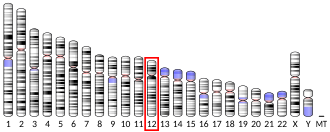
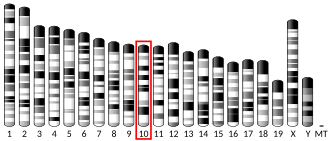
Probable E3 ubiquitin-protein ligase DTX3 is a protein that in humans is encoded by the DTX3 gene.5 It is expressed in three isoform variants differing on the N-terminal end: DTX3a, DTX3b, and DTX3c.6 DTX3a and DTX3b have distinct sets of 7 or 10 N-terminal amino acids, while DTX3c has both consecutively with one amino acid substitution.6
Function
DTX3 functions as an E3 ubiquitin ligase.7 Most but not all studies have found it to have a tumor-suppressing effect on human cancer: exceptions may be due to the failure to distinguish between different isoforms.6
References
References
- GRCh38: Ensembl release 89: ENSG00000178498 – Ensembl, May 2017
- GRCm38: Ensembl release 89: ENSMUSG00000040415 – Ensembl, May 2017
- "Human PubMed Reference:". National Center for Biotechnology Information, U.S. National Library of Medicine.
- "Mouse PubMed Reference:". National Center for Biotechnology Information, U.S. National Library of Medicine.
-
"Entrez Gene: Deltex E3 ubiquitin ligase 3". Retrieved 2016-09-26.
- Scalia, Pierluigi; Williams, Stephen J.; Suma, Antonio; Carnevale, Vincenzo (2023-06-21). "The DTX Protein Family: An Emerging Set of E3 Ubiquitin Ligases in Cancer". Cells. 12 (13): 1680. doi:10.3390/cells12131680. ISSN 2073-4409. PMC 10340142. PMID 37443713.
- Takeyama, Kunihiko; Aguiar, Ricardo C. T.; Gu, Liqun; He, Chunyan; Freeman, Gordon J.; Kutok, Jeffery L.; Aster, Jon C.; Shipp, Margaret A. (2003-06-13). "The BAL-binding protein BBAP and related Deltex family members exhibit ubiquitin-protein isopeptide ligase activity". The Journal of Biological Chemistry. 278 (24): 21930–21937. doi:10.1074/jbc.M301157200. ISSN 0021-9258. PMID 12670957.
Further reading
Further reading
This article incorporates text from the United States National Library of Medicine, which is in the public domain.