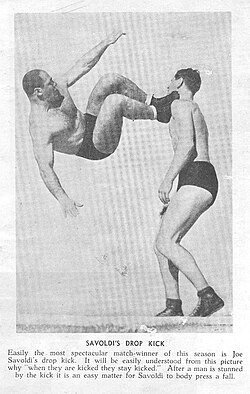

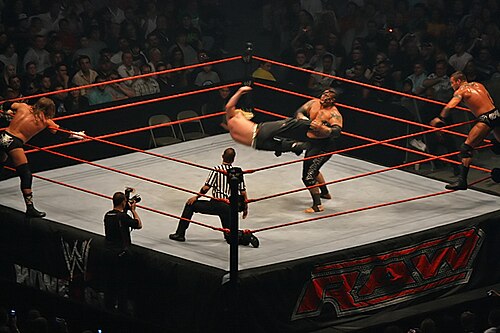
A dropkick is an attacking maneuver in professional wrestling. It is defined as an attack where the wrestler jumps up and kicks the opponent with the soles of both feet; this sees the wrestler twist as they jump so that when the feet connect with the opponent one foot is raised higher than the other (depending on which way they twist) and the wrestler falls back to the mat on their side, or front.1 This is commonly employed by light and nimble wrestlers who can take advantage of their agility, and is often executed on a charging opponent, while charging at an opponent, or a combination of the two.
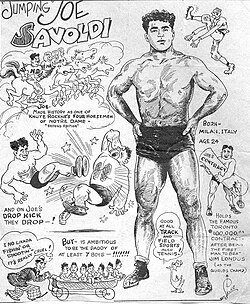
The most basic form of a dropkick, but potentially the hardest to pull off, is a standing dropkick first used by "Jumping Joe" Savoldi where the wrestler catches a standing or running opponent with a standard dropkick from a standing position. In order to be pulled off effectively, it requires great leg strength in order to gain elevation. Savoldi, a former All-American running back for Knute Rockne at Notre Dame, used his association with football to identify the move as the "drop-kick"2 and the press also called it a "flying dropkick".3
The dropkick in its current form was thought to perhaps4 originated by "Jumping Joe" Savoldi, although wrestler Abe Coleman, known as "Hebrew Hercules" and "Jewish Cougars", can also be seen in early video using a feet-first dive at an opponent's waist. Coleman, listed at 5'2" in height, called the move a "Kangaroo Kick"5 and claimed the move was inspired by kangaroos he saw on a tour of Australia in 1930.6 When Savoldi performed the "drop" kick in 1933, the press simply said it was another name for Coleman's existing "kangaroo" kick specialty.3
Variations
There are many variations, including the following.
Dropsault
Also known as a backflip dropkick, or a moonsault dropkick, this move is an attack where the wrestler jumps up and kicks the opponent with both feet and then executes a backflip, landing on the mat chest-first. This move was popularized by Paul London during his tenure in the WWE and is also used by Matt Sydal and Adam Page. Randy Orton sparingly used this move early in his career; notably once while in OVW7 and one time later in a WWE dark match, both in 20018.
This move can also be used to attack both a standing opponent as well as an already supine opponent. The attacker begins with an opponent standing in front of them and a supine horizontal opponent just behind them. The attacker performs the dropsault to strike Opponent A. The contact is brief and controlled so the attacker’s rotation continues. Using of momentum and rebound from the on impact from knocking Opponent A back or down, the attacker’s body naturally continues rotating and moving back and downward, redirecting the rotation and trajectory so they land chest or torso lands across Opponent B. Paul London and Adam Page have used this technique.
Because the move in general combines a full backward rotation with a striking extension, the dropsault carries significant risk of mis‑timing, under‑rotation, or severe head/neck impact, for the attacker upon failing. Both the attacker must make sure they are agile enough to leap high into the air, while striking the opponent, to push themselves up and away while the opponent must provide a strong standing base to rebound the attack off of them, also pushing up and back to allow the attacker to land safely.
Front dropkick
Popularized by Jumping Joe Savoldi and Abe Coleman, the front dropkick involves the wrestler jumping kicking forward so that they hit the opponent with the soles of both feet. This enables the wrestler to fall backwards to the mat, landing on their upper back and shoulder area. This is often used to attack lower parts of the opponent than the modern dropkick.
Another variation, known as a shotgun dropkick, sees the wrestler charge from one corner to an opponent standing in the middle of the ring and dropkicking them with such force that it catapults the opponent into the corner. This was popularized in Japan by Takahiro Suwa and Yasushi Kanda before Finn Bálor made it famous in America.9
Missile dropkick
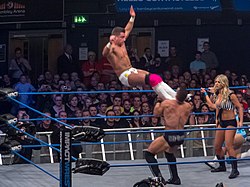
A missile dropkick involves the wrestler jumping off the second or top turnbuckle and performing the dropkick on a standing opponent.
Running single leg dropkick
In this dropkick an attacking wrestler runs towards an opponent and jumps up sideways striking an opponent's head or chin with the sole of their highest foot, with similar execution as a big boot. A front dropkick variation, in which the attacking wrestler does not twist like in a normal dropkick, is also possible. Drew McIntyre uses this as a finisher and calls it the Claymore. Swerve Strickland also uses this as his finisher called the House Call.
Standing dropkick
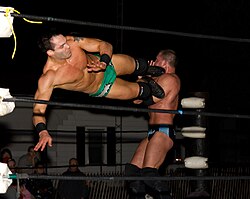
In this variation, the wrestler executes a traditional dropkick, but twists their body while performing it in a standing position. There is also a slight variation where the attacker holds on to their opponent by the head with one hand while dropkicking them. This variation was innovated by David Von Erich and popularized by Curt Hennig.
See also
See also
Footnotes
Footnotes
- "Professional Wrestling Moves: Part 1". Death Valley Driver.com. Archived from the original on 2013-05-06. Retrieved 2007-11-29.
- "JOE SAVOLDI WINS MAT BOUT IN PHILADELPHIA". Times Leader. 18 May 1933. p. 17. Archived from the original on 12 February 2019. Retrieved 6 June 2018.
At no time did Savoldi attempt to employ the new attack that he calls "drop-kick." Once he offended the rules by using a flying tackle, but for the most part Joe relied upon orthodox holds.
- "10,000 FANS SEE LEWIS WIN FIFTH WRESTLING TITLE". St. Louis Star-Times. 16 May 1933. p. 14.
Joe was unable to return to the ring after missing a flying dropkick. "Flying Dropkick." The 202-pound Savoldi appeared superior to his elderly 240-pound opponent during most of the match, but lay helpless on the floor after hurtling from the ring when he jumped into the air and tried to kick Lewis in the chest with a "flying dropkick." This is another name for the "kangaroo kick," the quaint specialty of Abe Coleman. Some 10,000 fans saw the former Notre Dame All-American fullback repeatedly bowl over the former champion and twice he used his "flying dropkick" before Lewis sidestepped and permitted the ex-collegian to hurtle through the ropes to the floor outside the ring.
- "WHAT'S HAPPENED TO OLD-TIME FAVOURITES?". 10 June 1949. Archived from the original on 16 June 2011.
Joe Savoldi, perhaps the originator of the dropkick
- "Clipped from the St. Louis Star and Times". The St. Louis Star and Times. 16 May 1933. p. 14.
- Martin, Douglas (April 2, 2007). "Abe Coleman, 101, Wrestler Known as Hebrew Hercules". The New York Times. Archived from the original on 16 June 2008. Retrieved April 23, 2010.
his pièce de résistance was the drop kick, a still-common tactic in which a wrestler turns himself into a human missile. Coleman said he learned it from kangaroos on a 1930 trip to Australia.
- Penca Wrestling (October 10, 2010). "Backflip Kick / Dropsault - Randy Orton". Youtube. Retrieved May 13, 2026.
- Iron-On Wrestling (April 30, 2024). "Randy Orton Dropsault - WWF Dark Match 2001". Youtube. Retrieved May 13, 2026.
- Goldstein, Richard (November 6, 2007). "Mary Lillian Ellison, 84, the Fabulous Moolah, Is Dead". New York Times. Archived from the original on 2008-12-11. Retrieved 2009-03-25.
References
References
- The Professional Wrestlers' Workout & Instructional Guide - Harley Race, Ricky Steamboat, Les Thatcher, and Alex Marvez pg. 66