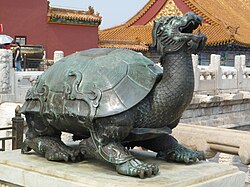
A dragon turtle (Chinese : 龍龜, pinyin : Lóngguī) is a legendary Chinese creature that combines two of the four celestial animals of Chinese mythology: the shell of a turtle with a dragon's body is promoted as a positive ornament in Feng Shui,12 symbolizing courage, determination, fertility, longevity, power, success, and support. Decorative carvings or statuettes of the creature are traditionally placed facing the window.3
Mapmakers sometimes drew dragon turtles along with other fantastical creatures in unexplored areas.
Ancient mythology
When Fuxi wanted to create more divine patterns, He discovered a "square diagram" on the back of a dragon turtle.4
In popular culture
Tabletop games
- Dragon turtles have been present in the tabletop roleplaying game Dungeons & Dragons from its inception5 to its current 5th edition.6
TV
- In the animated series Avatar: The Last Airbender, a lion turtle, a gigantic creature which greatly resembles the dragon turtle, appears to grant the protagonist Aang spiritual guidance and special powers.
- A dragon turtle appears in the 1983 Dungeons & Dragons cartoon episode, "The Garden of Zinn", its poisonous bite setting up the events of the episode. These creatures have a dragon body and turtle shell, with some types having flippers.
Video games
- The character of Yachie Kicchou (吉弔 八千慧), from the 17th mainline video game of the Touhou Project series, is an anthropomorphic tortoise dragon.
See also
See also
- Bixi - one of the 9 sons of the Dragon King
- Chinese mythology in popular culture
- Black Tortoise
- Fuxi - the progenitor of the human race in Chinese mythology.
References
References
- William O'Connor (2013). Dracopedia The Bestiary: An Artist's Guide to Creating Mythical Creatures. Penguin. Page [1]
- Tchi, Rodika (2 November 2019). "The Dragon Turtle in Feng Shui Practice". The Spruce. Dotdash. Retrieved 9 October 2019.
- Jerebtsov, M; Pivtorak, P. "ANIMALISTIC IMAGE OF THE TURTLE IN CHINESE CLASSICAL CULTURE" (PDF). Scientific Enquiry in the Contemporary World: Theoretical Basics and Innovative Approach. 7: 13–14 – via Google Scholar.
- Aldern, Mary (2012). Connecting the Stars: Chinese Star Stories and the Art of Storytelling through a Cultural and Personal Lens. p. 58.
- Witwer, Michael; Newman, Kyle; Peterson, Jonathan; Witwer, Sam; Manganiello, Joe (October 2018). Dungeons & Dragons Art & Arcana: A Visual History. Ten Speed Press. p. 26. ISBN 9780399580949. OCLC 1033548473.
- Grebey, James (2021-07-16). "New D&D book explains why dragons are so important that they're half the game's name". SyFy Wire. Retrieved 2026-02-25.