Balancing rocks | |
|---|---|
Topographic feature | |
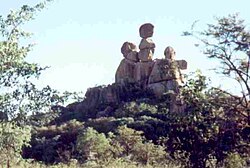 Balancing formation seen in Matobo National Park, known as the Mother and Child inselberg | |
 Interactive map of Balancing rocks | |
| Location | Zimbabwe |
Balancing rocks are found in many parts of Zimbabwe. These geomorphological features are formed of igneous rocks. Particularly noteworthy balancing rocks are located in Matobo National Park and near the township of Epworth, to the southeast of Harare.
Notable rocks
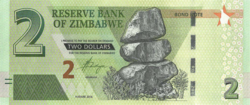
The Domboremari, also known as the Money Rock,1 is a formation of three boulders that form part of the Chiremba Balancing Rocks on the northwestern outskirts of Epworth (at coordinates 17°53′08″S 31°07′32″E / 17.8856°S 31.1256°E / -17.8856; 31.1256 (Domboremari (Money Rock))). This rock formation is notable because it appears in all Zimbabwean banknotes issued since 1981, and is also the prominent feature of the logo of the Reserve Bank of Zimbabwe.234
References
References
- Vumbunu, Tonderai; Offat Manyanhaire, Itai (2010). "Tourisits [sic] arrivals at Chiremba Balancing Rocks in Epworth, Zimbabwe". Journal of sustainable development in Africa. 12 (8). Clarion: Clarion University of Pennsylvania: 245. ISSN 1520-5509.
- Paul Murray (2010). Zimbabwe. Bradt Travel Guides. pp. 166–. ISBN 978-1-84162-295-8.
- A. J. Chennells; Flora Veit-Wild (1999). Emerging perspectives on Dambudzo Marechera. Africa World Press. pp. 153–. ISBN 978-0-86543-645-9. Retrieved 11 February 2011.
- "Matobo Hills:Brief Description". Unesco.org. Retrieved 11 February 2011.