| Dolichandra | |
|---|---|
| |
| Dolichandra unguis-cati | |
Scientific classification 
| |
| Kingdom: | Plantae |
| Clade: | Embryophytes |
| Clade: | Tracheophytes |
| Clade: | Spermatophytes |
| Clade: | Angiosperms |
| Clade: | Eudicots |
| Clade: | Asterids |
| Order: | Lamiales |
| Family: | Bignoniaceae |
| Tribe: | Bignonieae |
| Genus: | Dolichandra Cham.1 |
| Species | |
|
See text | |
| Synonyms2 | |
|
List
| |
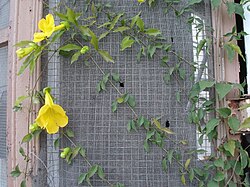
Dolichandra is a genus of flowering plants in the family Bignoniaceae, native to Latin America and the Caribbean.2 They are climbing lianas with trifid and uncate tendrils.3 The best-known species is Dolichandra unguis-cati.
Species
Currently accepted species include:2
- Dolichandra chodatii (Hassl.) L.G.Lohmann
- Dolichandra cynanchoides Cham.
- Dolichandra dentata (K.Schum.) L.G.Lohmann
- Dolichandra hispida (DC.) L.H.Fonseca & L.G.Lohmann
- Dolichandra quadrivalvis (Jacq.) L.G.Lohmann
- Dolichandra steyermarkii (Sandwith) L.G.Lohmann
- Dolichandra uncata (Andrews) L.G.Lohmann
- Dolichandra unguiculata (Vell.) L.G.Lohmann
- Dolichandra unguis-cati (L.) L.G.Lohmann
References
References
- Linnaea 7: 657 (1832)
- "Dolichandra Cham". Plants of the World Online. Board of Trustees of the Royal Botanic Gardens, Kew. 2017. Retrieved 6 September 2020.
- Fonseca, Luiz Henrique M.; Cabral, Simone Miranda; Agra, Maria DE Fatima; Lohmann, Lúcia G. (2017). "Taxonomic Revision of Dolichandra (Bignonieae, Bignoniaceae)". Phytotaxa. 301: 1. doi:10.11646/phytotaxa.301.1.1.