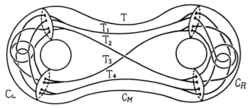
In geometric topology, the dogbone space, constructed by R. H. Bing,1 is a quotient space of three-dimensional Euclidean space such that all inverse images of points are points or tame arcs, yet it is not homeomorphic to . The name "dogbone space" refers to a fanciful resemblance between some of the diagrams of genus 2 surfaces in Bing's paper and a dog bone. Bing showed that the product of the dogbone space with is homeomorphic to .2
Although the dogbone space is not a manifold, it is a generalized homological manifold and a homotopy manifold.
See also
See also
- List of topologies
- Whitehead manifold, a contractible 3-manifold not homeomorphic to .
References
References
- Bing, R. H. (May 1957). "A Decomposition of E 3 into Points and Tame Arcs Such That the Decomposition Space is Topologically Different from E 3". The Annals of Mathematics. 65 (3): 484. doi:10.2307/1970058.
- Bing, R. H. (November 1959). "The Cartesian Product of a Certain Nonmanifold and a Line is E 4". The Annals of Mathematics. 70 (3): 399. doi:10.2307/1970322.
Sources
Sources
- Daverman, Robert J. (2007), "Decompositions of manifolds", Geom. Topol. Monogr., 9: 7–15, arXiv:0903.3055, doi:10.1090/chel/362, ISBN 978-0-8218-4372-7, MR 2341468
{{citation}}: CS1 maint: work parameter with ISBN (link)