 | |
| Developer(s) | University of Delaware |
|---|---|
| Operating system | Linux, macOS, and Windows1 |
| Platform | BOINC |
| Website | docking |
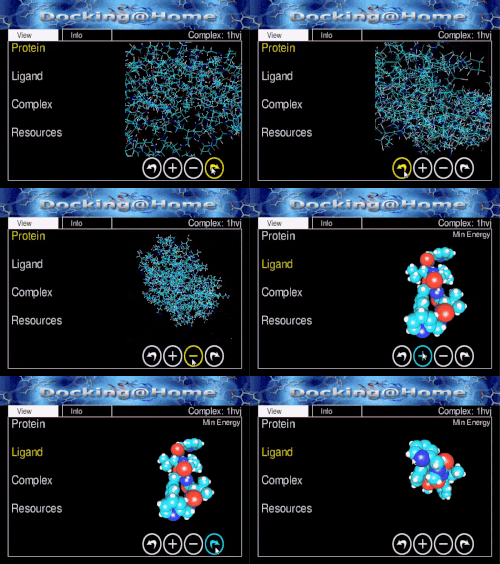
Docking@Home was a volunteer computing project hosted by the University of Delaware and running on the Berkeley Open Infrastructure for Network Computing (BOINC) software platform. It models protein-ligand docking using the CHARMM program. Volunteer computing allows an extensive search of protein-ligand docking conformations and selection of near-native ligand conformations are achieved by using ligand based hierarchical clustering.2 The ultimate aim was the development of new pharmaceutical drugs.
The project was retired on May 23, 2014.1
References
References
- "Docking@Home is Retiring". Archived from the original on 2014-10-17. Retrieved 2014-06-15.
- Estrada, Trlce; Armen, Roger; Taufer, Michela (2010-08-02). "Automatic selection of near-native protein-ligand conformations using a hierarchical clustering and volunteer computing". Proceedings of the First ACM International Conference on Bioinformatics and Computational Biology. BCB '10. New York, NY, USA: Association for Computing Machinery. pp. 204–213. doi:10.1145/1854776.1854807. ISBN 978-1-4503-0438-2. S2CID 6040735.
Further reading
Further reading
- "Computer Idle? Now You Can Donate Its Time to Find a Cure for Major Diseases". Newswise. June 16, 2009. Retrieved 2009-07-27.
