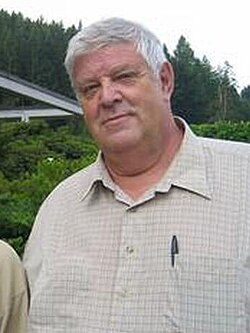
Dmitry Borisovich Fuchs (Russian: Дмитрий Борисович Фукс, romanized: Dmitry Borisovich Fuks,1 born 30 September 1939) is a Soviet and American mathematician, specializing in the representation theory of infinite-dimensional Lie groups and in topology.2 He was born in Kazan, Soviet Tatarstan.3
Education and career
Fuchs received in 1964 his Russian candidate degree (Ph.D.) under Albert S. Schwarz at Moscow State University,4 where he taught thereafter. Schwarz conducted a seminar on algebraic topology with Mikhail Postnikov and Vladimir Boltyanski. Fuchs participated in the seminar and, as a student, published papers with Schwarz, as did Askold Ivanovich Vinogradov a few years earlier. Fuchs received his Russian doctorate (higher doctoral degree) in 1987 at Tbilisi State University. Since 1991 he has been a professor at the University of California, Davis.
With Israel Gelfand he introduced in 1970 the Gelfand-Fuchs cohomology of Lie algebras.5 Gelfand-Fuchs cohomology has applications in the proof of the Macdonald identities in combinatorics and in the calculation of characteristic classes of foliations. With Boris Feigin he determined the structure of Verma modules in the Virasoro algebra representation theory, which has applications in string theory and conformal field theory.6
His students include Boris Feigin (with whom he has collaborated extensively), Fedor Malikov, Sergei Tabachnikov, and Vladimir Rokhlin, as well as Edward Frenkel for whom Fuchs was a second advisor.7 Frenkel, among many others, was affected by the Soviet antisemitism which flourished from 1954 to 1970 (described by Fuchs) and on into the 1980s.89
In 1978 Fuchs was an Invited Speaker with talk New results on the characteristic classes of foliations at the International Congress of Mathematicians in Helsinki.
Personal life
Fuchs's father was also a mathematician, and a student of Stefan Bergman.10 His daughter Elena Fuchs is also a professor in the mathematics department at UC Davis, and his daughter Ekaterina Fuchs is a professor in the mathematics department at the City College of San Francisco.111213
Selected publications
- with Anatoli T. Fomenko, Viktor L. Gutenmacher: Homotopic topology. Akadémiai Kiadó, Budapest 1986, ISBN 963-05-3544-0. Fomenko, Anatoly; Fuchs, Dmitry (2016). Homotopical topology, 2nd edition. ISBN 9783319234885.
- Cohomology of infinite-dimensional Lie algebras. Consultants Bureau, New York NY 1986, ISBN 0-306-10990-5.
- Singular vectors over the Virasoro Algebra and extended Verma Modules. In: Dmitry Fuchs (ed.): Unconventional Lie Algebras (= Advances in Soviet Mathematics. vol. 17). American Mathematical Society, Providence RI 1993, ISBN 0-8218-4121-1, pp. 65–74.
- with Serge Tabachnikov: Mathematical omnibus. Thirty lectures on classic mathematics. American Mathematical Society, Providence RI 2007, ISBN 978-0-8218-4316-1
Sources
Sources
- Alexander Astashkevich, Serge Tabachnikov (eds.): Differential topology, infinite-dimensional Lie algebras, and applications. D. B. Fuchs' 60th Anniversary Collection (= American Mathematical Society. Translations. Series 2, 194). American Mathematical Society, Providence RI 1999, ISBN 0-8218-2032-X.
References
References
- "Персоналии: Фукс Дмитрий Борисович". Math-Net.ru.
- Dmitry B. Fuchs, Mathematics, University of California, Davis
- Comprehensive Biographical Encyclopedia (in Russian)
- Dmitry Borisovich Fuchs at the Mathematics Genealogy Project
- Israel M. Gel'fand, Dmitry B. Fuks: Cohomologies of Lie algebra of tangential vector fields of a smooth manifold. In: Functional Analysis and its Applications. vol. 3, no. 3, 1969, pp. 194–210, doi:10.1007/BF01676621. Israel M. Gel'fand, Dmitry B. Fuks: Cohomology of the Lie algebra of formal vector fields. In: Mathematics of the USSR. Izvestija. vol. 4, no. 2, 1970, pp. 327–340, doi:10.1070/IM1970v004n02ABEH000908.
- with Fedor G. Malikov and Boris L. Feigin: Singular vectors in Verma modules over Kac—Moody algebras. In: Functional Analysis and its Applications. vol. 20, no. 2, 1986, pp. 103–113, doi:10.1007/BF01077264. Boris L. Feigin, Dmitry B. Fuchs: Representations of the Virasoro Algebra. In: Anatolii M. Vershik, Dmitrii P. Zhelobenko (eds.): Representation of Lie groups and related topics (= Advanced Studies in Contemporary Mathematics. vol. 7). Gordon and Breach, New York NY 1990, ISBN 2-88124-678-8, pp. 465–554.
- Fuchs also lectured at the unofficial Jewish University in Moscow at the Institute for Petrochemical and Natural Gas Industry. Saul, Mark (1999). "Kerosinka: An Episode in the History of Soviet Mathematics" (PDF). Notices of the American Mathematical Society. 46 (10): 1217–1220. ISSN 0002-9920.
- Fuchs, D. B. "On Soviet Mathematics of the 1950s and 1960s" (PDF).
- "Edward Frenkel: Reality is a Paradox - Mathematics, Physics, Truth & Love | Lex Fridman Podcast #370". Lex Fridman, YouTube. April 2023. (mention of Soviet antisemitism at 3:16:30 of 3:46:38 in video)
- Fuchs, D. B. (2007). "On Soviet Mathematics of the 1950s and 1960s". In Zdravkovska, Smilka; Duren, Peter L. (eds.). Golden Years of Moscow Mathematics. Washington D.C.: American Mathematical Soc. ISBN 978-0-8218-4261-4.
- Fialowski, Alice; Fuchs, Ekaterina; Fuchs, Elena; Khesin, Boris; Kirillov, Alexandre; Malikov, Fedor; Ovsienko, Valentin; Sossinsky, Alexei; Tabachnikov, Serge (7 April 2020). "On the 80th Birthday of Dmitry Borisovich Fuchs". Symmetry, Integrability and Geometry: Methods and Applications. arXiv:2004.03270. doi:10.3842/SIGMA.2020.023.
- "General Profile :: math.ucdavis.edu". Mathematics Home. 1 January 2016.
- "Katia Fuchs". CCSF.