| Dipus | |
|---|---|
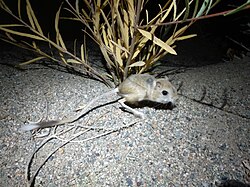
| |
| Northern three-toed jerboa (Dipus sagitta) | |
Scientific classification 
| |
| Kingdom: | Animalia |
| Phylum: | Chordata |
| Class: | Mammalia |
| Infraclass: | Placentalia |
| Order: | Rodentia |
| Family: | Dipodidae |
| Tribe: | Dipodini |
| Genus: | Dipus Zimmermann, 1780 |
| Type species | |
| Mus sagitta Pallas, 1773
| |
| Species | |
| |
Dipus, meaning "two foot" in Ancient Greek, is a genus of jerboa. Today only a single species is usually recognized, the northern three-toed jerboa (Dipus sagitta), widespread throughout Central Asia. Some authors recognize a second species, the Qaidam three-toed jerboa (Dipus deasyi) from the Qaidam Basin of western China.1 The genus has a fossil record that dates back to the Miocene, with several extinct species known from Asia.23 The oldest dated species is Dipus conditor.
References
References
- Cheng, Jilong; Ge, Deyan; Xia, Lin; Wen, Zhixin; Zhang, Qian; Lu, Liang; Yang, Qisen (2018). "Phylogeny and taxonomic reassessment of jerboa, Dipus (Rodentia, Dipodinae), in inland Asia". Zoologica Scripta. 47 (6): 630–644. doi:10.1111/zsc.12303. S2CID 92269183. Retrieved 12 January 2024.
- Zazhigin, V.; Lopatin, A.V. (2001). "The History of the Dipodoidea (Rodentia, Mammalia) in the Miocene of Asia: 4. Dipodinae at the Miocene-Pliocene Transition". Paleontological Journal. 35 (1): 60–74.
- Wu, Wen-Yu (2017). Late Cenozoic Yushe Basin, Shanxi Province, China: Geology and Fossil Mammals Volume II: Small Mammal Fossils of Yushe Basin. Springer Netherlands. p. 85. ISBN 9789402410501.