 | |
 | |
| Names | |
|---|---|
| Preferred IUPAC name
1,2-Benzenedicarboxylic acid, di-C8-10 branched alkyl esters, C9 rich | |
| Other names
1,2-Benzenedicarboxylic acid, 1,2-diisononyl ester
| |
| Identifiers | |
3D model (JSmol)
|
|
| Abbreviations | DINP |
| ChEBI | |
| ChemSpider |
|
| ECHA InfoCard | 100.044.602 |
PubChem CID
|
|
| UNII | |
CompTox Dashboard (EPA)
|
|
| |
| |
| Properties | |
| C26H42O4 | |
| Molar mass | 418.618 g·mol−1 |
| Appearance | Oily viscous liquid |
| Density | 0.98 g/cm3 |
| Melting point | −43 °C (−45 °F; 230 K) |
| Boiling point | 244 to 252 °C (471 to 486 °F; 517 to 525 K) at 0.7 kPa |
| <0.01 g/mL at 20 °C | |
| Viscosity | 64 to 265 mPa·s |
| Hazards | |
| Flash point | 221 °C (430 °F; 494 K) (c.c.) |
| 380 °C (716 °F; 653 K) | |
Except where otherwise noted, data are given for materials in their standard state (at 25 °C [77 °F], 100 kPa).
| |


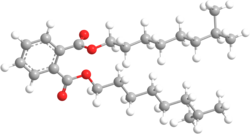
Diisononyl phthalate (DINP) is a phthalate used as a plasticizer. DINP is typically a mixture of chemical compounds consisting of various isononyl esters of phthalic acid۔
Use
It is commonly used in a large variety of plastic products including:
- Plasticizer in polyvinyl chloride (PVC)2
- Construction and building material
- Fuel and automotive products
- In electronics materials (as a flexible vinyl additive)3
- As cable insulation additive
- Adhesives and sealants
- Paints and coatings
- Rubber products.
Health issues
The European Union has set a maximum specific migration limit (SML) from food contact materials of 9 mg/kg food for the sum of diisononyl phthalates and diisodecyl phthalates.4
DINP is listed as a substance "known to the State of California to cause cancer" under Proposition 65 legislation.5
Studies find that exposure to environmentally relevant concentrations of DINP in zebrafish disrupt the endocannabinoid system (ECS) and affect reproduction in a gender specific manner,6 and have other adverse effects on aquatic organisms, as DINP upregulates orexigenic signals and causes hepatosteatosis together with deregulation of the peripheral ECS and lipid metabolism.7
The ECHA's Risk Assessment Committee (RAC) has concluded, on March 7, 2018, that Di-isononyl phthalate (DINP) does not warrant classification for reprotoxic effects under the EU's Classification, Labelling and Packaging (CLP) regulations.8
Children and childcare products are strictly regulated by regulatory organizations.3
References
References
- Diisononyl phthalate at Inchem.org
- "Risk Evaluation for Diisononyl phthalate (1,2-Benzene- dicarboxylic acid, 1,2- diisononyl ester) (DINP)". United States Environmental Protection Agency. 2020-10-29. Retrieved 2025-05-13.
- "Diisononyl Phthalate Alternatives For A Safer Environment". 2025-04-17. Retrieved 2025-05-13.
- "EU legislative list for food contact materials".
- "State of California, Chemicals known to the state to cause cancer or reproductive toxicity, January 3, 2014" (PDF). Archived from the original (PDF) on 2014-01-10.
- Forner-Piquer, Isabel; Santangeli, Stefania; Maradonna, Francesca; Rabbito, Alessandro; Piscitelli, Fabiana; Habibi, Hamid R.; Di Marzo, Vincenzo; Carnevali, Oliana (2018-10-01). "Disruption of the gonadal endocannabinoid system in zebrafish exposed to diisononyl phthalate". Environmental Pollution. 241: 1–8. doi:10.1016/j.envpol.2018.05.007. ISSN 0269-7491. PMID 29793103. S2CID 44120848.
- Forner-Piquer, Isabel; Maradonna, Francesca; Gioacchini, Giorgia; Santangeli, Stefania; Allarà, Marco; Piscitelli, Fabiana; Habibi, Hamid R; Di Marzo, Vincenzo; Carnevali, Oliana (2017-08-14). "Dose-Specific Effects of Di-Isononyl Phthalate on the Endocannabinoid System and on Liver of Female Zebrafish". Endocrinology. 158 (10): 3462–3476. doi:10.1210/en.2017-00458. ISSN 0013-7227. PMID 28938452.
- "Evaluation of new scientific evidence concerning DINP and DIDP". European Chemicals Agency. Archived from the original on 2022-09-01. Retrieved 2020-01-26.