 | |
 | |
| Names | |
|---|---|
| Preferred IUPAC name
Dinitromethane | |
| Identifiers | |
| |
3D model (JSmol)
|
|
| ChemSpider |
|
PubChem CID
|
|
CompTox Dashboard (EPA)
|
|
| |
| |
| Properties | |
| CH2N2O4 | |
| Molar mass | 106.037 g·mol−1 |
| Appearance | Colorless liquid |
| Odor | Pleasant |
| Boiling point | 39 to 40 °C (102 to 104 °F; 312 to 313 K) (at 2 mmHg)1 |
Except where otherwise noted, data are given for materials in their standard state (at 25 °C [77 °F], 100 kPa).
| |


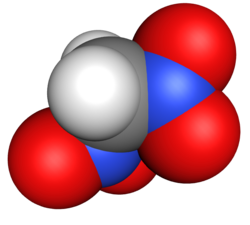
Dinitromethane is an organic compound with the chemical formula CH2(NO2)2.2 Purified dinitromethane is a colorless liquid with a weak pleasant odor. It is relatively stable at room temperature and can be safely stored for months at 0 °C.1
Synthesis
The conjugate base of dinitromethane, dinitromethanide, was first prepared in 1884 by reduction of bromodinitromethane using hydrogen sulfide as its potassium salt.3 Several years later, the neutral dinitromethane compound was prepared by reacting potassium dinitromethanide with hydrogen fluoride and diethyl ether.1 Free dinitromethane was previously understood to be a pale, yellow oil that decomposed rapidly at ambient temperatures.4 Several other synthetic methods for producing various dinitromethanide salts were later reported.5
Safety
The transportation of dinitromethane is forbidden by the U.S. Department of Transportation.6
References
References
- Legin, G. Ya.; Okhlobystina, L. V.; Fainzilberg, A. A. (1965). "Preparation of pure dinitromethane and its physical properties". Russian Chemical Bulletin. 14 (12): 2190–2191. doi:10.1007/BF00846018.
- Linstrom, P. J.; Mallard, W. G. (eds.). "Dinitromethane". NIST Chemistry WebBook, NIST Standard Reference Database Number 69. NIST.
- Villiers, R. (1884). "Sur le bromure d'èthylène tétranitré". Bulletin de la Société Chimique de France. 41: 281.
- Duden, P. (1893). "Ueber das Dinitromethan". Berichte der Deutschen Chemischen Gesellschaft. 26 (3): 3003–3011. doi:10.1002/cber.189302603135.
- Mondal, Subrata; Lal, Sohan; Kumbhakarna, Neeraj; Chowdhury, Arindrajit; Namboothiri, Irishi N. N.; Vaitheeswaran, G. (2025). "Experimental and Theoretical Study on the Structural and Energetic Properties of Potassium Dinitromethanide". Propellants, Explosives, Pyrotechnics. 50 (10): 70–78. doi:10.1002/prep.70047.
- "DOT Hazardous Materials". Archived from the original on 2012-04-10. Retrieved 2012-03-01.