| DF-4/CSS-3 | |
|---|---|
 | |
| Type | ICBM |
| Place of origin | People's Republic of China |
| Service history | |
| In service | 1975/197612–2023 |
| Used by | PLA Rocket Force |
| Production history | |
| Manufacturer | Factory 211 (Capital Astronautics Co.) |
| Unit cost | ? |
| Specifications | |
| Mass | 82,000 kg |
| Length | 28.05 m |
| Diameter | 2.25 m |
| Warhead | One,1 or three (DF-4A)34 |
| Blast yield | 3.3 Mt1 |
| Engine | Liquid fueled |
Operational range | 5,500 km56 |
| Maximum speed | ? |
Guidance system | Astro-inertial guidance |
| Accuracy | 1.5 km |
The Dongfeng 4 (Chinese: 东风-4; pinyin: Dōng Fēng Sì; lit. 'East Wind 4') or DF-4 (also known as the CSS-3) is a first-generation two-stage liquid-fuelled Chinese intercontinental ballistic missile.7 It was estimated to be deployed in limited numbers in underground silos beginning in the late 1970s and retired around 2023,8 deploying around 10 to 15 launchers in the late 2010s.9 The yield of its nuclear warhead was estimated at 3.5 megatons.10: 106
The DF-4's rocket propellant is the hypergolic mixture of nitric acid and unsymmetrical dimethylhydrazine. The DF-4 has a takeoff thrust of 1,224.00 kN, a takeoff weight of 82000 kg, a diameter of 2.25 m, a length of 28.05 m and a fin span of 2.74 m. The range of the DF-4, equipped with a 2,190 kg nuclear warhead with a 3.5 megaton yield, was nominally 5,500 km. This gives it sufficient range to strike targets as far away as Russia, India, and American bases in the Pacific.11 It was the first Chinese missile capable of striking the Soviet capital city of Moscow and US assets on Guam.10: 210 The missile uses an inertial guidance system, resulting in a large CEP of 1,500 meters.
The nuclear warhead for the DF-4, named "512", was tested in China's tenth, eleventh, and twelfth nuclear tests.10: 106
History
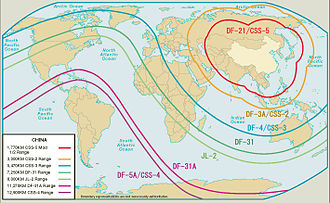
The decision to develop the DF-4 was made in 196512 in response to the U.S. ballistic missile submarine patrols that began operating out of Guam. The missile's designer has been variously identified as Ren Xinmin or Tu Shou'e [屠守锷], and it was produced at Factory 211 (Capital Astronautics Co. [首都航天机械公司], also known as Capital Machine Shop [首都机械厂]).
In 1972 US intelligence estimated an Initial Operational Capability for this system as being expected in 1974 or 1975. Deployment actually began in 1975–76, but only four DF-4s were believed to be in place by 1984.13
There were two versions of the missile developed,14 one version housed in caves or garages to be rolled out on launch and another silo based version.
The US DoD estimates that the missile will continue to serve as a regional deterrence instrument until they can be replaced by the DF-31.15 This will be a significant capability gain for the Second Artillery Corps. The DF-31A has a range of 11,700 kilometers (as opposed to just 7,000 for the DF-4) and is road- and rail-mobile, and thus more survivable than the silo-based DF-4.16
Operators
 China: The People's Liberation Army Rocket Force was the only operator of the Dong-Feng 4.
References
References
- The Federation of American Scientists & The Natural Resources Defense Council Chinese Nuclear Forces and U.S. Nuclear War Planning p. 202 [1] Archived 2011-04-28 at the Wayback Machine
- PRC Defense Policy and Armed Forces, National Intelligence Estimate 13-76, November 11, 1976, p. 47.
- "中国东风系列导弹简介" [Introduction to China's Dongfeng Series Missiles]. www.5school.com. Archived from the original on 2012-08-01. Retrieved 2010-04-28.
- http://csatm.cn/f0309110006.html
- "DF-4 - China Nuclear Forces". Federation of American Scientists.
- "DF-4 - China Nuclear Forces". www.globalsecurity.org.
- "东风4型洲际导弹 (Dongfeng VI intercontinental ballistic missile)". 兵器装备网 [Weapons and Equipment Network]. Archived from the original on 2009-09-15. Retrieved 2009-07-22.
- Kristensen, Hans M.; Korda, Matt; Reynolds, Eliana (2023-03-04). "Chinese nuclear weapons, 2023". Bulletin of the Atomic Scientists. 79 (2): 108–133. doi:10.1080/00963402.2023.2178713. ISSN 0096-3402.
- Ballistic and Cruise Missile Threat (Report). Defense Intelligence Ballistic Missile Analysis Committee. June 2017. p. 29. NASIC-1031-0985-17. Retrieved 16 July 2017.
- Zhang, Hui (2025-11-25). The Untold Story of China's Nuclear Weapon Development and Testing. Cambridge, Massachusetts: MIT Press. ISBN 978-0-262-05182-8.
- Diamond, Howard (July 1, 1999). "Chinese Strategic Plans Move Forward with Missile Test". Arms Control Today. Arms Control Association. ISSN 0196-125X. Archived from the original on October 19, 2019.
- U.S. Department of Defense, Office of the Secretary of Defense, The Military Power of the People’s Republic of China, 2005, 2005, p. 28
- "DF-4 – China Nuclear Forces". Federation of Atomic Scientists. Retrieved 2010-03-21.
- U.S. Department of Defense, Office of the Secretary of Defense, The Military Power of the People’s Republic of China, 2000, 2000, p. 17.
- U.S. Department of Defense, Office of the Secretary of Defense, Military Power of the People’s Republic of China, 2006, May 22, 2006, p. 50.
- "DF-31/-31A (CSS-9) - Missile Threat". missilethreat.com. Archived from the original on 2016-01-13.
External links
External links
- Astronautix
- DongFeng 4 (CSS-3) Intermediate-Range Ballistic Missile - SinoDefence.com
- "DF-4 (CSS-3)". Missile Threat.
{{cite web}}: CS1 maint: deprecated archival service (link)