In mathematics, Lebesgue's density theorem states that for any Lebesgue measurable set , the "density" of is 0 or 1 at almost every point in . Additionally, the "density" of is 1 at almost every point of . Intuitively, this means that the boundary of , the set of points in for which all neighborhoods are partially in and partially outside , is of measure zero.
The definition
Let be the Lebesgue measure on the Euclidean space and be a Lebesgue measurable set. Let and let ε denote the open ball of radius centered at . Define
Lebesgue's density theorem asserts that for almost every point of the density
exists and is equal to 0 or 1.
What the Lebesgues density theorem states
For every measurable set , the density of is 0 or 1 almost everywhere1. If , then there are always points of where the density either does not exist or exists but is neither 0 nor 1.2.
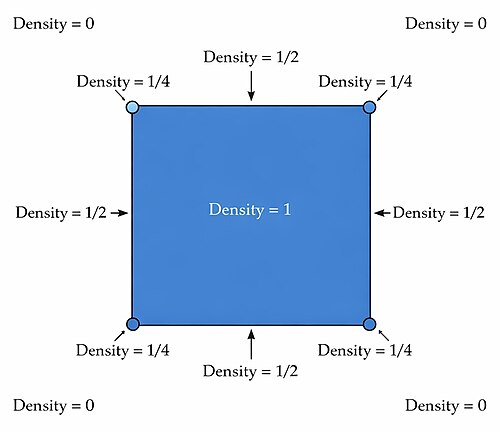
For example, given a square in the plane, the density at every point inside the square is 1, on the edges is 1/2, and at the corners is 1/4. The set of points in the plane at which the density is neither 0 nor 1 is non-empty (the square boundary), but it is of measure zero.
The Lebesgue density theorem is a particular case of the Lebesgue differentiation theorem.
Thus, this theorem is also true for every finite Borel measure on instead of Lebesgue measure, as proven in sections 2.8–2.9 of Federer's Geometric Measure Theory, 1969.
References
References
- Mattila, Pertti (1999). Geometry of Sets and Measures in Euclidean Spaces: Fractals and Rectifiability. ISBN 978-0-521-65595-8.
- Croft, Hallard (1982). "Three lattice-point problems of Steinhaus". Quarterly J. Math. Oxford (2). 33: 71–83.
This article incorporates material from Lebesgue density theorem on PlanetMath, which is licensed under the Creative Commons Attribution/Share-Alike License.