A Delta Scuti variable (sometimes termed dwarf cepheid when the V-band amplitude is larger than 0.3 mag.) is a class of pulsating star, comprising several sub-classes of object with A- or F-type spectra.
The variables follow a period-luminosity relation in certain passbands like other standard candles such as Cepheids.23456 Delta Scuti variables are standard candles. They have been used to establish the distance to the Large Magellanic Cloud, globular clusters, open clusters, and the Galactic Center.7834 The OGLE and MACHO surveys have detected nearly 3,000 Delta Scuti variables in the Large Magellanic Cloud.29
Typical brightness fluctuations of Delta Scuti variables are from 0.003 to 0.9 magnitudes in V over a period of a few hours, although the amplitude and period of the fluctuations can vary greatly. Indeed, Delta Scuti variables exhibit an overtone pulsation period boundary with classical Cepheids near 0.23-0.5 days.610 They are usually A0 to F5 type giant, subgiant, or main sequence stars. The high-amplitude Delta Scuti variables are also called AI Velorum stars, after the prototype AI Velorum. SX Phoenicis variables are generally considered to be a subclass of Delta Scuti variables that contain Population II stars, often blue stragglers, and can be found in globular clusters. SX Phe variables also follow a period-luminosity relation.35 One last sub-class are the pre-main sequence (PMS) Delta Scuti variables, stars that are more luminous than main sequence stars of the same temperature, still contracting towards the main sequence.
Delta Scuti stars exhibit both radial and non-radial luminosity pulsations. Non-radial pulsations are when some parts of the surface move inwards and some outward at the same time. Radial pulsations are a special case, where the star expands and contracts around its equilibrium state by altering the radius to maintain its spherical shape. The variations are due to the swelling and shrinking of the star through the Eddington Valve or Kappa-mechanism. The stars have a helium rich atmosphere. As helium is compressed it becomes more ionised, which is more opaque. So at the dimmest part in the cycle the star has highly ionised opaque helium in its atmosphere blocking part of the light from escaping. The energy from this “blocked light” causes the helium to heat up then expand, become more transparent and therefore allow more light through. As more light is let through the star appears brighter and, with the expansion, the helium begins to cool down. Hence the helium contracts under gravity and heats up again and the cyclical process continues. Throughout their lifetime Delta Scuti stars exhibit pulsation when they are situated on the classical Cepheid instability strip. They then move across from the main sequence into the giant branch.
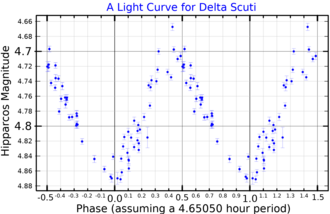
The prototype of these sorts of variable stars is Delta Scuti (δ Sct), which exhibits brightness fluctuations from +4.60 to +4.79 in apparent magnitude with a period of 4.65 hours. Other well known Delta Scuti variables include Altair and Denebola (β Leonis). Vega (α Lyrae) is a suspected Delta Scuti variable,11 but this remains unconfirmed.
Examples
| Designation (name) | Discovery | Maximum12 (magnitude) | Minimum12 (magnitude) | Range of magnitude | Period | Spectral type | Comment |
|---|---|---|---|---|---|---|---|
| γ Boötis | 3.02 | 3.07 | 0.05 | 6.96 h | A7III | ||
| ε Cephei | 4.15 | 4.21 | 0.06 | 0.98 h | F0IV | ||
| HD 40372 | 5.88 | 5.92 | 0.04 | 1.466 h | A5me | In eclipsing binary system | |
| α Lyrae (Vega) | −0.02 | 0.07 | 0.03 | 2.57 h | A0Va | 5th brightest star in the night sky | |
| HR 1170 | 5.77 | 5.91 | 0.14 | 2.39 h | A9IV | ||
| δ Scuti | 4.60 | 4.79 | 0.19 | 4.65 h | F2 IIIp | prototype | |
| V701 Coronae Australis | Lampens & Rufuen (1990) | 5.69 | 5.73 | 0.04 | 3.25 h | F2 III/IV | |
| QQ Telescopii | Kurtz (1982) | 6.53 (blue) | 6.58 (blue) | 0.05 | 1.52 h | F2 IV |
Other examples include σ Octantis and β Cassiopeiae.
References
References
- "Light Curve". Hipparcos ESA. ESA. Retrieved 17 February 2022.
- Poleski, R.; Soszyński, I.; Udalski, A.; Szymański, M. K.; Kubiak, M.; Pietrzyński, G.; Wyrzykowski, Ł.; Szewczyk, O.; Ulaczyk, K. (2010). "The Optical Gravitational Lensing Experiment. The OGLE-III Catalog of Variable Stars. VI. Delta Scuti Stars in the Large Magellanic Cloud". Acta Astronomica. 60 (1): 1. arXiv:1004.0950. Bibcode:2010AcA....60....1P.
- Majaess, D. J.; Turner, D. G.; Lane, D. J.; Henden, A. A.; Krajci, T. (2011). "Anchoring the Universal Distance Scale Via a Wesenheit Template". Journal of the American Association of Variable Star Observers (Jaavso). 39 (1): 122. arXiv:1007.2300. Bibcode:2011JAVSO..39..122M.
- Majaess, Daniel J.; Turner, David G.; Lane, David J.; Krajci, Tom (2011). "Deep Infrared ZAMS Fits to Benchmark Open Clusters Hosting delta Scuti Stars". Journal of the American Association of Variable Star Observers (Jaavso). 39 (2): 219. arXiv:1102.1705. Bibcode:2011JAVSO..39..219M.
- Cohen, Roger E.; Sarajedini, Ata (2012). "SX Phoenicis period-luminosity relations and the blue straggler connection". Monthly Notices of the Royal Astronomical Society. 419 (1): 342. Bibcode:2012MNRAS.419..342C. doi:10.1111/j.1365-2966.2011.19697.x.
- Soszyński, I.; Pietrukowicz, P.; Udalski, A.; Skowron, J.; Szymański, M. K.; Poleski, R.; Skowron, D. M.; Kozłowski, S.; Mróz, P.; Kołaczkowski, P.; Wrona, M.; Ulaczyk, K.; Rybicki, K.; Gromadzki, M.; Mróz, M. (2023). "The OGLE Collection of Variable Stars. Over 15000 δ Scuti Stars in the Large Magellanic Cloud". Acta Astronomica. 73 (2): 105–126. doi:10.32023/0001-5237/73.2.1.
- McNamara, D. H.; Madsen, J. B.; Barnes, J.; Ericksen, B. F. (2000). "The Distance to the Galactic Center". Publications of the Astronomical Society of the Pacific. 112 (768): 202. Bibcode:2000PASP..112..202M. doi:10.1086/316512.
- McNamara, D. Harold; Clementini, Gisella; Marconi, Marcella (2007). "A δ Scuti Distance to the Large Magellanic Cloud". The Astronomical Journal. 133 (6): 2752–2763. arXiv:astro-ph/0702107. Bibcode:2007AJ....133.2752M. doi:10.1086/513717. S2CID 18053647.
- Garg, A.; Cook, K. H.; Nikolaev, S.; Huber, M. E.; Rest, A.; Becker, A. C.; Challis, P.; Clocchiatti, A.; Miknaitis, G.; Minniti, D.; Morelli, L.; Olsen, K.; Prieto, J. L.; Suntzeff, N. B.; Welch, D. L.; Wood-Vasey, W. M. (2010). "High-amplitude δ-Scutis in the Large Magellanic Cloud". The Astronomical Journal. 140 (2): 328. arXiv:1004.0955. Bibcode:2010AJ....140..328G. doi:10.1088/0004-6256/140/2/328. hdl:1969.1/181688. S2CID 118386274.
- Majaess, D.; Bonatto, C. J.; Turner, D. G.; Saito, R. K.; Minniti, D.; Moni Bidin, C.; González-Díaz, D.; Alonso-Garcia, J.; Bono, G.; Braga, V. F.; Navarro, M. G.; Carraro, G.; Gomez, M. (2025). "The Gaia Parallax Discrepancy for the Cluster Pismis 19 and Separating δ Scutis from Cepheids". The Astrophysical Journal. 982 (2): 165. doi:10.3847/1538-4357/adb9e4.
- I.A., Vasil'yev; et al. (1989-03-17). "On the Variability of Vega". Commission 27 of the I.A.U. Retrieved 2007-10-30.
- (apparent visual magnitude
Further reading
Further reading
- Samus N.N., Durlevich O.V., et al. Combined General Catalog of Variable Stars (GCVS4.2, 2004 Ed.)
- AI Velorum star at The Encyclopedia of Astrobiology, Astronomy, and Spaceflight
- AAVSO: Delta Scuti and the Delta Scuti variables