  | |
| Observation data Epoch J2000 Equinox J2000 | |
|---|---|
| Constellation | Libra |
| Right ascension | 15h 00m 58.34830s1 |
| Declination | −08° 31′ 08.2104″1 |
| Apparent magnitude (V) | 4.932 |
| Characteristics | |
| Evolutionary stage | main sequence3 |
| Spectral type | B9.5V4 |
| U−B color index | −0.105 |
| B−V color index | +0.005 |
| Variable type | Algol eclipsing6 |
| Astrometry | |
| Radial velocity (Rv) | −38.7±27 km/s |
| Proper motion (μ) | RA: −63.0511 mas/yr Dec.: −6.0241 mas/yr |
| Parallax (π) | 9.2824±0.4725 mas1 |
| Distance | 350 ± 20 ly (108 ± 5 pc) |
| Absolute magnitude (MV) | +0.158 |
| Orbit | |
| Period (P) | 2.3273543 days9 |
| Semi-major axis (a) | 12.73±0.34 mas9 |
| Eccentricity (e) | 0.0710 |
| Semi-amplitude (K1) (primary) | 76.610 km/s |
| Semi-amplitude (K2) (secondary) | 218.710 km/s |
| Details9 | |
| δ Lib A | |
| Mass | 3.78±0.13 M☉ |
| Radius | 3.60±0.13 R☉ |
| Luminosity | 155+11 −10 L☉ |
| Temperature | 10,520±110 K |
| Age | 0.511 Gyr |
| δ Lib B | |
| Mass | 1.50±0.04 M☉ |
| Radius | 3.79±0.04 R☉ |
| Luminosity | 9.1+1.4 −1.2 L☉ |
| Temperature | 5,150±175 K |
| Other designations | |
| δ Lib, Zuben Elakribi, 19 Librae, BD−07°3938, HD 132742, HIP 73473, HR 5586, SAO 140270 | |
| Database references | |
| SIMBAD | data |
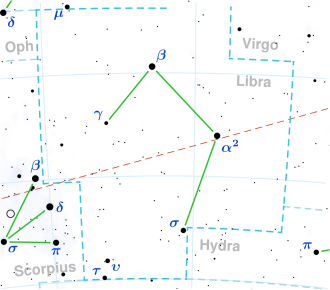
Delta Librae, Latinized from δ Librae, is a variable star in the constellation Libra. It has the traditional name Zuben Elakribi, a variant of the traditional name of Gamma Librae.12 With μ Virginis it forms one of the Akkadian lunar mansions Mulu-izi13 (meaning "Man-of-fire").14

δ Librae is approximately 350 light years from the Earth and the primary, component A, belongs to the spectral class B9.5V, indicating it is a B-type main-sequence star. It is visible to the naked eye with an apparent visual magnitude of 4.932 and is moving closer to the Sun with a radial velocity of −39 km/s.7 This is an Algol-like eclipsing binary star system, with a period of 2.3274 days and an eccentricity of 0.07.10 Its apparent magnitude varies from 4.91 to 5.90.16 The secondary is filling its Roche lobe and there is evidence of large-scale mass transfer in the past, with the secondary being more evolved than the primary despite now being less massive.10
Along with λ Tauri, it was one of the first stars on which rotational line broadening was observed, by Frank Schlesinger in 1911.17
References
References
- Vallenari, A.; et al. (Gaia collaboration) (2023). "Gaia Data Release 3. Summary of the content and survey properties". Astronomy and Astrophysics. 674: A1. arXiv:2208.00211. Bibcode:2023A&A...674A...1G. doi:10.1051/0004-6361/202243940. S2CID 244398875. Gaia DR3 record for this source at VizieR.
- Ducati, J. R. (2002). "VizieR Online Data Catalog: Catalogue of Stellar Photometry in Johnson's 11-color system". CDS/ADC Collection of Electronic Catalogues. 2237. Bibcode:2002yCat.2237....0D.
- Zorec, J.; Royer, F. (2012). "Rotational velocities of A-type stars. IV. Evolution of rotational velocities". Astronomy and Astrophysics. 537: A120. arXiv:1201.2052. Bibcode:2012A&A...537A.120Z. doi:10.1051/0004-6361/201117691.
- Houk, N.; Swift, C. (1999). "Michigan catalogue of two-dimensional spectral types for the HD Stars, Vol. 5". Michigan Spectral Survey. 5. Bibcode:1999MSS...C05....0H.
- Johnson, H. L. (1966). "UBVRIJKL Photometry of the Bright Stars". Communications of the Lunar and Planetary Laboratory. 4: 99. Bibcode:1966CoLPL...4...99J.
- "Del Lib". The International Variable Star Index. AAVSO – American Association of Variable Star Observers. Retrieved 27 September 2017.
- Wilson, Ralph Elmer (1953). "General catalogue of stellar radial velocities". Carnegie Institute Washington D.C. Publication. Bibcode:1953GCRV..C......0W.
- Anderson, E.; Francis, Ch. (2012). "XHIP: An extended hipparcos compilation". Astronomy Letters. 38 (5): 331. arXiv:1108.4971. Bibcode:2012AstL...38..331A. doi:10.1134/S1063773712050015. S2CID 119257644.
- Malkov, Oleg Yu (2020-02-01). "Semidetached double-lined eclipsing binaries: Stellar parameters and rare classes". Monthly Notices of the Royal Astronomical Society. 491 (4): 5489–5497. Bibcode:2020MNRAS.491.5489M. doi:10.1093/mnras/stz3363. ISSN 0035-8711.
- Tomkin, J. (April 1978). "Secondaries of eclipsing binaries. I. Detection of the secondary of Delta Librae". Astrophysical Journal. 221: 608–615. Bibcode:1978ApJ...221..608T. doi:10.1086/156064.
- Rhee, Joseph H.; Song, Inseok; Zuckerman, B.; McElwain, Michael (2007). "Characterization of Dusty Debris Disks: The IRAS and Hipparcos Catalogs". The Astrophysical Journal. 660 (2): 1556–1571. arXiv:astro-ph/0609555. Bibcode:2007ApJ...660.1556R. doi:10.1086/509912. S2CID 11879505.
- Becvar, Antonin (1964). Atlas coeli II - Katalog 1950.0. Bibcode:1964ack..book.....B.
- Allen, R. H. (1963). Star Names: Their Lore and Meaning (rep. ed.). New York, NY: Dover Publications Inc. pp. 277, 473.
- Brown Jr., R. (1891). "Remarks on the Euphratean Astronomical Names of the Signs of the Zodiac". Proceedings of the Society of Biblical Archaeology. 13: 194.
- Shobbrook, R. R. (December 2005). "Photometry of 20 eclipsing and ellipsoidal binary systems". The Journal of Astronomical Data. 11: 7. Bibcode:2005JAD....11....7S.
- Samus, N. N.; Kazarovets, E. V.; Durlevich, O. V.; Kireeva, N. N.; Pastukhova, E. N. (2017). "General Catalogue of Variable Stars". Astronomy Reports. GCVS 5.1. 61 (1): 80–88. Bibcode:2017ARep...61...80S. doi:10.1134/S1063772917010085. S2CID 125853869. Retrieved 2018-01-07.
- Schlesinger, F. (1909). "Rotation of Stars about their Axes". Monthly Notices of the Royal Astronomical Society. 71 (9): 719. Bibcode:1911MNRAS..71..719S. doi:10.1093/mnras/71.9.719.