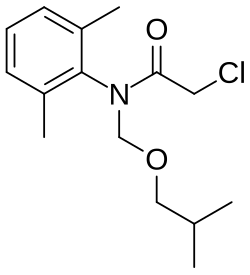
 | |
| Names | |
|---|---|
| IUPAC name
2-Chloro-2′,6′-dimethyl-N-[(2-methylpropoxy)methyl]acetanilide
| |
| Preferred IUPAC name
2-Chloro-N-(2,6-dimethylphenyl)-N-[(2-methylpropoxy)methyl]acetamide | |
Other names
| |
| Identifiers | |
3D model (JSmol)
|
|
| ChEBI | |
| ChemSpider | |
| KEGG | |
PubChem CID
|
|
| UNII | |
CompTox Dashboard (EPA)
|
|
| |
| |
| Properties | |
| C15H22ClNO2 | |
| Molar mass | 283.80 g·mol−1 |
| Appearance | colourless or very pale yellow3 |
| Density | 1.1014 |
| 59 ppm1 | |
| Hazards | |
| GHS labelling:3 | |
| Warning | |
| H302, H312, H315, H317, H319, H332, H351, H361f, H373, H410 | |
| P260, P264, P273, P280, P391, P501 | |
| Lethal dose or concentration (LD, LC): | |
LD50 (median dose)
|
|
Except where otherwise noted, data are given for materials in their standard state (at 25 °C [77 °F], 100 kPa).
| |
Delachlor is a chloroacetanilide herbicide, used on grasses, rice and sugarbeet.15 It was first reported in 1967 and introduced by Monsanto,6 though by 1974 commercial factors had halted its commercialisation,7 so delachlor is now considered obsolete,8 and appears never to have been registered in the USA.9
Delachlor's HRAC group is Group K (Australia), Group K3 (Global) and Group 15 (numeric).8
In artificial soil tests of phytotoxicity, with the herbicides cycloate, benzthiazuron and pyrazon. Delachlor was the most active in organic soils (>11% organics) though cycloate was more potent in other soils.10
The LD50 (by mouth) is reported to be 1775 mg/kg on an SDS,3 but 733 mg/kg on PPDB.8 The difference is similar to the difference between paracetamol and methanol.
It is soluble in chloroform and somewhat soluble in ethyl acetate.3
References
References
- Paranjape, Kalyani; Gowariker, Vasant; Krishnamurthy, V.N.; Gowariker, Sudha (2015). The Pesticide Encyclopedia. CABI. ISBN 978-1-78064-014-3.
- "delachlor data sheet". www.bcpcpesticidecompendium.org. Retrieved 22 February 2026.
- "VEILIGHEIDSINFORMATIEBLAD" [Safety Data Sheet] (PDF). LGC Standards. 12 February 2024.
- "Delachlor". echemi.com.
- Berber, Ahmet Ali; Demi̇R, Şefika Nur; Akinci KenanoğLu, Nihan (25 August 2023). "Potential Health Risks of Chloroacetanilide Herbicides: An In Silico Analysis". Sakarya University Journal of Science. 27 (4): 865–871. doi:10.16984/saufenbilder.1281720.
- MacBean, C. (2012). A World Compendium: The Pesticide Manual (Sixteenth ed.). Hampshire: British Crop Production Council. ISBN 978-1-901396-86-7.
- BCPC, (1974) "Proceedings 12th British Weed Control Conference", accessed 22nd Feb 2026
- Hertfordshire, University of. "Delachlor (Ref: CP 52553), Pesticide Properties Database". sitem.herts.ac.uk.
- "Delachlor". ordspub.epa.gov/. EPA Office of Pesticide Programs. Retrieved 16 March 2026.
- Horowitz, M.; Blumenfeld, T. (December 1973). "Phytotoxicity of four herbicides in different synthetic soils". Phytoparasitica. 1 (2): 101–110. doi:10.1007/BF02981039.