| Deepwater grenadier | |
|---|---|
Scientific classification 
| |
| Kingdom: | Animalia |
| Phylum: | Chordata |
| Class: | Actinopterygii |
| Order: | Gadiformes |
| Family: | Macrouridae |
| Genus: | Coryphaenoides |
| Species: | C. profundicolus
|
| Binomial name | |
| Coryphaenoides profundicolus (Nybelin, 1893)
| |
| Synonyms2 | |
| |
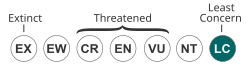
The deepwater grenadier (Coryphaenoides profundicolus) is a species of deep-sea fish in the family Macrouridae.34567
Description
The deepwater grenadier is very large for its genus, measuring up to 129 cm (4.23 ft) and 14 kg (31 lb).8 Olfaction and taste are important senses for finding prey, which is unsurprising as it lives in the near-total darkness of the deep sea.98 It has a swim bladder, showing that it is a mobile forager.10
Habitat
The deepwater grenadier lives in the Atlantic Ocean, off the Bay of Biscay and Canary Islands, and in the Great Australian Bight;1112 it lives at depths of up to 4,872 m (15,984 ft).13 The specific name is from Latin profundus ("deep") and the suffix -colus ("inhabitant"); -colus, -colum is not considered to be correct Latin but is still used in several species names.14 Otolith studies have shown that the deepwater grenadier lives at a variety of temperatures during its life.1516
Behaviour
It is parasitised by Lepidapedon zubchenkoi and Steringophorus thulini, both trematode worms of the order Plagiorchiida.17
References
References
- Fernandes, P.; Cook, R.; Florin, A.; Lorance, P.; Nielsen, J.; Nedreaas, K. (2014). "Coryphaenoides profundicolus". IUCN Red List of Threatened Species. 2014 e.T18125838A45136875. doi:10.2305/IUCN.UK.2014-3.RLTS.T18125838A45136875.en. Retrieved 25 June 2023.
- "WoRMS - World Register of Marine Species - Coryphaenoides profundicolus (Nybelin, 1957)". www.marinespecies.org.
- Quéro, Jean-Claude (October 31, 2003). Guide des poissons de l'Atlantique européen. Delachaux et Niestlé. ISBN 978-2-603-01271-0 – via Google Books.
- Klimpel, Sven (October 31, 2001). Deep-water Metazoan Fish Parasites of the World. Logos. ISBN 978-3-89722-681-4 – via Google Books.
- Reutter, Klaus (January 8, 2005). Fish Chemosenses. CRC Press. ISBN 978-1-4822-9439-2 – via Google Books.
- "Fisheries Review". Department of the Interior, U.S. Fish and Wildlife Service. October 31, 1994 – via Google Books.
- Orlov, Aleksei M.; Iwamoto, Tomio (October 31, 2008). Grenadiers of the World Oceans: Biology, Stock Assessment, and Fisheries. American Fisheries Society. ISBN 978-1-934874-00-4 – via Google Books.
- Davies, Wayne Iwan Lee; Collin, Shaun (August 27, 2020). Biodiversity of Sensory Systems in Aquatic Vertebrates. Frontiers Media SA. ISBN 978-2-88963-960-1 – via Google Books.
- Emde, Gerhard von der; Mogdans, Joachim; Kapoor, B. G. (December 6, 2012). The Senses of Fish: Adaptations for the Reception of Natural Stimuli. Springer Science & Business Media. ISBN 978-94-007-1060-3 – via Google Books.
- Merrett, N. R.; Haedrich, R. L. (October 31, 1997). Deep-Sea Demersal Fish and Fisheries. Springer Science & Business Media. ISBN 978-0-412-39410-2 – via Google Books.
- "Coryphaenoides profundicolus". fishesofaustralia.net.au.
- "Coryphaenoides profundicolus (Nybelin, 1957)". www.gbif.org.
- "Coryphaenoides profundicolus, Deepwater grenadier". fishbase.mnhn.fr.
- "Order GADIFORMES (part 2): Family MACROURIDAE". February 10, 2021.
- "Aquatic Sciences and Fisheries Abstracts". Information Retrieval Limited. March 31, 1995 – via Google Books.
- Harbach, Ralph E. (October 17, 2018). Culicipedia: Species-group, genus-group and family-group names in Culicidae (Diptera). CABI. ISBN 978-1-78639-905-2 – via Google Books.
- "WoRMS - World Register of Marine Species - Coryphaenoides profundicolus (Nybelin, 1957)". www.marinespecies.org.