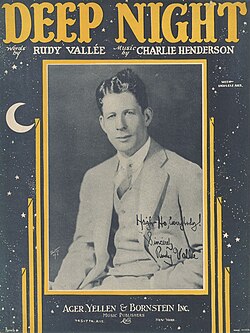
"Deep Night" is a song and jazz standard with a melody composed in 1929 by Charles E. Henderson and lyrics written by Rudy Vallee.1 The tune is written in a minor key.2
History
The song was first recorded in 1929 by Vallee with The Connecticut Yankees,3 as the B side of his song "Weary River". These were the first recordings Vallee made for RCA Victor.4 Popular recordings in 1929 were those by Vallee and by Ruth Etting.5
Recorded versions
It has been covered by many jazz musicians67 notably:
- Sonny Clark in his album Cool Struttin'
- Bud Powell
- Art Tatum
- Buddy DeFranco.89
It has also been recorded by vocalists, including:
- Frank Sinatra with Harry James in 1951 on Columbia 39527,10
- Tony Martin on his 1949 album You, and the Night, and the Music ...11
- Vic Damone for his 1962 album Linger Awhile with Vic Damone12
- Ann Richards on her 1958 album I'm Shooting High
- Barbara Rosene on her album of the same name.13
Additionally, inventor Leon Theremin recorded an instrumental performance of the song on his own instrument, the Theremin, in 1930.14
Popular culture
Deep Night was also part of the sound track of the films My Own Private Idaho, "Tomorrow Is Another Day" and Bonnie and Clyde.15 and features in the Score of Matthew Bourne's 2021 dance theatre work 'The Midnight Bell'.
References
References
- Don Tyler (April 2, 2007). Hit Songs, 1900–1955: American Popular Music of the Pre-Rock Era. McFarland. pp. 409–. ISBN 978-0-7864-2946-2.
- Jack Gottlieb (February 1, 2012). Funny, It Doesn't Sound Jewish: Comparative Studies of Domestic Labor and Self-Employment. SUNY Press. pp. 44–. ISBN 978-0-7914-8502-6.
- Warren W. Vaché (2000). The Unsung Songwriters: America's Masters of Melodies. Scarecrow Press. p. 507. ISBN 978-0-8108-3570-2.
- Michael Pitts; Frank Hoffmann; Dick Carty; Jim Bedoian (December 22, 2001). The Rise of the Crooners: Gene Austin, Russ Columbo, Bing Crosby, Nick Lucas, Johnny Marvin and Rudy Vallee. Scarecrow Press. pp. 188–. ISBN 978-1-4617-0712-7.
- Whitburn, Joel (1986). Joel Whitburn's Pop Memories 1890-1954. Menomonee Falls, Wisconsin: Record Research Inc. p. 491. ISBN 0-89820-083-0.
- Michael Pitts; Frank Hoffmann; Dick Carty; Jim Bedoian (December 22, 2001). The Rise of the Crooners: Gene Austin, Russ Columbo, Bing Crosby, Nick Lucas, Johnny Marvin and Rudy Vallee. Scarecrow Press. pp. 188–. ISBN 978-1-4617-0712-7.
- Robert C. Kriebel (1995). Blue Flame: Woody Herman's Life in Music. Purdue University Press. pp. 1–. ISBN 978-1-55753-073-8.
- "JazzStandards.com". www.jazzstandards.com. Retrieved December 20, 2014.
- "Jazz.com". www.jazz.com. Archived from the original on March 4, 2016. Retrieved December 29, 2014.
- Richard Grudens (1999). Jukebox Saturday Night: More Memories of the Big Band Era and Beyond. celebrity profiles publishing. pp. 107–. ISBN 978-1-57579-142-5.
- "Discogs.com". Discogs.com. Retrieved February 19, 2018.
- "Discogs.com". Discogs.com. Retrieved February 19, 2018.
- "AllMusic.com". www.allmusic.com. Retrieved December 29, 2014.
- "YouTube.com". www.youtube.com.
- Mario Falsetto (March 12, 2015). Conversations with Gus Van Sant. Rowman & Littlefield Publishers. pp. 19–. ISBN 978-1-4422-4767-3.