
Decommunization in Ukraine started during the dissolution of the Soviet Union in 1991 and expanded afterwards.1 Following the 2014 Revolution of Dignity and beginning of the Russo-Ukrainian War, the Ukrainian government approved laws that banned communist symbols, as well as symbols of Nazism as both ideologies were deemed to be totalitarian.23
On 15 May 2015, President Petro Poroshenko signed a set of laws that started a six-month period for the removal of Soviet communist monuments (excluding World War II monuments) and renaming of public places that had been named after Soviet communists.456 At the time, this meant that 22 cities and 44 villages were set to get new names.7 Until 21 November 2015, municipal governments had the authority to implement this;8 if they failed to do so, the oblasts had until 21 May 2016 to change the names.8 If the settlement still kept its old name, the Cabinet of Ministers of Ukraine could give a new name to the settlement.8 Violation of the law carries a penalty of a potential media ban and prison sentences of five to ten years.910
In the early stages of the Russo-Ukrainian conflict, Oleksandr Turchynov alleged that the Communist Party of Ukraine had been helping pro-Russian separatists and Russian proxy forces in the country.4 In July 2015, the Ministry of the Interior stripped the Communist Party, the Communist Party of Ukraine (renewed), and the Communist Party of Workers and Peasants of their right to participate in elections and stated it was continuing court actions to end the registration of communist parties in Ukraine.11 By December 2015, these parties had been banned, for involvement in violating Ukraine's sovereignty and territorial integrity, inciting a violent overthrow of the state, and supporting Russian proxy forces.12 The Communist Party of Ukraine appealed the ban to the European Court of Human Rights.51314
By 2016, 51,493 streets and 987 cities and villages were renamed (with either the restoration of their historic names or new names), and 1,320 Lenin monuments and 1,069 monuments to other communist figures removed.15
History
Early unofficial reforms
An unofficial decommunization process started in Ukraine after the dissolution of the Soviet Union and the following independence of Ukraine in 1991.1 Decommunization was carried out much more ruthlessly and visibly in the former Soviet Union's Baltic states and Warsaw Pact countries outside the Soviet Union.16 Ukraine's first president after the country's 1991 independence from the Soviet Union, Leonid Kravchuk, had also issued orders aimed at "de-sovietisation" in the early 1990s.1
In the following years, although at a slow rate, historical monuments to Soviet leaders were removed in Ukraine.1 This process went on much further in Western Ukraine than in Eastern Ukraine, which was more industrialised and largely Russian-speaking.1 Decommunization laws were proposed in the Ukrainian parliament in 2002, 2005, 2009, 2011, and 2013, but none of them were passed.17
Post-Euromaidan reforms
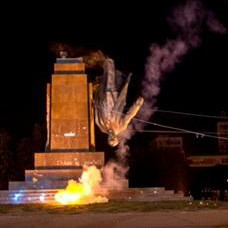
During and after Euromaidan, starting with the fall of the monument to Lenin in Kyiv on 8 December 2013, several Lenin monuments and statues were removed or destroyed by protesters.6
In April 2014, a year before the formal, nationwide decommunization process in Ukraine, local authorities removed and altered communist symbols and place names, as in Dnipropetrovsk.181920
On 9 April 2015, the Ukrainian parliament passed legislation on decommunization.2122 It was submitted by the Second Yatsenyuk Government, banning the promotion of symbols of "Communist and National Socialist totalitarian regimes".2223 One of the main provisions of the bill was the recognition of the Soviet Union's regime as "criminal" and one that "pursued a state terror policy".23 The legislation prohibits the use of communist symbols and propaganda and also bans all symbols and propaganda of national-socialism and its values and any activities of Nazi or fascist groups in Ukraine.23 The ban applies to monuments, place and street names.6 The ban does not apply to World War II monuments and when symbols are located in a cemetery.69
Expressing pro-communist views was not made illegal.2 The ban on communist symbols did result in the removal of hundreds of statues, the replacement of street signs and the renaming of populated places including some of Ukraine's biggest cities like Dnipro.6 The city administration of Dnipro estimated in June 2015 that 80 streets, embankments, squares, and boulevards would have to be renamed.24 Maxim Eristavi of Hromadske.TV estimated late April 2015 that the nationwide renaming would cost around $1.5 billion.17
The legislation also granted special legal status to veterans of the "struggle for Ukrainian independence" from 1917 to 1991 (the lifespan of the Soviet Union).22 The same day, the parliament also passed a law that replaced the term "Great Patriotic War" in the national lexicon with "World War II" from 1939 to 1945 (instead of 1941–45 as is the case with the "Great Patriotic War"),2225 a change of great significance.26
On 15 May 2015, President of Ukraine Petro Poroshenko signed the Decommunisation Laws.2728 This started a six-month period for the removal of communist monuments and renaming of public places named after communist-related themes.2728
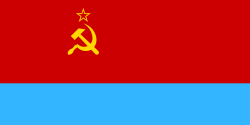
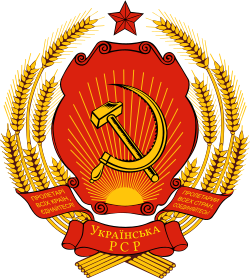
The Ukrainian decommunization law applies, but is not limited to:
- the Flag of the Soviet Union
- the flags of the Ukrainian Soviet Socialist Republic and of the 14 other republics of the Soviet Union, as well as the flags of the socialist countries of Eastern Europe and abroada
- the State Emblem of the Soviet Union and its constituent republics as well as the socialist countries of Eastern Europe and abroadb
- the State Anthem of the Soviet Union and the republicsc
- the Red star
- the Hammer and sickle
- images bearing the likeness of Vladimir Lenin, Leon Trotsky, Joseph Stalin, Mao Zedong, Kim Il Sung, and Che Guevara
- soviet military uniforms
The laws were published in Holos Ukrayiny on 20 May 2015; this made them come into force officially the next day.29
On 3 June 2015, the Ukrainian Institute of National Memory published a list of 22 cities and 44 villages subject to renaming.7 By far most of these places were in the Donbas region in East Ukraine; the others were situated in Central Ukraine and South Ukraine.7 Under the Decommunisation Laws the municipal governments had until 21 November 2015 to change the name of the settlement they govern.8 For settlements that failed to rename, the provincial authorities had until 21 May 2016 to change the name.8 If after that date the settlement still retained its old name the Cabinet of Ministers of Ukraine renamed the settlement.8
In a 24 July 2015 decree based on the decommunization laws, the Ukrainian Interior Ministry stripped the Communist Party of Ukraine, Communist Party of Ukraine (renewed) and Communist Party of Workers and Peasants of their right to participate in elections and it stated it was continuing the court actions (that started in July 2014) to end the registration of Ukraine's communist parties.1130
On 3 September 2015, the District Administrative Court in Kyiv banned the parties Communist Party of Workers and Peasants and Communist Party of Ukraine (renewed); they both did not appeal.3132
In October 2015, a statue of Lenin in Odesa was converted into a statue of Star Wars villain Darth Vader.33
On 16 December 2015, the Kyiv District Administrative Court validated the claim of the Ministry of Justice in full, banning the activities of the Communist Party of Ukraine.1234 The party appealed this ban at the European Court of Human Rights.13


In March 2016, statues of Lenin, Felix Dzerzhinsky, Sergey Kirov and a Komsomol monument were removed or taken down in the eastern city of Zaporizhzhia.36 The statue overlooking the Dnieper Hydroelectric Station (formerly named Lenin Dam) was the largest remaining Lenin statue in Ukraine.36
On 19 May 2016, the Ukrainian parliament voted to rename Ukraine's fourth-largest city Dnipropetrovsk to "Dnipro".37 The renaming of various locations was signed into the law on 20 May 2016.3839
The Ukrainian parliament declared in July 2016 that the new names of places in Crimea,d under full Russian control since the 2014 Russian annexation of Crimea, "will enter force with the return of temporarily occupied territory of the Autonomous Republic of Crimea and Sevastopol under the general jurisdiction of Ukraine."43
In May 2017, 46 Ukrainian MPs, mostly from the Opposition Bloc party, appealed to the Constitutional Court of Ukraine to declare the 2015 decommunization laws unconstitutional.4445
Director of the Ukrainian Institute of National Remembrance Volodymyr Viatrovych stated in February 2018 that "De-communism in the context of depriving the symbols of the totalitarian regime has actually been completed".46 Although according to him the city of Kyiv was lagging behind.46
In February 2019, the Central Election Commission of Ukraine refused to register the candidacy of (leader of Communist Party) Petro Symonenko for the 2019 Ukrainian presidential election due to the fact that the statute, name and symbolism of the Communist Party of Ukraine did not comply with the 2015 decommunization laws.47 Symonenko appealed the decision, but the court of appeal confirmed decision of the Central Election Commission of Ukraine.
It was proposed that the oblast of Dnipropetrovsk would be renamed to "Sicheslav".48
On 16 July 2019, the Constitutional Court of Ukraine upheld the 2015 Ukrainian decommunization laws.4445
On 7 November 2020 in the village Mala Rohan, an Emblem of the Ukrainian Soviet Socialist Republic was dismantled from the facade of a school.49
Reforms following the Russian invasion of Ukraine
On 27 April 2022 (during the Russian invasion of Ukraine), the 27-foot (8 m) Soviet-era bronze statue under the People's Friendship Arch in Kyiv, representing Russian–Ukrainian friendship, was removed by order of Mayor of Kyiv Vitali Klitschko.50

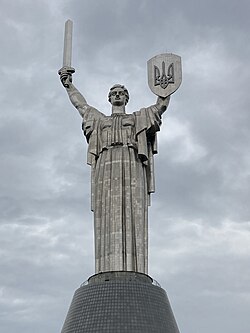
On 1 August 2023, the Soviet emblem was removed from the Motherland Monument (part of the National Museum of the History of Ukraine in the Second World War) in Kyiv.51 Its replacement, the Ukrainian Trident, was fully installed on 24 August 2023 (the Independence Day of Ukraine).5253 The monument was also renamed to Mother-Ukraine.54
On 24 October 2023 President Volodymyr Zelenskyy signed Law No. 8263 that abolished the concept of urban-type settlements in Ukraine.55 Law No. 8263 was meant to facilitate "de-Sovietization of the procedure for solving certain issues of the administrative and territorial system of Ukraine."55
On 30 January 2024, the governor of Lviv Oblast said that the region was the first in Ukraine to remove all of its communist-era monuments.56
Criticism and reception

On 18 May 2015, the OSCE expressed concern that the laws could negatively impact the freedom of the press in Ukraine.10 The OSCE also regretted what it perceived as a lack of opportunity of civil society to participate in public discussions about the laws.10
The Kharkiv Human Rights Protection Group stated (in May 2015) the laws "(one of which) effectively criminalizes public expression of views held by many Ukrainians".2557
On 18 December 2015, the Venice Commission stated that Ukraine's decommunization laws did not comply with the laws of the Council of Europe.58 It was in particular critical about the banning of communist parties.58
In April 2015, Russian lawmakers claimed that it was "cynical" to put communist and Nazi symbol on par with each other, and Russian-backed paramilitaries have condemned the law.9 The then leader and head of the self-proclaimed Donetsk People's Republic Alexander Zakharchenko stated in late February 2016 that when renamed cities "return under our jurisdiction", they would be renamed to their pre-decommunized name.59
In his February 2022 Address concerning the events in Ukraine, Putin claimed that Ukraine's decommunization does not make any sense because "modern Ukraine was created by communist Russia, and specifically Lenin". Vitaly Chervonenko from the BBC noted how Putin's statement was a lie due to independent Ukrainian state formations of 1917–1920 and Kyiv's war with Lenin's Bolshevik government, whose purpose was to include Ukraine in Bolshevik Russia.60
Results

Since 16 December 2015 three communist parties are banned in Ukraine (the Communist Party of Ukraine, Communist Party of Ukraine (renewed) and Communist Party of Workers and Peasants).3113 The only party that appealed this ban was the Communist Party of Ukraine; this resulted in the court's decision to ban the Communist Party of Ukraine did not come into force. However, the April 2015 decommunization law contains a norm that allows the Ministry of Justice to prohibit the Communist Party from participating in elections.
Ukraine had 5,500 Lenin monuments in 1991, declining to 1,300 by December 2015.62 More than 700 Lenin monuments were removed and/or destroyed from February 2014 (when 376 came down) to November 2015.62 On 16 January 2017 the Ukrainian Institute of National Remembrance announced that 1,320 Lenin monuments were dismantled during decommunization.6364
On 16 January 2017, the Ukrainian Institute of National Remembrance stated that 51,493 streets, squares and "other facilities" had been renamed due to decommunization.6364 By June 2016 there were renamed 19 raions, 27 urban districts, 29 cities, 48 urban-type settlements, 119 rural settlements and 711 villages. The fourth largest city was renamed from Dnipropetrovsk to Dnipro. In the second-largest city of Ukraine,65 Kharkiv, more than 200 streets, 5 administrative raions, 4 parks and 1 metro station had been renamed by early February 2016.66
In all of 2016, 51,493 streets and 987 cities and villages were renamed, 25 raions were renamed and 1,320 Lenin monuments and 1,069 monuments to other communist figures removed.15 In some villages Lenin statues were remade into "non-communist historical figures" to save money.67 One of the most prominent examples was a Lenin monument in Odesa, which was remade into the monument to Darth Vader.68
In February 2019, The Guardian reported that the two Lenin statues in the Chernobyl Exclusion Zone were the only two remaining statues of Lenin in Ukraine, if not taking into account occupied territories of Ukraine.69 In January 2021 "Radio Free Europe/Radio Liberty" located three remaining Lenin statues in three (Ukrainian controlled) small villages.70
In January 2021, 24 Ukrainian streets were still named after former Russian cosmonaut and current United Russia member of the Russian State Duma Valentina Tereshkova (6 of them in parts of Ukraine occupied by Russiae), according to the 2015 decommunization laws they should have been renamed.71 They were renamed in 2022. The last Lenin statue in Ukraine (excluding territories currently annexed by Russia or occupied by separatists) was demolished in Stari Troyany, Izmail Raion, Odesa Oblast on 27 January 2021.72
The director of the Ukrainian Institute of National Remembrance Volodymyr Viatrovych stated in February 2018 that the then-still existing Soviet hammer and sickle on the shield of the Motherland Monument in Kyiv should be removed to comply with the country's decommunization laws and replace it with the Ukrainian trident,46 which was subsequently done in 2023.

During the Russian invasion of Ukraine, many Lenin statues across Ukraine, which had been taken down by the Ukrainians in the preceding years, were re-erected by the Russians in the Russian-controlled areas.73747576
Polling
A November 2016 poll showed that 48% of respondents supported a ban on Communist ideology in Ukraine, 36% were against it and 16% were undecided. It also showed that 41% of respondents supported the initiative to dismantle all monuments to Lenin in the country, whereas 48% were against it and 11% were undecided.77
As of 8 April 2022, according to a poll by the sociological group Rating, 76% of Ukrainians support the initiative to rename streets and other objects whose names are associated with the Soviet Union and Russia after the Russian invasion of Ukraine.7879
See also
See also
- Bans on communist symbols
- Decommunization
- Human rights in Ukraine
- Demolition of monuments to Vladimir Lenin in Ukraine
- List of communist monuments in Ukraine
- List of Ukrainian toponyms that were changed as part of decommunization in 2016
- Lustration in Ukraine
- Derussification in Ukraine
- Soviet imagery during the Russo-Ukrainian War
Notes
Notes
- This ban does not include the national flags of the People's Republic of China, Cuba, Czech Republic, Hungary, Laos, Poland and Vietnam.
- The ban is not extended to the national emblems of Belarus, Cuba, Laos, North Macedonia, Tajikistan and Uzbekistan.
- This does not affect the Anthems of Russia, Belarus, Uzbekistan, Tajikistan and formerly, Kazakhstan and Turkmenistan. They all retained their Soviet-era melody with new lyrics written in its place.
- Since the annexation of Crimea by the Russian Federation, the status of the Crimea and of the city of Sevastopol is under dispute between Russia and Ukraine; Ukraine and the majority of the international community considers the Crimea and Sevastopol an integral part of Ukraine, while Russia, on the other hand, considers the Crimea and Sevastopol an integral part of Russia, with Sevastopol functioning as a federal city within the Crimean Federal District.404142
- There were (also) Tereshkova streets in Lviv Oblast's Busk, Rivne Oblast's Radyvyliv and Sarny, Khmelnytskyi Oblast's Dunaivtsi and Cherkasy Oblast's Smila and in some other towns and villages.71
References
References
- Khotin, Rostyslav (26 November 2009). "Ukraine tears down controversial statue". BBC News. Archived from the original on 19 October 2017. Retrieved 17 October 2017.
- Motyl, Alexander J. (28 April 2015). "Decommunizing Ukraine". Foreign Affairs. Archived from the original on 20 May 2015. Retrieved 19 May 2015.
- "Rada bans Communist, Nazi propaganda in Ukraine". Interfax-Ukraine. 9 April 2015. Archived from the original on 22 February 2026. Retrieved 2 April 2026.
- "Turchynov asks Justice Ministry to ban Communist Party of Ukraine". Interfax-Ukraine. 19 May 2014. Archived from the original on 16 February 2015. Retrieved 16 February 2015.
- "Європейський суд почав розгляд скарги на заборону діяльності КПУ". Ukrainska Pravda (in Ukrainian). 30 December 2016. Retrieved 17 December 2023.
- Shevchenko, Vitaly (14 April 2015). "Goodbye, Lenin: Ukraine moves to ban communist symbols". BBC News. Archived from the original on 17 April 2015. Retrieved 17 May 2015.
- "В Україні перейменують 22 міста і 44 селища" [22 cities and 44 towns will be renamed in Ukraine]. Українська правда (in Ukrainian). 4 June 2015. Archived from the original on 24 February 2026. Retrieved 3 April 2026.
- "Комсомольськ у будь-якому випадку перейменують" [Komsomolsk will be renamed anyway]. Depo. 1 October 2015. Archived from the original on 3 October 2015. Retrieved 29 November 2022.
- "Ukraine lawmakers ban 'Communist and Nazi propaganda'". Deutsche Welle. 9 April 2015. Archived from the original on 7 January 2023. Retrieved 3 April 2026.
- "New laws in Ukraine potential threat to free expression and free media, OSCE Representative says". OSCE. 18 May 2015. Archived from the original on 3 April 2026. Retrieved 3 April 2026.
- Antonovych, Mariana (24 July 2015). "Ukraine's Justice Ministry outlaws Communists from elections". Kyiv Post. Archived from the original on 3 April 2026. Retrieved 3 April 2026.
- "Court rules complete ban of Communist Party of Ukraine : UNIAN news". Ukrainian Independent Information Agency. 16 December 2015. Archived from the original on 4 March 2016. Retrieved 4 April 2016.
- Ishchenko, Volodymyr (18 December 2015). "Kiev has a nasty case of anti-communist hysteria". The Guardian. Archived from the original on 6 April 2016. Retrieved 4 April 2016.
- "Ukraine court bans Communist Party". Daily News & Analysis. 17 December 2015. Archived from the original on 6 December 2025. Retrieved 3 April 2026.
- "Decommunization reform: 25 districts and 987 populated areas in Ukraine renamed in 2016". www.ukrinform.net. 27 December 2016. Archived from the original on 21 February 2026. Retrieved 3 April 2026.
- Birnbaum, Michael (13 August 2015). "Ukraine topples Communist statues but raises a bigger debate". The Washington Post. ISSN 0190-8286. Archived from the original on 15 July 2025. Retrieved 3 April 2026.
- Eristavi, Maxim (27 April 2015). "Ukrainian PM leads charge to erase Soviet history". POLITICO. Archived from the original on 5 January 2026. Retrieved 4 April 2026.
- Gedmin, Jeffrey (10 March 2014). "Ukraine: the Day After". The Weekly Standard. Vol. 19, no. 25. Archived from the original on 17 June 2015. Retrieved 19 May 2015.
- Rudenko, Olga (14 March 2014). "In East Ukraine, fear of Putin, anger at Kiev". USA Today. Archived from the original on 4 May 2015. Retrieved 19 May 2015.
- Пам'ятник Леніну у Дніпропетровську остаточно перетворили в купу каміння [Monument to Lenin in Dnipro finally turned into a pile of stones]. TSN.ua (in Ukrainian). 19 August 2014. Retrieved 19 May 2015.
- Hyde, Lily (20 April 2015). "Ukraine to rewrite Soviet history with controversial 'decommunisation' laws". The Guardian. Archived from the original on 16 May 2015. Retrieved 17 May 2015.
- Peterson, Nolan (10 April 2015). "Ukraine Purges Symbols of Its Communist Past". Newsweek. Archived from the original on 15 May 2015. Retrieved 17 May 2015.
- "Rada bans Communist, Nazi propaganda in Ukraine". Interfax-Ukraine. 9 April 2015. Archived from the original on 12 May 2015. Retrieved 17 May 2015.
- Ratsybarska, Yulia (10 June 2015). "Ukraine's Dnipropetrovsk Digs In To Complex Decommunization Process". Radio Free Europe/Radio Liberty. Archived from the original on 11 September 2025. Retrieved 4 April 2026.
- Ayres, Sabra (13 May 2015). "Ukraine's plans to discard Soviet symbols are seen as divisive, ill-timed". Los Angeles Times. Archived from the original on 9 October 2025. Retrieved 4 April 2026.
- Davies, Norman (2006). "Phase 1, 1939–1941: the era of the Nazi-Soviet pact". Europe at War 1939–1945: No Simple Victory. London: Macmillan. pp. 153–155. ISBN 9780333692851. OCLC 70401618.
- "Порошенко підписав закони про декомунізацію" [Poroshenko signed laws on decommunization]. Українська правда (in Ukrainian). 15 May 2015. Archived from the original on 17 November 2025. Retrieved 4 April 2026.
- "Дни Европы открылись в Киеве" [The Days of Europe opened in Kyiv]. Интерфакс-Украина (in Russian). 16 May 2015. Archived from the original on 4 April 2026. Retrieved 4 April 2026.
- "Laws discommunization and status OUN and UPA published in "Holos Ukrayiny"". Ukrainska Pravda (in Ukrainian). 20 May 2015. Archived from the original on 18 November 2025. Retrieved 4 April 2026.
- "Justice Ministry bans three communist parties from taking part in election process as they violate Ukrainian law - minister". Interfax-Ukraine. 24 July 2015. Archived from the original on 20 January 2026. Retrieved 4 April 2026.
- "The court banned the two Communist parties". Ukrainska Pravda (in Ukrainian). 1 October 2015. Archived from the original on 16 September 2025. Retrieved 4 April 2026.
- "Kyiv's Court terminates two Communist parties". Ukrinform. 1 October 2015. Archived from the original on 4 April 2026. Retrieved 4 April 2026.
- Worland, Justin (25 October 2015). "Ukrainian Lenin Statue Turned Into Darth Vader". Time. Archived from the original on 25 October 2015. Retrieved 25 October 2015.
- "Ukraine bans Communist party for 'promoting separatism'". The Guardian. 17 December 2015. Archived from the original on 15 April 2016. Retrieved 4 April 2016.
- (in Ukrainian) Mykolaiv City Council on buildings dismantled Soviet "star", Ukrainska Pravda (12 November 2016)
- Shevchenko, Vitaly (31 May 2016), "In pictures: Ukraine removes communist-era symbols", BBC News, archived from the original on 15 July 2025, retrieved 4 April 2026
- "Ukraine Renames Third-Largest City". RadioFreeEurope/RadioLiberty. 19 May 2016. Archived from the original on 20 May 2016. Retrieved 19 May 2016.
- "Офіційний портал Верховної Ради України" [Official portal of the Verkhovna Rada of Ukraine]. w1.c1.rada.gov.ua (in Ukrainian). Archived from the original on 18 March 2026. Retrieved 4 April 2026.
- "Про перейменування деяких населених пунктів". Офіційний вебпортал парламенту України (in Ukrainian). Archived from the original on 8 February 2026. Retrieved 4 April 2026.
- Gutterman, Steve (18 March 2014). "Putin signs Crimea treaty, will not seize other Ukraine regions". Reuters.com. Retrieved 26 March 2014.
- "Ukraine crisis timeline". BBC News.
- UN General Assembly adopts resolution affirming Ukraine's territorial integrity Archived 4 March 2018 at the Wayback Machine, China Central Television (28 March 2014)
- "Google turned the Soviet Crimea names on the map". Ukrainska Pravda (in Ukrainian). 29 July 2015. Archived from the original on 9 September 2025. Retrieved 4 April 2026.
- "Ukraine's Constitutional Court Upholds Law Equating Communism To Nazism". Radio Free Europe/Radio Liberty. 17 July 2019. Archived from the original on 14 January 2026. Retrieved 4 April 2026.
- "Ukraine ultimately puts Nazis, Communists on equal footing". belsat.eu. 17 July 2019. Archived from the original on 19 August 2019.
- "Декомунізація в Україні фактично завершена – В'ятрович" [Decommunization in Ukraine is actually completed - Viatrovych]. Українська правда (in Ukrainian). 10 February 2018. Archived from the original on 8 September 2025. Retrieved 4 April 2026.
- "ЦВК відмовила у реєстрації майже півсотні "кандидатів" у президенти" [The CEC refused to register almost fifty "candidates" for the presidency]. Українська правда (in Ukrainian). 8 February 2019. Archived from the original on 28 August 2025. Retrieved 4 April 2026.
- Kocherhin, Ihor (2 February 2022). "Decommunisation in Dnipropetrovsk and Dnipro in 2014–2019". E-International Relations. Archived from the original on 21 August 2025. Retrieved 4 April 2026.
- Ishchuk, Elena (6 November 2020). "Со школы в Малой Рогани убрали запрещенный герб" [Banned coat of arms removed from school in Malaya Rohan]. Status Quo (in Russian). Archived from the original on 7 December 2024. Retrieved 4 April 2026.
- Sukheja, Bhavya, ed. (27 April 2022). "Soviet-Era Statue Symbolic Of Russia-Ukraine Friendship Destroyed In Kyiv". NDTV. Archived from the original on 10 June 2025. Retrieved 4 April 2026.
- Ogirenko, Valentyn (1 August 2023). "In pictures: Soviet emblem cut off Ukraine's Motherland Monument". Reuters. Archived from the original on 3 August 2023. Retrieved 4 April 2026.
- "Ukraine replaces Soviet hammer and sickle with trident on towering Kyiv monument". ABC News. 6 August 2023. Archived from the original on 7 August 2023.
- Kossov, Igor (30 July 2023). "Culture Ministry: Work begins to replace Soviet symbols on Motherland Monument". The Kyiv Independent. Archived from the original on 12 January 2025. Retrieved 4 April 2026.
- Court, Elsa (1 August 2023). "Soviet coat of arms removed from Kyiv's Motherland Monument". The Kyiv Independent. Archived from the original on 13 February 2025. Retrieved 4 April 2026.
- Pohorilov, Stanislav (24 October 2023). "Zelensky canceled urban-type settlements" (in Ukrainian). Ukrainska Pravda. Archived from the original on 24 October 2023. Retrieved 24 October 2023.
- Peleschuk, Dan (30 January 2024). "Ukraine's Lviv becomes first region to remove all Soviet-era monuments". Reuters. Retrieved 5 April 2024.
- Coynash, Halya (16 May 2015). "President signs dangerously flawed 'decommunization' laws". Human Rights in Ukraine. Archived from the original on 15 February 2026. Retrieved 4 April 2026.
- "Ukraine's law on 'decommunisation' does not comply with EU standards – Venice Commission, OSCE/ODIHR". Interfax-Ukraine. 19 December 2015. Archived from the original on 25 January 2026. Retrieved 5 April 2026.
- "Захарченко мріє захопити і перейменувати декомунізовані міста Донбасу" [Zakharchenko dreams of capturing and renaming decommunized cities of Donbas]. Українська правда (in Ukrainian). 25 February 2016. Archived from the original on 7 September 2025. Retrieved 5 April 2026.
- ""Ленін створив сучасну Росію, а не Україну". Історики про скандальну промову Путіна" ["Lenin created modern Russia, not Ukraine". Historians about Putin's scandalous speech]. BBC News Україна (in Ukrainian). 22 February 2022. Archived from the original on 4 March 2022. Retrieved 4 March 2022.
- "Soviet bas-reliefs being dismantled from Ukrainian House façade".
- Kovalevska, Olga (28 December 2015). "Out of Sight". The Ukrainian Week. Archived from the original on 17 February 2022. Retrieved 5 April 2026.
- "Декомунізували 1320 пам'ятників Леніну, Бандері поставили 4" [1320 monuments to Lenin were decommunized, 4 were erected to Bandera]. pda.pravda.com.ua (in Ukrainian). 16 January 2017. Archived from the original on 17 September 2025. Retrieved 5 April 2026.
- "З 50 ТИСЯЧ ПЕРЕЙМЕНОВАНИХ ОБ'ЄКТІВ ТОПОНІМІКИ, ЛИШЕ 34 БУЛИ НАЗВАНІ НА ЧЕСТЬ БАНДЕРИ" [OF THE 50 THOUSAND RENAMED TOPONYMIC OBJECTS, ONLY 34 WERE NAMED AFTER BANDERA]. memory.gov.ua. Archived from the original on 19 October 2017.
- "Kharkiv 'never had eastern-western conflicts'". Euronews. 23 October 2014. Archived from the original on 3 March 2026. Retrieved 4 April 2026.
- (in Ukrainian) In Kharkiv "dekomunizuvaly" has 48 streets and 5 regions, Ukrainska Pravda (3 February 2015)
(in Russian) In Kharkiv was renamed three district, SQ (3 February 2015)
(in Ukrainian) In Kharkiv, decided not to rename October and Frunze district, Korrespondent.net (3 February 2015)
(in Russian) In Kharkiv, it was decided not to rename the Oktyabrsky and the Frunze district, Korrespondent.net (3 February 2015)
(in Russian) List of 170 renamed streets, SQ (20 November 2015)
(in Ukrainian) Kharkiv city council renamed 173 streets, 4 parks and a metro station, RBC Ukraine (20 November 2015)
(in Russian) In Kharkiv was renamed even 50 streets: list, SQ (3 February 2015) - "Декомунізація по-запорізьки: з Леніна "виліпили" Пилипа Орлика" [Decommunization in the Zaporizhzhia style: Pylyp Orlyk was "molded" from Lenin]. Українська правда (in Ukrainian). 13 June 2017. Archived from the original on 10 June 2025. Retrieved 5 April 2026.
- Macdonald, Fiona (23 October 2015). "The man who turned Lenin into Darth Vader". BBC. Archived from the original on 16 December 2018. Retrieved 16 December 2018.
- Borthwick, Malcolm (28 February 2019). "Revisiting Chernobyl: 'It is a huge cemetery of dreams'". The Guardian. ISSN 0261-3077. Archived from the original on 12 November 2025. Retrieved 4 April 2026.
- Goodbye Lenin? Not In These Ukrainian Villages. 24 January 2026. Archived from the original on 19 November 2025. Retrieved 5 April 2026 – via RadioFreeEurope/RadioLiberty.
- Podznyakov, Vadym (6 January 2021). "Куди веде вулиця Валентини Терешкової?" [Where does Valentina Tereshkova Street lead?]. lb.ua. Archived from the original on 15 February 2026. Retrieved 5 April 2026.
- "На Украине снесли последний памятник Владимиру Ленину" [In Ukraine, the last monument to Vladimir Lenin was demolished]. Радио Свобода (in Russian). 27 January 2021. Archived from the original on 11 July 2025. Retrieved 5 April 2026.
- Harding, Luke (23 April 2022). "Back in the USSR: Lenin statues and Soviet flags reappear in Russian-controlled cities". The Guardian. Archived from the original on 4 May 2022. Retrieved 4 May 2022.
- Fink, Andrew (20 April 2022). "Lenin Returns to Ukraine". The Dispatch. Archived from the original on 23 April 2022. Retrieved 4 May 2022.
- Bowman, Verity (27 April 2022). "Kyiv pulls down Soviet-era monument symbolising Russian-Ukrainian friendship". The Telegraph. Archived from the original on 27 April 2022. Retrieved 4 May 2022.
- Trofimov, Yaroslav (1 May 2022). "Russia's Occupation of Southern Ukraine Hardens, With Rubles, Russian Schools and Lenin Statues". The Wall Street Journal. Archived from the original on 3 May 2022. Retrieved 4 May 2022.
- "Almost half of residents of Ukraine want decommunization". Kyiv Post. 18 November 2016. Archived from the original on 22 November 2016. Retrieved 5 April 2026.
- "76% of Ukrainians support renaming streets and other objects related to Russia". Nikopol.City (in Ukrainian). Archived from the original on 26 April 2022. Retrieved 22 April 2022.
- "Eighth National Poll: Ukraine in War Conditions (6 April 2022)". Rating Group (in Ukrainian). 8 April 2022. Archived from the original on 12 August 2025. Retrieved 5 April 2026.
External links
External links
- Interactive map of settlements that need to be renamed. Archived 27 February 2022 at the Wayback Machine (in Ukrainian).