Article · Wikipedia archive·Last revised Jul 12, 2026
Dawson function
In mathematics, the Dawson function or Dawson integral (named after H. G. Dawson) is the one-sided Fourier–Laplace sine transform of the Gaussian function.
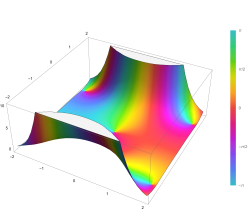
Plot of the Dawson integral function F(z) in the complex plane from -2-2i to 2+2i with colors created with Mathematica 13.1 function ComplexPlot3D source ↗
In mathematics, the Dawson function or Dawson integral1
(named after H. G. Dawson2)
is the one-sided Fourier–Laplace sine transform of the Gaussian function.
Definition
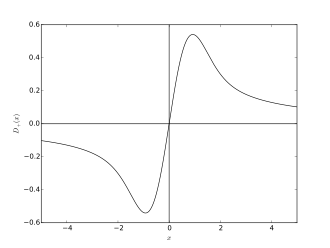
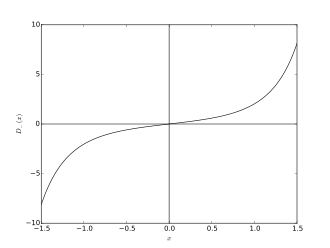
The Dawson function, around the origin source ↗The Dawson function, around the origin source ↗
The Dawson function is defined as either:
also denoted as or
or alternatively
where erfi is the imaginary error function, erfi(x) = −i erf(ix).
Similarly,
in terms of the real error function, erf.
In terms of either erfi or the Faddeeva function the Dawson function can be extended to the entire complex plane:3
which simplifies to
for real
For near zero, F(x) ≈ x.
For large, F(x) ≈ 1/(2x).
More specifically, near the origin it has the series expansion
while for large it has the asymptotic expansion
Inflection points follow for
resulting in x = ±1.50197526... (OEIS: A133843), F(x) = ±0.42768661... (OEIS: A245262).
(Apart from the trivial inflection point at )
P.V. denotes the Cauchy principal value, and we restrict ourselves to real can be related to the Dawson function as follows. Inside a principal value integral, we can treat as a generalized function or distribution, and use the Fourier representation
With we use the exponential representation of and complete the square with respect to to find
We can shift the integral over to the real axis, and it gives
Thus
We complete the square with respect to and obtain
We change variables to
The integral can be performed as a contour integral around a rectangle in the complex plane. Taking the imaginary part of the result gives
where is the Dawson function as defined above.
The Hilbert transform of is also related to the Dawson function. We see this with the technique of differentiating inside the integral sign. Let
Introduce
The th derivative is
We thus find
The derivatives are performed first, then the result evaluated at A change of variable also gives Since we can write where and are polynomials. For example, Alternatively, can be calculated using the recurrence relation (for )
libcerf, numeric C library for complex error functions, provides a function voigt(x, sigma, gamma) with approximately 13–14 digits precision. It is based on the Faddeeva function as implemented in the MIT Faddeeva Package