David Pears | |
|---|---|
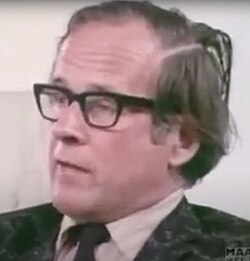 Pears in 1972 | |
| Born | David Francis Pears (1921-08-08)August 8, 1921 Bedfont, Middlesex, England |
| Died | July 1, 2009(2009-07-01) (aged 87) Oxford, England |
| Alma mater | Balliol College, Oxford |
| Occupation | Philosopher |
| Employer | Corpus Christi College, Oxford |
| Notable work | Tractatus Logico-Philosophicus (1961) translation with Brian McGuinness |
David Francis Pears, FBA (8 August 1921 – 1 July 2009) was a British philosopher renowned for his work on Ludwig Wittgenstein.12 Along with Brian McGuinness, he published what became the standard English translation of the Tractatus in 1961.3
Life
David Francis Pears was born on 8 August 1921 in Bedfont, Middlesex. He was the second of four sons born to Robert Pears (1891–1986) and Gladys Eveline, née Meyers (1892–1977). His father was a descendant of Andrew Pears the creator of Pears soap, and Robert's family were amongst those who benefitted from the sale of the company to the Lever Brothers.43
Pears attended Westminster school with Richard Wollheim and Patrick Gardiner who became fellow philosophers and lifelong friends.15 At Westminster he had specialized in classics and it was as a classical scholar that he went to Balliol College, Oxford in 1939. He obtained a first in classical moderations in 1940 but his academic career was interrupted by World War II.3
He served in the Royal Artillery, but was seriously injured in a practice gas attack. As a result Pears was not sent to North Africa with the rest of his regiment. Peacocke reports that "Casualties there were so heavy that, [Pears] said, this accident may have saved his life."4
Another accident would help determine just what he would do with it. After leaving the army, he returned to Balliol College and achieved a first in literae humaniores in 1947.3 The master of Balliol, Sandie Lindsay, thought he ought try for an assistant lectureship in Latin at Glasgow, but Pears was unsure what he ought do next.6
Jumping, to escape a brawl, out of a window of the Randolph Hotel, Oxford that, unexpectedly, opened on to a well to the basement, Pears landed up in hospital with a broken leg, and a copy of Wittgenstein’s Tractatus.7 The latter reportedly being grabbed from a friend as he was being carried to the ambulance.128 Pears left hospital fascinated by Wittgenstein's work and certain that philosophy was his true interest.3
On this account he started the Oxford B.Phil but his appointment as research lecturer at Christ Church, Oxford in 1948 meant he did not have to complete it.7 Pears took up a fellowship in philosophy at Corpus Christi College, Oxford from 1950 to 1960 then returned to Christ Church in 1960 as a tutor in philosophy. There he became reader in philosophy in 1972 and professor of philosophy in 1985, retiring in 1988 as a professor emeritus.9
Works
Books authored
- Bertrand Russell and the British Tradition in Philosophy 1967
- What is Knowledge? 1971
- Ludwig Wittgenstein. Viking Press 1970.
- Questions in the Philosophy of Mind 1975
- Motivated Irrationality. Oxford: Clarendon Press 1984.10
- The False Prison: A Study of the Development of Wittgenstein's Philosophy. 2 vols. Oxford: Oxford University Press 1987/1988.1112
- Hume's System: An Examination of the First Book of His Treatise. Oxford: Oxford University Press 1991.13
References
References
- O'Grady, Jane (2 July 2009). "Obituary: David Pears". The Guardian.
- Levy, Paul (9 July 2009). "David Pears: Philosopher renowned for his work on Wittgenstein". The Independent.
- David Charles "Pears, David Francis (1921–2009), philosopher". Oxford Dictionary of National Biography. (Archived by Wayback Machine).
- Peacocke 2013, p. 325.
- Anon, David Pears: philosopher, (obituary) The Times, 3 July 2009, Archived from the original by Wayback Machine
- Peacocke 2013, p. 325–326.
- Peacocke 2013, p. 326.
- Edmonds, David (17 September 2024). Parfit: A Philosopher and His Mission to Save Morality. Princeton University Press. p. 80. ISBN 978-0-691-22524-1.
- Addis, Mark (1 August 2005). "Pears, David". In Brown, Stuart (ed.). Dictionary of Twentieth-Century British Philosophers. A&C Black. pp. 756–760. ISBN 978-1843710967.
- Seabright, Paul (20 September 1984). "When three is one". London Review of Books. Vol. 06, no. 17. ISSN 0260-9592. Retrieved 8 November 2025.
{{cite news}}: CS1 maint: deprecated archival service (link) - Stroud, Barry (2002). "Private Objects, Physical Objects, and Ostension". Meaning, understanding, and practice : philosophical essays. New York : Oxford University Press. ISBN 978-0-19-925214-5.
{{cite book}}: CS1 maint: publisher location (link) - Budd, Malcolm (4 December 1987). "Expounding a rope-trick". Times Literary Supplement. p. 1356.
- Baier, Annette C. (1994). "Review of Hume's System: An Examination of the First Book of his Treatise". Philosophy and Phenomenological Research. 54 (2): 475–479. doi:10.2307/2108509. ISSN 0031-8205.
- Moyal-Sharrock, Danièle (17 January 2008). "Paradox and Platitude in Wittgenstein's Philosophy". Notre Dame Philosophical Reviews. Archived from the original on 11 August 2024. Retrieved 8 November 2025.
- Paradox and Platitude in Wittgenstein’s Philosophy (2008), critical notice by Derek A. McDougall for the British Wittgenstein Society.
- White, Roger M. (2010). "Review of Paradox and Platitude in Wittgenstein's Philosophy". The Philosophical Review. 119 (3): 381–384. ISSN 0031-8108.
Sources
Sources
- Peacocke, Christopher (2013). "David Francis Pears 1921–2009" (PDF). Biographical Memoirs of Fellows of the British Academy. XII: 325–338.
Further reading
Further reading
- David Charles and William Child (Eds.). Wittgensteinian Themes: Essays in Honour of David Pears. Oxford: Oxford University Press 2002.
External links
External links
- "The Idea of Freedom" (1972) – A philosophical conversation between Iris Murdoch and David Pears on ethics, freedom, determinism, and Freud from the Logic Lane series of educational films by Michael Chanan