Dalj
| |
|---|---|
  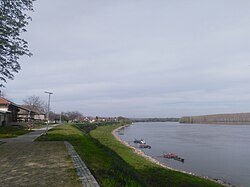       Clockwise, from top: Cultural and Scientific Center "Milutin Milanković", Danube riverfront, Roman Catholic church, seat of the Eparchy of Osijek Plain and Baranya, Dalj High School, Dalj Elementary School, Municipal building, Saint Demetrius Cathedral, central image: Monastery of the Dormition of the Theotokos, Dalj Planina | |
Dalj Location of Dalj in Osijek-Baranja County Show map of Osijek-Baranja CountyDalj Dalj (Croatia) Show map of CroatiaDalj Dalj (Europe) Show map of Europe | |
| Coordinates: 45°29′N 18°59′E / 45.483°N 18.983°E / 45.483; 18.983 | |
| Country |  Croatia Croatia |
| County |  Osijek-Baranja Osijek-Baranja |
| Municipality | Erdut |
| Government | |
| • Body | Local Committee |
| Area | |
• Total | 73.7 km2 (28.5 sq mi) |
| Population (2021)3 | |
• Total | 2,877 |
| • Density | 39.0/km2 (101/sq mi) |
| Demonym(s) | Daljac (♂) Daljanka (♀) (per grammatical gender) |
| Time zone | UTC+1 (CET) |
| • Summer (DST) | UTC+2 (CEST) |
| Postal code | 31226 |
| Area code | +385 31 |
| Vehicle registration | OS |
| Official languages | Croatian, Serbian1 |
Dalj (Serbian Cyrillic: Даљ,1 Hungarian: Dálya, German: Dallia, Latin: Teutoburgium4) is a village on the Danube in eastern Croatia, near the confluence of the Drava and Danube, on the border with Serbia. It is located on the D519 road, south of its intersection with the D213 road and the Vukovar–Erdut railway.
Administratively, it is a part of the municipality of Erdut, Osijek-Baranja County. Although the namesake of the municipality is the Erdut village, Dalj is the largest settlement of the municipality and its administrative, cultural and economic center.5
History

One Scordisci archaeological site in Dalj dating back to late La Tène culture was excavated in the 1970s and 1980s as a part of rescue excavations in eastern Croatia.6 The archaeological site was a part of the settlement network of Scordisci in the area of Vinkovci.6
Following Ottoman retreat from the region the Lordship of Dalj was established, and the village became seat of its domains.7
Croatian War of Independence
During the Croatian War of Independence, the village became the site of the Dalj massacre - killing of 39 prisoners of war in August 1991. The prisoners were Croatian policemen, Croatian National Guard troops and Civil defencemen and killed after the Yugoslav People's Army and Serbian paramilitaries captured Dalj on 1 August. Goran Hadžić, Croatian Serb political leader at the time, was charged with war crimes by the International Criminal Tribunal for the former Yugoslavia (ICTY) in relation to these atrocities.8
The ICTY also charged Hadžić with illegal detention of hundreds of civilians in Dalj police station and a hangar near village's railway station.9 The detainees were beaten and otherwise physically abused.10 After Hadžić was diagnosed with a terminal illness, his trial was discontinued in 2015. He died in July 2016.11
Demographics
According to the 2011 census12 the Erdut municipality (part of which is Dalj) has a population of 7,308. The municipal population consists of Serbs (55.56%), Croats (37.96%) and Hungarians (5.06%).
Education
Secondary
Dalj High School is public high school in Dalj. School offers students the following educational programs: Economist, Commercial Officer (in Serbian), Agricultural Technician and Agricultural Technician General.
Notable natives and residents
- Dimitrije Isailović, professor and newspaper editor
- Jovan Isailović Jr., 19th century painter
- Milutin Milanković, Serbian scientist
- Vasilije Trbić, Serbian Chetnik commander
- Časlav Ocić, Serbian economist and academician
- Danica Tomić, the first woman pilot in Yugoslavia
- Alexander Cvijanović, Yugoslav-American architect
See also
See also
References
References
- Government of Croatia (October 2013). "Peto izvješće Republike Hrvatske o primjeni Europske povelje o regionalnim ili manjinskim jezicima" (PDF) (in Croatian). Council of Europe. p. 36. Retrieved 30 November 2016.
- Register of spatial units of the State Geodetic Administration of the Republic of Croatia. Wikidata Q119585703.
- "Population by Age and Sex, by Settlements" (xlsx). Census of Population, Households and Dwellings in 2021. Zagreb: Croatian Bureau of Statistics. 2022.
- "Teutoburgium". www.enciklopedija.hr. Retrieved 2022-08-09.
- "Statute of the Municipality of Erdut" (in Croatian). September 25, 2001. Retrieved November 24, 2020.
- Dizdar, Marko (2016). "Late La Tène Settlements in the Vinkovci Region (Eastern Slavonia, Croatia): Centres of Trade and Exchange" (PDF). Boii - Taurisci: Proceedings of the International Seminar, Oberleis-Klement, June 14th-15th, 2012. Austrian Academy of Sciences Press: 31–48. Retrieved 22 January 2019.
- Mažuran, Ive (1993). "Vlastelinstvo Ilok-gornji Srijem". In Vladimir Stipetić (ed.). Stanovništvo i vlastelinstva u Slavoniji 1736. godine i njihova ekonomska podloga (in Croatian). Osijek, Croatia: Croatian Academy of Sciences and Arts: Institute for Scientific Work Osijek. pp. 271–292. ISBN 953-154-000-4.
{{cite book}}: CS1 maint: publisher location (link) - Branimir Felger (1 August 2011). "Ni nakon 20 godina od pokolja u Dalju nitko nije stao pred lice pravde" [Even after 20 years since the Dalj massacre, nobody was tried for the crime] (in Croatian). Nova TV (Croatia).
- "The Prosecutor of the Tribunal Against Goran Hadžić - Indictment". International Criminal Tribunal for the former Yugoslavia. 21 May 2004.
- "Svjedok na suđenju Hadžiću o mučenju u Dalju: Cigaretom sam palio tetovažu da mi ne odsjeku ruku" [Witness at Hadžić Trial on Torture in Dalj: I Had to Burn off a Tattoo with a Cigarette, Otherwise They Would Cut off my Hand]. Novi list (in Croatian). 16 October 2012. Archived from the original on 21 August 2013. Retrieved 13 July 2013.
- Ristic, Marija (13 July 2016). "Croatian Serb Wartime Leader Goran Hadzic Dies". Balkan Insight. Retrieved 15 August 2021.
- Croatian Bureau of Statistics (2013). "2011 Census - Croatian Bureau of Statistics (Erdut Municipality)" (PDF). Croatian Bureau of Statistics.