| −C≡P | |
| Names | |
|---|---|
| IUPAC name
Cyaphide
| |
| Other names
Methanidylidynephosphane
| |
| Identifiers | |
3D model (JSmol)
|
|
PubChem CID
|
|
| |
| |
| Properties | |
| CP− | |
| Molar mass | 42.985 g·mol−1 |
Except where otherwise noted, data are given for materials in their standard state (at 25 °C [77 °F], 100 kPa).
| |
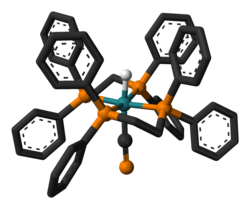
Cyaphide, −C≡P, is the phosphorus analogue of cyanide. The molecule features a triple bond between carbon and phosphorus. With weaker π bonds than cyanide, the cyaphide ion is more reactive than its lighter congener.1 It is not known as a discrete salt; however, in silico measurements reveal that the −1 charge in this ion is located mainly on carbon (0.65), as opposed to phosphorus.
The word "cyaphide" was first coined in 1992, by analogy with cyanide.2
Coordination Modes
The cyaphide anion has been found in various coordination modes. The terminal σ-complex involves a metal–carbon bond.3 A side-on η2 interaction has also been observed, in which the metal fragment donates electron density into the ligands low-lying π* orbital.3
Preparation
Organometallic complexes of cyaphide were first reported in 1992.4 More recent preparations use two other routes:
From SiR3-functionalised phosphaalkynes
Treatment of the η1-coordinated phosphaalkyne complex trans–[RuH(P≡CSiPh3)(dppe)2]+ with an alkoxide resulted in desilylation, followed by subsequent rearrangement to the corresponding carbon-bound cyaphide complex.5 Cyaphide-alkynyl complexes are prepared similarly.6
From 2-phosphaethynolate anion (−O−C≡P)
An actinide cyaphide complex can be prepared by C−O bond cleavage of the phosphaethynolate anion, the phosphorus analogue of cyanate.7 Reaction of the uranium complex [((Ad,MeArO)3N)UIII(DME)] with [Na(OCP)(dioxane)2.5] in the presence of 2.2.2-cryptand results in the formation of a dinuclear, oxo-bridged uranium complex featuring a C≡P ligand.
References
References
- Wilson, Daniel W. N.; Urwin, Stephanie J.; Yang, Eric S.; Goicoechea, Jose M. (2021). "A Cyaphide Transfer Reagent". Journal of the American Chemical Society. doi:10.1021/jacs.1c04417. PMC 8297854. PMID 34190545.
- Jun, Hyoung; Young, Victor G.; Angelici, Robert J. (1992). "A phosphorus analog (C≡P−) of a bridging cyanide (C≡N−) ligand: synthesis and structure of (Cl)(PEt3)2Pt(μ-C≡P)Pt(PEt3)2". Journal of the American Chemical Society. 114 (25): 10064–10065. doi:10.1021/ja00051a050. ISSN 0002-7863.
- Görlich, Tim; Coburger, Peter; Yang, Eric S.; Goicoechea, Jose M.; Grützmacher, Hansjörg; Müller, Christian (2023-08-07). "The Chemistry of the Cyaphide Ion". Angewandte Chemie International Edition. 62 (32). doi:10.1002/anie.202217749. hdl:20.500.11850/616020. ISSN 1433-7851.
- Robert J. Angelici (2007). "Cyaphide (C≡P−): The Phosphorus Analogue of Cyanide (C≡N−)". Angew. Chem. Int. Ed. 46 (3): 330–332. doi:10.1002/anie.200603724. PMID 17154215.
- Cordaro; et al. (2006). "Making the True "CP" Ligand". Angewandte Chemie International Edition. 45 (37): 6159–6162. doi:10.1002/anie.200602499. PMID 16937421.
- Trathen; et al. (2014). "Synthesis and electronic structure of the first cyaphide-alkynyl complexes" (PDF). Dalton Transactions. 43 (24): 9004–9007. doi:10.1039/C4DT01108B. PMID 24867599.
- Christopher J. Hoerger, Frank W. Heinemann, Elisa Louyriac, Laurent Maron, Hansjörg Grützmacher, Karsten Meyer (2017). "Formation of a Uranium-Bound η1-Cyaphide Ligand via Activation and C−O Bond Cleavage of Phosphaethynolate". Organometallics. 36: 4351–4354. doi:10.1021/acs.organomet.7b00590.
{{cite journal}}: CS1 maint: multiple names: authors list (link)