| Blue-backed tanager | |
|---|---|

| |
Scientific classification 
| |
| Kingdom: | Animalia |
| Phylum: | Chordata |
| Class: | Aves |
| Order: | Passeriformes |
| Family: | Thraupidae |
| Genus: | Cyanicterus Bonaparte, 1850 |
| Species: | C. cyanicterus
|
| Binomial name | |
| Cyanicterus cyanicterus (Vieillot, 1819)
| |

| |
| Synonyms | |
|
Pyranga cyanicterus (protonym) | |
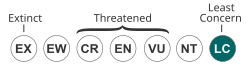
The blue-backed tanager (Cyanicterus cyanicterus) is a species of South American bird in the tanager family Thraupidae. It is the only member of the genus Cyanicterus. It is found in Brazil, French Guiana, Guyana, Suriname, and Venezuela. Its natural habitat is subtropical or tropical moist lowland forests.
Taxonomy
The blue-backed tanager was formally described in 1819 by the French ornithologist Louis Pierre Vieillot under the binomial name Pyranga cyanicterus.2 The type locality is Cayenne in French Guiana.3 This species is now the only member of the genus Cyanicterus that was introduced by Charles Lucien Bonaparte in 1850.45 The word cyanicterus is formed from the Ancient Greek kuanos meaning "dark-blue" and ikteros meaning "jaundice-yellow".6 The blue-backed tanager is monotypic: no subspecies are recognised.5
Description
The blue-backed tanager is, on average, 17 cm (6.7 in) long and weighs 33–36 g (1.2–1.3 oz). It is a striking species, with males having bright blue upperparts and heads down to the breast, with the remainder of the underparts being golden-yellow. The lores are black and the wing coverts are dark. Females have a lighter cerulean coloration, compared to the male's cadet-blue, which is restricted to the upperparts; the underparts are yellow up to the sides of the head and the lores.7
Distribution and habitat
The blue-backed tanager has a distribution centered around the Guianas, to which it was previously thought to be endemic. Besides its range in the Guianas from eastern Venezuela through Guyana and Suriname into French Guiana, there are also several small populations inhabiting unconnected localities in Pará and Amazonas in Brazil. This tanager is a denizen of moist lowland forests, alongside woodland edges and clearings with high trees, and can be found at elevations of up to 600 m (2,000 ft).7
References
References
- BirdLife International (2018). "Cyanicterus cyanicterus". IUCN Red List of Threatened Species. 2018 e.T22722555A132016127. doi:10.2305/IUCN.UK.2018-2.RLTS.T22722555A132016127.en. Retrieved 11 November 2021.
- Vieillot, Louis Pierre (1819). Nouveau dictionnaire d'histoire naturelle, appliquée aux arts, à l'agriculture, à l'économie rurale et domestique, à la médecine, etc (in French). Vol. 28. Paris: Deterville. p. 290. doi:10.5962/bhl.title.20211.
- Paynter, Raymond A. Jr, ed. (1970). Check-List of Birds of the World. Vol. 13. Cambridge, Massachusetts: Museum of Comparative Zoology. p. 326.
- Bonaparte, Charles Lucien (1850). Conspectus Generum Avium (in Latin). Vol. 1. Leiden: E.J. Brill. p. 240.
- Gill, Frank; Donsker, David; Rasmussen, Pamela, eds. (July 2020). "Tanagers and allies". IOC World Bird List Version 10.2. International Ornithologists' Union. Retrieved 22 November 2020.
- Jobling, James A. (2010). The Helm Dictionary of Scientific Bird Names. London: Christopher Helm. p. 126. ISBN 978-1-4081-2501-4.
- Hilty, Steven (2020-03-04), Billerman, Shawn M.; Keeney, Brooke K.; Rodewald, Paul G.; Schulenberg, Thomas S. (eds.), "Blue-backed Tanager (Cyanicterus cyanicterus)", Birds of the World, Cornell Lab of Ornithology, doi:10.2173/bow.blbtan2.01, retrieved 2026-05-31