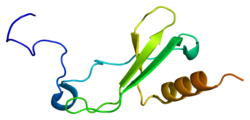
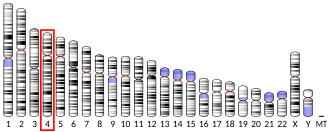





Chemokine (C-X-C motif) ligand 7 (CXCL7) is a human gene.5
The encoded protein, Chemokine (C-X-C motif) ligand is a small cytokine belonging to the CXC chemokine family. It is an isoform of Beta-Thromboglobulin or Pro-Platelet basic protein (PPBP).6
It is a protein that is released in large amounts from platelets following their activation.7 It stimulates various processes including mitogenesis, synthesis of extracellular matrix, glucose metabolism and synthesis of plasminogen activator.89
References
References
- GRCh38: Ensembl release 89: ENSG00000163736 – Ensembl, May 2017
- GRCm38: Ensembl release 89: ENSMUSG00000029372 – Ensembl, May 2017
- "Human PubMed Reference:". National Center for Biotechnology Information, U.S. National Library of Medicine.
- "Mouse PubMed Reference:". National Center for Biotechnology Information, U.S. National Library of Medicine.
- "Entrez Gene: PPBP pro-platelet basic protein (chemokine (C-X-C motif) ligand 7)".
- Hristov M, Zernecke A, Bidzhekov K, et al. (March 2007). "Importance of CXC chemokine receptor 2 in the homing of human peripheral blood endothelial progenitor cells to sites of arterial injury". Circ. Res. 100 (4): 590–7. doi:10.1161/01.RES.0000259043.42571.68. PMID 17272812.
- Majumdar S, Gonder D, Koutsis B, Poncz M (1991). "Characterization of the human beta-thromboglobulin gene. Comparison with the gene for platelet factor 4". J Biol Chem. 266 (9): 5785–9. doi:10.1016/S0021-9258(19)67665-9. PMID 1826003.
- Castor C, Miller J, Walz D (1983). "Structural and biological characteristics of connective tissue activating peptide (CTAP-III), a major human platelet-derived growth factor". Proc Natl Acad Sci USA. 80 (3): 765–9. Bibcode:1983PNAS...80..765C. doi:10.1073/pnas.80.3.765. PMC 393460. PMID 6572368.
- Castor C, Furlong A, Carter-Su C (1985). "Connective tissue activation: stimulation of glucose transport by connective tissue activating peptide III". Biochemistry. 24 (7): 1762–7. doi:10.1021/bi00328a029. PMID 4005226.
Further reading
Further reading
- Begg GS, Pepper DS, Chesterman CN, Morgan FJ (1978). "Complete covalent structure of human beta-thromboglobulin". Biochemistry. 17 (9): 1739–44. doi:10.1021/bi00602a024. PMID 77677.
- Kaplan KL, Broekman MJ, Chernoff A, et al. (1979). "Platelet alpha-granule proteins: studies on release and subcellular localization". Blood. 53 (4): 604–18. doi:10.1182/blood.V53.4.604.604. PMID 426909.
- Tunnacliffe A, Majumdar S, Yan B, Poncz M (1992). "Genes for beta-thromboglobulin and platelet factor 4 are closely linked and form part of a cluster of related genes on chromosome 4". Blood. 79 (11): 2896–900. doi:10.1182/blood.V79.11.2896.2896. PMID 1316786.
- Cohen AB, Stevens MD, Miller EJ, et al. (1992). "Generation of the neutrophil-activating peptide-2 by cathepsin G and cathepsin G-treated human platelets". Am. J. Physiol. 263 (2 Pt 1): L249–56. doi:10.1152/ajplung.1992.263.2.L249. PMID 1387511.
- Morris SW, Nelson N, Valentine MB, et al. (1992). "Assignment of the genes encoding human interleukin-8 receptor types 1 and 2 and an interleukin-8 receptor pseudogene to chromosome 2q35". Genomics. 14 (3): 685–91. doi:10.1016/S0888-7543(05)80169-7. PMID 1427896.
- Majumdar S, Gonder D, Koutsis B, Poncz M (1991). "Characterization of the human beta-thromboglobulin gene. Comparison with the gene for platelet factor 4". J. Biol. Chem. 266 (9): 5785–9. doi:10.1016/S0021-9258(19)67665-9. PMID 1826003.
- Wenger RH, Hameister H, Clemetson KJ (1991). "Human platelet basic protein/connective tissue activating peptide-III maps in a gene cluster on chromosome 4q12-q13 along with other genes of the beta-thromboglobulin superfamily". Hum. Genet. 87 (3): 367–8. doi:10.1007/BF00200921. PMID 1830861. S2CID 19420329.
- Hjemdahl P, Perneby C, Theodorsson E, et al. (1992). "A new assay for beta-thromboglobulin in urine". Thromb. Res. 64 (1): 33–43. doi:10.1016/0049-3848(91)90203-9. PMID 1837963.
- Brandt E, Van Damme J, Flad HD (1991). "Neutrophils can generate their activator neutrophil-activating peptide 2 by proteolytic cleavage of platelet-derived connective tissue-activating peptide III". Cytokine. 3 (4): 311–21. doi:10.1016/1043-4666(91)90499-4. PMID 1873479.
- Clark-Lewis I, Moser B, Walz A, et al. (1991). "Chemical synthesis, purification, and characterization of two inflammatory proteins, neutrophil activating peptide 1 (interleukin-8) and neutrophil activating peptide". Biochemistry. 30 (12): 3128–35. doi:10.1021/bi00226a021. PMID 2007144.
- Walz A, Baggiolini M (1990). "Generation of the neutrophil-activating peptide NAP-2 from platelet basic protein or connective tissue-activating peptide III through monocyte proteases". J. Exp. Med. 171 (2): 449–54. doi:10.1084/jem.171.2.449. PMC 2187709. PMID 2406364.
- Holt JC, Harris ME, Holt AM, et al. (1986). "Characterization of human platelet basic protein, a precursor form of low-affinity platelet factor 4 and beta-thromboglobulin". Biochemistry. 25 (8): 1988–96. doi:10.1021/bi00356a023. PMID 2423119.
- Walz A, Baggiolini M (1989). "A novel cleavage product of beta-thromboglobulin formed in cultures of stimulated mononuclear cells activates human neutrophils". Biochem. Biophys. Res. Commun. 159 (3): 969–75. Bibcode:1989BBRC..159..969W. doi:10.1016/0006-291X(89)92203-1. PMID 2522778.
- Wenger RH, Wicki AN, Walz A, et al. (1989). "Cloning of cDNA coding for connective tissue activating peptide III from a human platelet-derived lambda gt11 expression library". Blood. 73 (6): 1498–503. doi:10.1182/blood.V73.6.1498.1498. PMID 2713489.
- Castor CW, Walz DA, Ragsdale CG, et al. (1989). "Connective tissue activation. XXXIII. Biologically active cleavage products of CTAP-III from human platelets". Biochem. Biophys. Res. Commun. 163 (2): 1071–8. Bibcode:1989BBRC..163.1071C. doi:10.1016/0006-291X(89)92330-9. PMID 2783111.
- Holt JC, Rabellino EM, Gewirtz AM, et al. (1988). "Occurrence of platelet basic protein, a precursor of low affinity platelet factor 4 and beta-thromboglobulin, in human platelets and megakaryocytes". Exp. Hematol. 16 (4): 302–6. PMID 2966071.
- Castor CW, Furlong AM, Carter-Su C (1985). "Connective tissue activation: stimulation of glucose transport by connective tissue activating peptide III". Biochemistry. 24 (7): 1762–7. doi:10.1021/bi00328a029. PMID 4005226.
- McLaren KM, Pepper DS (1983). "Immunological localisation of beta-thromboglobulin and platelet factor 4 in human megakaryocytes and platelets". J. Clin. Pathol. 35 (11): 1227–31. doi:10.1136/jcp.35.11.1227. PMC 497932. PMID 6183294.
- Castor CW, Miller JW, Walz DA (1983). "Structural and biological characteristics of connective tissue activating peptide (CTAP-III), a major human platelet-derived growth factor". Proc. Natl. Acad. Sci. U.S.A. 80 (3): 765–9. Bibcode:1983PNAS...80..765C. doi:10.1073/pnas.80.3.765. PMC 393460. PMID 6572368.
- Malkowski MG, Wu JY, Lazar JB, et al. (1995). "The crystal structure of recombinant human neutrophil-activating peptide-2 (M6L) at 1.9-A resolution". J. Biol. Chem. 270 (13): 7077–87. doi:10.1074/jbc.270.13.7077. PMID 7706245.
External links
External links
- Human PPBP genome location and PPBP gene details page in the UCSC Genome Browser.