| Blue eared pheasant | |
|---|---|

| |
| In Songpan County, Sichuan, China | |
Scientific classification 
| |
| Kingdom: | Animalia |
| Phylum: | Chordata |
| Class: | Aves |
| Order: | Galliformes |
| Family: | Phasianidae |
| Genus: | Crossoptilon |
| Species: | C. auritum
|
| Binomial name | |
| Crossoptilon auritum (Pallas, 1811)
| |
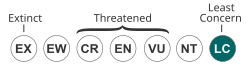
The blue eared pheasant (Crossoptilon auritum), also sometimes hyphenated as blue eared-pheasant, is a large pheasant endemic to China. Although it is considered rare,2 the blue eared pheasant is evaluated as of least concern.
Description
The blue eared pheasant is around 96 cm (38 in) long (including the 49–56 cm (19–22 in) tail); males weigh 1700–2110 g, and females 1450–1880 g.3 It has dark blue-grey plumage with velvet black crown, red facial wattles of bare skin surrounding the eyes, yellow iris, long white ear coverts below and behind the eyes, a pale pink bill, and crimson legs. Its tail of 24 elongated bluish-grey feathers is curved, loose, and dark-tipped, with the outer five pairs of tail feathers having a white base. Both sexes have similar plumage, though the male is slightly larger, and has short spurs on the legs.34
Distribution
The blue eared pheasant is found in the mountain forests of central China, preferring juniper scrub in alpine meadows at 2700–4400 m altitude.35 Its range is to the northeast of the closely related white eared pheasant C. crossoptilon, and southwest of the brown eared pheasant C. mantchuricum.5
Ecology

Its diet consists mainly (about 80%) of berries and vegetable matter; the remaining 20% being insects, particularly beetles.3
References
References
- BirdLife International (2016). "Crossoptilon auritum". IUCN Red List of Threatened Species. 2016 e.T22679307A92810024. doi:10.2305/IUCN.UK.2016-3.RLTS.T22679307A92810024.en. Retrieved 13 November 2021.
- Yi-Qun, Wu; Xiu, Xu; et al. (2013). "Seasonal Changes in Habitat Use of Blue-Eared Pheasant, Crossoptilon auritum" (PDF). Pakistan Journal of Zoology. 45 (6): 1699–1704.
- Handbook of the Birds of the World Volume 2 New World Vultures to Guineafowl. Barcelona: Lynx edicions. 1994. p. 539. ISBN 84-87334-15-6.
- "Blue Eared-Pheasant". eBird. 2026-03-04. Retrieved 2026-03-04.
- Hoyo, Josep del (2020). All the birds of the world. Barcelona: Lynx edicions. p. 64. ISBN 978-84-16728-37-4.