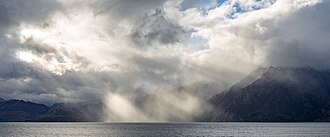
Crepuscular rays, sometimes colloquially known as god rays, twilight rays, or Jacob's ladder, are visible shafts of sunlight that originate when the Sun appears to be just above or below a layer of clouds, during the twilight period.12 Crepuscular rays are often observed as visible light beams passing through gaps in clouds, and are especially prominent when the contrast between light and dark is most obvious.3 The term "crepuscular" comes from the Latin word crepusculum, meaning "twilight".4
During twilight, Crepuscular rays can commonly exhibit an orange or reddish coloration. This is due to the Rayleigh scattering phenomenon, in which as light travels through the atmosphere, it encounters particles and gases which scatters short-wavelength (blue) light more strongly than longer wavelengths (orange and red). During dawn and dusk, sunlight travels at low solar angles and through a greater thickness of the atmosphere - about 40 times more air than when the Sun is overhead at midday - resulting in a more pronounced warm colouration in sunbeams.5
Crepuscular rays are in fact almost parallel to one another; however they appear to radiate outwards, due to a perspective effect, similar to how parallel lines of a long road appear to meet in the distance.678 Loosely, the term crepuscular rays is sometimes extended to the general phenomenon of rays of sunlight that appear to converge at a point in the sky, irrespective of time of day.910
A rare related phenomenon are anticrepuscular rays which can appear at the same time (and coloration) as crepuscular rays but in the opposite direction of the setting sun (east rather than west).
Gallery
-
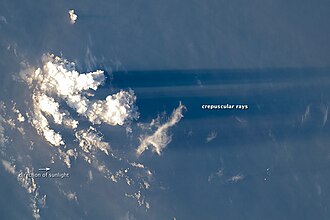 Orbital view of crepuscular rays
 -
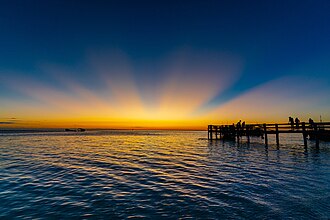 Sunset at Heron Island, Queensland, Australia (April 2023)
 -
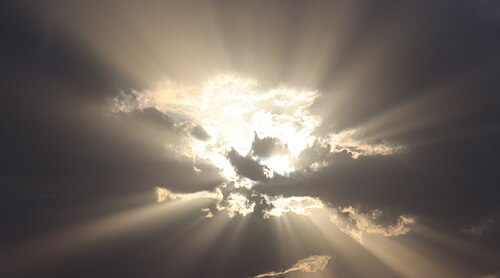 Crepuscular rays before sunset, Tikveš
 -
 Crepuscular rays through dark rain clouds over suburban New South Wales, Australia
See also
See also
- Caustic (optics) – Envelope of light rays reflected or refracted by a curved surface/object
- Earth's shadow – Shadow that Earth itself casts through its atmosphere and into outer space
- Foreglow – Whitish or rosy light during twilight or after sunsetPages displaying short descriptions of redirect targets
- Jacob's ladder – Ladder in Genesis joining Earth to heavenPages displaying short descriptions of redirect targets
References
References
- Plait, Phil. "Sunbeams and the Belt of Venus Are Delightful Twilight Sights". Scientific American. Retrieved 2026-04-14.
- "Crepuscular rays are sunrays in twilight skies". EarthSky. 2024-05-18. Retrieved 2026-04-14.
- Naylor, John (2002). Out of the Blue: A 24-Hour Skywatcher's Guide. Cambridge University Press. pp. 77–79. ISBN 9780521809252.
- Edens, Harald. "Crepuscular rays". weatherscapes.com. Retrieved 2011-11-01.
- "Crepuscular Rays and Light Scattering - NASA Science". 2022-07-17. Retrieved 2026-04-13.
- "Crepuscular Rays: sun rays converging on the horizon". ww2010.atmos.uiuc.edu.
- "Speculative Science". The Guardian. Retrieved 2026-04-13.
- "Gallery: Crepuscular rays". BBC Weather. 2017-01-11. Retrieved 2026-04-13.
- "Crepuscular Rays". Atmospheric Optics. Retrieved 29 September 2025.
- "Weather Facts: Crepuscular rays | weatheronline.co.uk".