Craig Packer | |
|---|---|
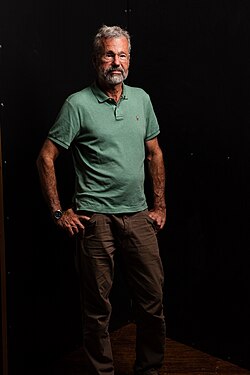 | |
| Born | 1950 (age 75–76) Fort Worth, Texas, U.S. |
| Alma mater | Stanford University (B.S., 1972) University of Sussex (Ph.D., 1977)1 |
| Known for | study of lions, study of animal pathology, conservation, authorship |
| Spouse |
Susan James (m. 1999) |
| Awards | Guggenheim Fellowship (1990) John Burroughs Medal (1995) Distinguished McKnight University Professorship (1997) American Academy of Arts and Sciences (2003) |
| Scientific career | |
| Fields | Biology, Ecology, Zoology |
| Institutions | IUCN, Lion Researcher Center, National Geographic, Savannahs Forever Tanzania |
Craig Packer (born 1950, Fort Worth, Texas) is an American biologist and professor in the Department of Ecology, Evolution and Behavior at the University of Minnesota. He is known for his long-term research on the behavior, ecology, and conservation of African lions, particularly through decades of fieldwork in the Serengeti ecosystem. His work has contributed to understanding social behavior, population dynamics, disease ecology, and human–wildlife conflict in large carnivores.13
Biography
Packer was born in Fort Worth, Texas in 1950.1 He attended his local Eastern Hills High School in 1964 and graduated in 1968.2 Growing up, Packer was originally interested in becoming a doctor or an engineer.However, these fields did not support his desire to work outside and to travel to exotic places. Furthermore, Packer was fascinated by evolution and animal ethology. He ultimately abandoned his place at the University of Texas Medical School to work as a field assistant for Jane Goodall in Gombe National Park, Tanzania to study olive baboons.14
He graduated Stanford in 1972 with a bachelor's degree in Human Biology.2 He later attended the University of Sussex to complete his doctoral research on baboons, graduating with a Ph.D. in Behavioral Ecology in 1977. After a subsequent study on Japanese macaques in Hakusan National Park, Packer returned to Tanzania in 1978 as the head of the Serengeti Lion Project. His interest in lions derives from their unique behavior as social carnivorans, and it is a passion he continues to exercise as director of the Lion Research Center.
Career
Following completion of his doctorate, Packer held a series of research and academic appointments in both the United Kingdom and the United States. From 1977 to 1980, he worked as a research associate at the University of Sussex,5 and beginning in 1978, he became affiliated with the Serengeti Wildlife Research Institute, where he conducted long-term ecological studies for more than three decades.6
He later held a postdoctoral research fellowship at the University of Chicago from 1980 to 1982, followed by a visiting assistant professorship at the University of Illinois at Urbana–Champaign.7 In 1983, he joined the University of Minnesota as an assistant professor in the Department of Ecology, Evolution and Behavior, where he was promoted to associate professor in 1989 and to full professor in 1994.8
Packer has held numerous additional academic and research affiliations, including visiting scientist positions at University of Oxford and the Santa Fe Institute.9
He also served as an adjunct professor in the University of Minnesota's Department of Medicine and Infectious Diseases and International Medicine Division from 2004 to 2022, and as an adjunct faculty member in its International Center for Global Change beginning in 2008.10
From 2006 to 2012, he was co-executive director of Savannas Forever Tanzania, an organization focused on sustainable development and conservation.11 In 2013, he was named a National Geographic Explorer.1213Between 2014 and 2020, he held positions as Honorary Professor at the University of KwaZulu-Natal14 and Research Associate at Oxford's Wildlife Conservation Research Unit.10
He has also been affiliated with the Institute on the Environment at the University of Minnesota since 2016.6 In 2019, he became Scientific Director of the Mara Predator Conservation Program in Kenya, a role he has held through 2025.15
Research
Packer has received sustained research support from a wide range of organizations, including the National Science Foundation,16 the National Geographic Society,4 the Leakey Foundation, the American Philosophical Society, and the Harry Frank Guggenheim Foundation.4 These grants have supported long-term studies in behavioral ecology, population biology, and conservation science, particularly in East Africa.9
Craig Packer's research lies in behavioral ecology and conservation biology, with a primary focus on the social behavior, population dynamics, and conservation of large carnivores, particularly African lions (Panthera leo).17
His early work at the Gombe Stream Research Center under Jane Goodall examined coalition formation and male dispersal in baboons, contributing to early empirical tests of adaptive explanations for social behavior.18 He continued this line of inquiry during his doctoral training at the University of Sussex, where he was mentored by the evolutionary theorist John Maynard Smith.1920
From 1978 to 2015, Packer led the Serengeti Lion Project in Serengeti National Park, one of the longest-running studies of a large carnivore population.21
His work has advanced understanding of lion social systems, including cooperation, territoriality, and reproductive strategies, while also addressing broader ecological and conservation issues.22
Notably, his research demonstrated how environmental conditions, particularly drought and rainfall variability, influence disease dynamics in wildlife populations, including the interaction between canine distemper virus and co-infections such as Babesia.2324 He has also examined patterns of human–wildlife conflict, identifying ecological and behavioral factors associated with lion attacks on humans.
In addition to his extensive body of peer-reviewed publications, Packer has contributed to interdisciplinary and applied conservation research, including large-scale initiatives such as Snapshot Serengeti, a citizen science project using camera traps to monitor wildlife. His work has informed conservation policy and management strategies across East Africa.25
Packer is also the author of several books that synthesize his scientific research for both academic and general audiences, including Into Africa,26 which received the John Burroughs Medal;27 Lions in the Balance, which examines conservation challenges facing African lions;28 and The Lion: Behavior, Ecology and Conservation of an Iconic Species, a comprehensive scholarly volume on lion biology and conservation.17
Awards
He has received various honors and awards in recognition of his work as a biologist. Packer was awarded with a Guggenheim Fellowship in 1990, a Distinguished McKnight University Professorship in 1997, and was elected to the American Academy of Arts and Sciences in 2003,293031 and a Fellow of the American Association for the Advancement of Science in 2019.5 His conservation work has also been recognized with awards such as the Wildlife Conservation Award from the Cincinnati Zoo (2017) 32and the Dawkins Conservation Award from Balliol College, Oxford (2018).15 His research initiative Snapshot Serengeti was named one of the "Top Ten" citizen science projects by The Ecologist in 2013.333435 He is a regular contributor to National Geographic and the IUCN.4
Personal life
Packer is married to Susan James6 and has two children from his previous marriage to Anne Pusey: Jonathan (1987), who is a pulmonologist in Sacramento, California and Catherine (1984), who holds an MPH from Johns Hopkins.36 He has two grandchildren, Sienna and Felix.
Selected publications
Articles
- PACKER, CRAIG; PUSEY, ANNE E. (1983-03-24). "Cooperation and competition in lions (reply)". Nature. 302 (5906): 356. Bibcode:1983Natur.302..356P. doi:10.1038/302356b0. ISSN 0028-0836.
- Pusey, Anne E.; Packer, Craig (1987). "The Evolution of Sex-Biased Dispersal in Lions". Behaviour. 101 (4): 275–310. doi:10.1163/156853987x00026. ISSN 0005-7959.
- Packer, Craig (1992-01-01). "Captives in the wild". National Geographic.
- Packer, Craig (1996). "Who Rules The Park?" (PDF). Wildlife Conservation: 36–39.
- Packer, Craig; Pusey, Anne E. (1997). "Divided We Fall: Cooperation among Lions". Scientific American. 276 (5): 52–59. Bibcode:1997SciAm.276e..52P. doi:10.1038/scientificamerican0597-52. ISSN 0036-8733.
- Packer, Craig. "Why Menopause?". Natural History. 98 (7): 24–26.
- Packer, Craig (2006). "Lions". In Macdonald, David (ed.). The Encyclopedia of Mammals. Oxford University Press. ISBN 978-0-19-920608-7.
- Packer, Craig (2010-07-27). "Lions". Current Biology. 20 (14): R590–R591. Bibcode:2010CBio...20.R590P. doi:10.1016/j.cub.2010.05.003. ISSN 0960-9822. PMID 20656196.
Books
- Packer, Craig (1994). Into Africa. University of Chicago Press. doi:10.7208/chicago/9780226055992.001.0001. ISBN 978-0-226-64430-1.
- Whitman, Karyl L; Packer, Craig (2007). A Hunter's Guide to Aging Lions in Eastern and Southern Africa. ISBN 978-1-57157-283-7.
- Sinclair, A. R. E.; Packer, Craig; Mduma, Simon A. R.; Fryxel, John M. (eds.). Serengeti III: Human Impacts on Ecosystem Dynamics. Chicago, IL: University of Chicago Press.
- Packer, Craig (2015). Lions in the Balance. University of Chicago Press. doi:10.7208/chicago/9780226093000.001.0001. ISBN 978-0-226-09295-9.
- Packer, Craig (2023). The Lion. Princeton University Press. doi:10.1353/book.111069. ISBN 978-0-691-23595-0.
References
References
- "Craig Packer". University of Minnesota. 2015. Retrieved April 21, 2017.
- Packer, Craig (November 3, 2010). "About". Facebook. Retrieved April 21, 2017.
- "Interview: Lion Expert Craig Packer". Public Broadcasting Service. September 6, 2012. Retrieved October 15, 2012.
- "Craig Packer". National Geographic. 2015. Archived from the original on April 27, 2015. Retrieved April 21, 2017.
- "AAAS Fellow Craig Packer Runs with Lions". AAAS.
- Walentik, Steve (2025-03-10). "Biologist Craig Packer highlights conservation efforts aimed at protecting lions during Jane and Whitney Harris Lecture". UMSL Daily. Retrieved 2026-03-30.
- "ORCID Craig Packer (0000-0002-3939-8162)". orcid.org. Retrieved 2026-03-30.
- "How I fell in love with natural history, with Craig Packer | Princeton University Press". press.princeton.edu. Retrieved 2026-03-30.
- "Craig Packer | College of Biological Sciences". cbs.umn.edu. Retrieved 2026-03-30.
- "Craig Packer | The Lion Center". lioncenter.umn.edu. Retrieved 2026-03-30.
- Tucker, Abigail. "The Truth About Lions". Smithsonian Magazine. Retrieved 2026-03-30.
- "Explorer Home". explorers.nationalgeographic.org. Retrieved 2026-03-30.
- "This Lion Expert Was Banned From Tanzania for Exposing Corruption". History. 2015-09-16. Retrieved 2026-03-30.
- "Forum Biographies - Craig Packer". www.wcs-ahead.org. Retrieved 2026-03-30.
- "Lion Conservation". Catawba College. Retrieved 2026-03-30.
- "Craig Packer | College of Biological Sciences". cbs.umn.edu. Retrieved 2026-03-30.
- Packer, Craig; Rosengren, Daniel (2023). The Lion: Behavior, Ecology, and Conservation of an Iconic Species. Princeton University Press. ISBN 978-0-691-21529-7. JSTOR j.ctv2xqngnz.
- Packer, C. (1975). "Male transfer in olive baboons". Nature. 255 (5505): 219–220. Bibcode:1975Natur.255..219P. doi:10.1038/255219a0. ISSN 1476-4687.
- Smith, John Maynard (1978). "The Evolution of Behavior". Scientific American. 239 (3): 176–193. Bibcode:1978SciAm.239c.176S. doi:10.1038/scientificamerican0978-176. ISSN 0036-8733. JSTOR 24955805. PMID 705322.
- Angier, Natalie (1995-04-18). "Lions Find Peace Without Rankings". The New York Times. ISSN 0362-4331. Retrieved 2026-03-30.
- Dloniak, Stephanie M. (2012-09-10). "Suburban Lions Present a Conundrum". The New York Times. ISSN 0362-4331. Retrieved 2026-03-30.
- "Growing old with prides: male and female lions socialise differently with age". www.biology.ox.ac.uk. Retrieved 2026-03-30.
- "Ecology: Drought and the lion". Nature. 454 (7200): 5. 2008. Bibcode:2008Natur.454R...5.. doi:10.1038/454005b. ISSN 1476-4687.
- Munson, Linda; Terio, Karen A.; Kock, Richard; Mlengeya, Titus; Roelke, Melody E.; Dubovi, Edward; Summers, Brian; Sinclair, Anthony R. E.; Packer, Craig (2008-06-25). "Climate extremes promote fatal co-infections during canine distemper epidemics in African lions". PLOS ONE. 3 (6) e2545. Bibcode:2008PLoSO...3.2545M. doi:10.1371/journal.pone.0002545. ISSN 1932-6203. PMC 2435602. PMID 18575601.
- "Craig Packer". Snapshot Serengeti. Retrieved 2026-03-30.
- Packer, Craig (1996). Into Africa. University of Chicago Press. ISBN 978-0-226-64430-1.
- John Burroughs Association. "John Burroughs Medal Award List". John Burroughs Association. Retrieved April 21, 2017.
- "Lions in the Balance: Can hunting save the kings of the jungle?". New Scientist. Retrieved 2026-03-30.
- "Craig Packer". John Simon Guggenheim Memorial Foundation. Retrieved April 21, 2017.
- "Distinguished McKnight University Professors". University of Minnesota. Archived from the original on May 12, 2017. Retrieved April 21, 2017.
- "Professor Craig Packer". American Academy of Arts and Sciences. Retrieved April 21, 2017.
- Lab, M. S. D. (2017-05-04). "Cincinnati Zoo Celebrates 25 Years of Celebrating Wildlife Conservation Achievement". Cincinnati Zoo & Botanical Garden. Retrieved 2026-03-30.
- "Be part of a Serengeti soap opera". Atlas of the Future. Retrieved 2026-03-30.
- "Today I Learned: Female Lions Are Attracted to Black Manes". National Geographic. 2016. Archived from the original on March 12, 2016. Retrieved April 21, 2017.
- Bauer, H.; Packer, C.; Funston, P.F.; Henschel, P.; Nowell, K. (2017) [errata version of 2016 assessment]. "Panthera leo". IUCN Red List of Threatened Species. 2016 e.T15951A115130419. doi:10.2305/IUCN.UK.2016-3.RLTS.T15951A107265605.en.
- Wieder, Ben (2011-06-26). "At Duke, an Evolutionary Anthropologist Plumbs Jane Goodall's Research Trove". The Chronicle of Higher Education. Retrieved 2026-04-16.