| Figeater beetle | |
|---|---|
| |
Scientific classification 
| |
| Kingdom: | Animalia |
| Phylum: | Arthropoda |
| Clade: | Pancrustacea |
| Class: | Insecta |
| Order: | Coleoptera |
| Suborder: | Polyphaga |
| Infraorder: | Scarabaeiformia |
| Family: | Scarabaeidae |
| Genus: | Cotinis |
| Species: | C. mutabilis
|
| Binomial name | |
| Cotinis mutabilis (Gory & Percheron, 1883)
| |
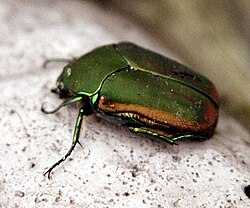
The figeater beetle (also green fruit beetle or fig beetle, Cotinis mutabilis) is a member of the scarab beetle family in the subfamily Cetoniinae, comprising a group of beetles commonly called flower chafers, since many of them feed on pollen, nectar, or petals.1 Its habitat is primarily the southwestern United States (including California2) and Mexico.1 Figeater beetles are often mistaken for green June beetles (Cotinis nitida) and occasionally Japanese beetles (Popillia japonica), which occur in the Eastern US.1 C.mutabilis are also named by the synonym Cotinins texana.3
Life cycle

After mating, eggs are laid in decaying matter or compost piles, which provide sustenance for the emerging larvae. Oviposition spans roughly three months, beginning in early August and continuing until the end of October.4 Freshly laid eggs are small and white and measure roughly 2.3 mm in length and 1.8 mm in width.4 In laboratory conditions with optimal temperatures, eggs hatch within one week. Laboratory reared larvae measure 2-3 mm in length, while fully grown third instar grubs can reach 7.5 cm in length and weigh 5 grams.5 Larvae are white with a yellow-brown head. Although larvae have legs, they are ineffective for movement. Larvae move using their backs, gaining traction from the short, brown hair on their bodies, allowing them to move in a wave-like manner.4 Figeater beetle larvae are commonly called "crawlybacks." 6
Mature larvae construct an oval pupal cell underground that is roughly 2-2.5 cm by 2.5- 3.5 cm before pupating.5 The pupation stage lasts several months without emerging until summer rains soften the soil.5 In Oaxaca, Mexico, adult figeater beetles are seen in nature during the months of April to November.7 Adult figeater beetles grow to about 1.25 inches (3.2 cm).8 They are active during daylight hours, often congregating in the shade of trees near choice breeding grounds to find mates. A wild figeater beetle's entire life cycle lasts 12 months.5 They make a loud buzzing sound similar to that of carpenter bees, possibly because they do not need to open their elytra in order to fly, an ability shared with many other flower beetles.1
Adult morphology

Adult figeater beetles have green elytra and prothorax, along with a distinct clypeal horn.4 The clypeal horn can be triangular or rectangular, with a blunt tip. The elytra are smooth and have shallow depressions, with faint or completely absent longitudinal costae.10 The abdominal segments reveal the sex of the figeater beetle. Females have a bristly patch on their abdomen, whereas males have a smooth patch on their abdomen.4 When evaluated within the same feeding regions, male and female figeater beetles exhibited size differences, with females being larger than the males.4
Taxonomy
C. mutabilis is often confused with the green June beetle (Cotinis nitida).1 Both are members of the flower beetle subfamily11 (Cetoniinae), and are similar in appearance, but the green June beetle is smaller, and its range is in the Eastern United States. They are also occasionally mistaken for Japanese beetles (Popillia japonica), which also occur in the Eastern US.1
Between 1833 and 1915, researchers described 31 taxa that are no longer considered separate species.10 The most widely distributed within the genus is C. mutabilis.10 Many of these, such as Cotinis texana Casey, Cotinis arizonica Casey, and Cotinis abdominalis Casey, have been placed in synonymy with C. mutabilis, meaning they are no longer recognized as distinct subspecies but rather are variations of C. mutabilis.10
Diet

The figeater beetle is native to wetter areas of the American Southwest, where its natural diet includes fruit from cacti and sap from desert trees.1 Their range has expanded considerably since the 1960s with the increasing availability of home gardens, compost piles, and organic mulch.18 The larvae are detritivores 12 and are found eating decomposing organic matter, such as that found in compost piles, manure piles, and organic mulch, and occasionally plant roots, such as the roots of grass in lawns18 and the detritus of Atta mexicana ants.13

The adult's primary food has become fruit in gardens and orchards.1 As Figeater beetles migrated across the United States, native plants have served as food sources. They have been documented feeding and pollinating dessert plants in Arizona (Baccharis sarothroides), Western Texas (Gutierrezia sarothrae), and Nevada (Baccharis salicifolia).3 Figeater beetles are melliphagous 7 and prefer sweet food, which includes leaves, flowers, and saps of some plants and ripe or overripe fruit.1 Fruit with tough skins is too hard for them to bite through,18 so they most often eat softer-skinned fruit such as figs, peaches, grapes,8 pears, and tomatoes.17. Birds, bats, and insects such as Japanese beetles (Popillia japonica) damage fruits, providing easier access to fruits like guavas, soursop, apples, plums, mangos, and apricots.37 Figeater beetles have mandibles too weak to penetrate intact fruit on their own, so they use their clypeal horn to break through the skin, giving them access to the inner parts of the fruit.3 The beetles are particularly attracted to ripening and fermenting fruit, which emit gases that lead the beetles to them.1
In most small gardens, the adult beetles are minor pests that do little damage, but they can swarm on soft or damaged fruit and have been known to eat an entire garden grape or fig crop.1 They forage throughout the day, with highest foraging activity occuring in the morning.4 While foraging, they may cluster onto a single ripe fruit.15 They are not considered to be an important pest because they do not damage lawns as larvae and trees as much as June beetles or Japanese beetles.18 They have the potential to be considered of agricultural importance in the future.16
Habitat and distribution
Distribution of C. mutabilis ranges from the US to northern South America and has been recorded in almost all of Mexico. It inhabits tropical and subtropical forests, oak forests, and cloud forests, as well as many different types of vegetation and land in urban areas up to 2,700 m (10,000 ft) above sea level.16 In Guerrero, Mexico, figeater beetles can be found at elevations reaching 840 and 1,600 meters above sea level and have been observed on marigold flowers (Tagetes erecta).17 Figeater beetles have geographically expanded northward in recent decades. The first recording of figeater beetles in Nevada was in 1967. The first recording in Utah was in 2009, and the first recording in Colorado was in 2012.3 Expansion has been associated with climate change and agricultural activity, which have created suitable new habitats for the figeater beetle to expand their habitat range.3 With increasing use of irrigation in agriculture, the availability of favorable moist soil breeding conditions has increased and has resulted in an increase of figeater populations across the United States.4 As figeater habitats expand, they can have positive effects on vegetation by acting as pollinators. However, figeater beetles may pose an economic risk to farmers by damaging fruit crops.3
Thermoregulation
Figeater beetles are endothermic and are able to generate heat through the metabolic activity of their flight muscles.15 Even when resting and not in direct contact with the sun, figeater beetles are able to keep their thoracic temperatures up to 12 degrees Celsius warmer than the surrounding air.15 Their thoracic temperature can reach between 32-39 degrees Celsius before flight and, during flight, can range from 30-42 degrees Celsius.15 Figeater beetles have also been observed basking in the sun, which can increase their thoracic temperatures by 7-10 degrees Celsius.15
Phoresis
Figeater beetles interact with other species as a host in a phoretic relationship for the pseudoscorpion species Lustrochernes minor. The first recorded phoretic association between C. mutabilis and L. minor was in Oaxaca, Mexico, in 2019.7 The L. minor pseudoscorpions participate in passive phoresy, meaning they do not grab onto the figeater beetle but instead sit beneath the figeater beetle's elytra.7 The commensal relationship benefits the pseudoscorpions by providing them access to new habitats and enabling efficient and long distance travel, which they cannot achieve on their own. The exact mechanisms of how pseudoscorpions get under the elytra are still unknown, but it is hypothesized that the pseudoscorpions living in soil may have encountered adult figeater beetles as they emerge from the ground after pupation.7
Cultural significance
Figeater beetle legs have been used in jewelry production by humans during the early Basketmaker II society and were worn to display status and prestige.18 Two necklaces constructed using the legs of figeater beetles, dating from 70 to 60 BCE, have been recovered from the Bears Ears National Monument in Utah.18
Natural enemies
A significant natural enemy is the fungus Metarrhizium anisophiae, which attacks the larvae during the third instar.4 When larvae are infected, they are distinguishable by their white, hardened appearance with their body completely filled by the fungus.4
Environmental interaction
Figeater beetles have been utilized as a reliable bioindicator to monitor soil arsenic levels.19 During the early stages of development, figeater beetle larvae break down organic matter underground, exposing them to prolonged and direct contact with arsenic contaminated soil.19 This makes them particularly susceptible to accumulating arsenic. Elevated concentrations within their bodies positively correlate with the high arsenic levels measured in the soil.19
Flight muscles
Figeater beetles have asynchronous flight muscles, allowing the wings to beat at higher frequencies without having to send a new nerve impulse after each contraction, which is characteristic of synchronous muscles.20 Before flight, a nerve signal activates the flight muscles, causing an initial contraction. This contraction then moves the wings in an oscillatory manner and is sustained by the mechanical properties of the wings and thorax.20 This allows figeater beetles to spend less energy during flight by reducing the energy required to activate their flight muscles.20 When figeater beetles fly, the wing oscillation frequency is 90 cycles per second.20 The measured respiratory quotient of the figeater beetle's flight muscles is 0.83, which rules out pure carbohydrates or pure fat as their primary energy sources for flight.20 The respiratory quotient closely resembles the metabolic pathway that converts proline to alanine, although it has not been completely determined.20
Structure and coloration
Figeater beetles have a glossy, metallic iridescence that is attributed to light reflecting structures within the cuticle. The cuticle consists of three distinct layers consisting of the outermost epicuticle, a middle exocuticle, and an innermost endocuticle 21 Within the outer exocuticle, there are helicoidal fibrous chitin protein lamellae called Bouligand structures, which selectively reflect left handed polarized light, giving figeater beetles the iridescent and metallic shine.21
The thickness of the epicuticle is approximately 70-89 nanometers across different individuals, while the exocuticle is thicker, roughly 6.6-9.2 micrometers across individuals.21 Individual beetles vary in color and commonly appear green, yellowish, or reddish. Color also differs between dorsal and ventral sides, where the dorsal side is typically are not shiny, but the ventral side is shiny and metallic.22 These color variations come from variations in how tightly the chitin fibrils are wound, which is a property of cuticle pitch. The pitch quantifies the vertical distance spanning one complete helical turn, and the difference in pitch across the different cuticle layers determines the color.21 In greenish figeater beetles, the pitch decreases from 380 nm near the surface to 335 nm at deeper layers. In yellowish figeater beetles, the pitch decreases from 388 nm to 326 nm, and in reddish figeater beetles, it decreases from 390 nm to 361 nm.21
Another contributing factor to the figeater beetle's perceived color is the angles at which light hits the cuticle. Perceived color shifts depending on the angle at which the cuticle is viewed. The same beetle can appear red when viewed straight on and green when viewed from steep side angels.23 When longer pitch yellowish cuticles are scratched, exposing the shorter pitch inner layer, the cuticle displays a greenish color.21 This phenomenon is due to pitch differences, which differ depending on the depth they are located within the cuticle, which reflect different wavelengths of light.21
Genetic polymorphism has historically caused researchers to describe the same species under different taxonomic names.10 Different color variations are more prominent in different regions.10 In central Mexico, distinctly green and black variations are found to live in the same geographical area without producing offspring with intermediate appearances of the black and green figeater beetles.10
References
References
- Constance M. Vadheim, ed. (August 24, 2013). "Green Fig Beetle (Figeater Beetle/ Green Fruit Beetle) – Cotinis mutabilis". Mother Nature's Backyard. Retrieved August 13, 2016.
- "Managing Pests in Gardens: Fruit: Invertebrates: Green fruit beetle". UC Integrated Pest Management (UC IPM). UC Agriculture (UC ANR). 2005-05-20. Retrieved 2022-07-31.
- Krell, Frank-Thorsten; Knight, Jeff B.; Hammon, Robert; Wheeler, Pamela; Roberts, Jeffrey Johns; Eckberg, Jason R. (2015-05-01). "Northern Range Extension of the Figeater Beetle, Cotinis mutabilis (Scarabaeidae: Cetoniinae), Into Nevada, Utah, and Colorado". Western North American Naturalist. 75 (1): 8–13. Bibcode:2015WNAN...75....8K. doi:10.3398/064.075.0103. ISSN 1527-0904.
- Nichol, A. A. A Study of the Fig Beetle, Cotinis Texana Casey. College of Agriculture, University of Arizona, 1935, pp. 157-97. University of Arizona Repository, http://hdl.handle.net/10150/199459.
- Slagle, M.L., and G. Davidowitz. "Substrate composition effect on growth ofCotinis mutabilis (Scarabaeidae) larvae: a case for detritivore scarabs in the insect agriculture industry". Journal of Insects as Food and Feed 8.8 (2022): 937-950. https://doi.org/10.3920/JIFF2021.0056 Web.
- Daniel Marlos, ed. (January 10, 2010). "Crawly Back: Figeater Larva". What's That Bug?. Retrieved August 27, 2016.
- Guzmán-Vásquez, Héctor Miguel; Villegas-Guzmán, Gabriel A.; Martínez-Martínez, Laura (2025-05-02). "First Record of Phoresis between the Pseudoscorpion Lustrochernes minor Chamberlin, 1938 (Pseudoscorpiones: Chernetidae) and the Fruit Beetle Cotinis mutabilis (Gory & Percheron, 1883) (Coleoptera: Scarabaeidae)". Entomological News. 132 (3). doi:10.3157/021.132.0312. ISSN 0013-872X.
- David Faulkner. "Cotinis mutabilis". Field Guide: Arthropods. San Diego Natural History Museum. Retrieved August 27, 2016.
- "BEETLE, FIG (Cotinis mutabilis) (7-8-11) 78 circulo montana, patagonia lake ranch estates, scc, az -01" by Sloalan is marked with CC0 1.0.
- Michael A. Goodrich, A Revision of the Genus Cotinis (Coleoptera: Scarabaeidae), Annals of the Entomological Society of America, Volume 59, Issue 3, 1 May 1966, Pages 550–568, https://doi.org/10.1093/aesa/59.3.550
- Eaton, Eric R.; Kaufman, Kenn (2007). Kaufman Field Guide to Insects of North America. Houghton Mifflin Harcourt. p. 138. ISBN 978-0-618-15310-7.
- Slagle, Meck L. Substrate Composition Effect on Growth of Cotinis mutabilis Larvae: A Case for Detritivore Scarabs in the Insect Agriculture Industry. Master's thesis, The University of Arizona, 2020. ProQuest, 28000709.
- Deloya, Cuauhtémoc; Ratcliffe, Brett C. (1988-10-14). "Las especies de Cotinis Burmeister en México (Coleóptera: Melolonthidae: Cetoniinae)". Acta Zoológica Mexicana (N.s.) (in Spanish) (28): 1–52. doi:10.21829/azm.1988.25282051. ISSN 2448-8445.
- "CotinisMutabilis 7871" by Davefoc is licensed under CC BY-SA 3.0.
- Chappell, Mark A. “Thermoregulation and Energetics of the Green Fig Beetle (Cotinus Texana) during Flight and Foraging Behavior.” Physiological Zoology, vol. 57, no. 6, Nov. 1984, pp. 581–89. DOI.org, https://doi.org/10.1086/physzool.57.6.30155984.
- Guzmán-Vásquez, Héctor Miguel; Granados-Echegoyen, Carlos Alejandro; Alonso-Hernandez, Nancy; García-Ramírez, María de Jesús; Serrano-Rodríguez, Annery; Diego-Nava, Fidel; Zárate-Nicolás, Baldomero Hortencio (March 2023). "New Records of Scarab Beetles from the State of Campeche, Mexico, with Comments on their Agricultural and Ecological Importance". Southwestern Entomologist. 48 (1): 115. doi:10.3958/059.048.0111. S2CID 258062973.
- Pacheco FC, Deloya C, Cortés GP. Phytophagous Scarab Beetles from the Central Region of Guerrero, Mexico (Coleoptera: Scarabaeidae: Melolonthinae, Rutelinae, Dynastinae, Cetoniinae). Revista Colombiana de Entomología. 2006;32(2):191-199. doi:10.25100/socolen.v32i2.9389
- Finet, Cédric (2023-06-22). "Light as matter: natural structural colour in art". Humanities and Social Sciences Communications. 10 (1) 348. doi:10.1057/s41599-023-01854-0. ISSN 2662-9992.
- Rebolloso-Hernández, Carlos Alberto; Vallejo-Pérez, Moisés Roberto; Carrizales-Yáñez, Leticia; Deloya-López, Aristeo Cuauhtémoc; Razo-Soto, Israel; Diaz-Barriga, Fernando (2025-07-10). "Arsenic exposure in insects from green spaces near a former copper smelter". The Science of Nature. 112 (4): 51. Bibcode:2025SciNa.112...51R. doi:10.1007/s00114-025-02001-2. ISSN 1432-1904. PMID 40637824.
- Josephson, Robert K.; Malamud, Jean G.; Stokes, Darrell R. (2001-12-01). "The efficiency of an asynchronous flight muscle from a beetle". Journal of Experimental Biology. 204 (23): 4125–4139. Bibcode:2001JExpB.204.4125J. doi:10.1242/jeb.204.23.4125. ISSN 1477-9145. PMID 11809787.
- Arturo, Mendoza-Galván; Eloy, Muñoz-Pineda; Kenneth, Järrendahl; Hans, Arwin (2018-12-01). "Pitch profile across the cuticle of the scarab beetle Cotinismutabilis determined by analysis of Mueller matrix measurements". Royal Society Open Science. 5 (12). doi:10.1098/r (inactive 24 May 2026). Archived from the original on 2026-04-30.
{{cite journal}}: CS1 maint: DOI inactive as of May 2026 (link) - Mendoza-Galván, A., et al. “Evidence for a Dispersion Relation of Optical Modes in the Cuticle of the Scarab Beetle Cotinis Mutabilis.” Optical Materials Express, vol. 4, no. 12, Dec. 2014, p. 2484. DOI.org (Crossref), https://doi.org/10.1364/OME.4.002484.
- Muñoz-Pineda, E., et al. “Symmetries and Relationships between Elements of the Mueller Matrix Spectra of the Cuticle of the Beetle Cotinis Mutabilis.” Thin Solid Films, vol. 571, Nov. 2014, pp. 660–65. DOI.org (Crossref), https://doi.org/10.1016/j.tsf.2013.11.144.